If you’ve ever wanted to experience a part of India that feels genuinely distinct from the rest of the country, south india is where you should start. It’s a region that defies easy summaries. From ancient Dravidian temples rising above dense jungle to pristine beaches stretching along two coastlines, from spice-scented backwaters to bustling tech corridors, this part of the subcontinent carries centuries of history while moving confidently into the future. I’ve spent considerable time exploring these states, and the more I travel here, the more I realize how much depth there is to uncover. This guide is designed to give you a thorough, honest look at what makes this region so compelling.
Overview of South India
South india comprises five major states: Tamil Nadu, Kerala, Karnataka, Andhra Pradesh, and Telangana. Together they occupy the southern peninsula of the Indian subcontinent, bordered by the Arabian Sea to the west, the Bay of Bengal to the east, and the Indian Ocean at the southernmost tip. The region is home to roughly 250 million people, making it one of the most densely populated areas in Asia.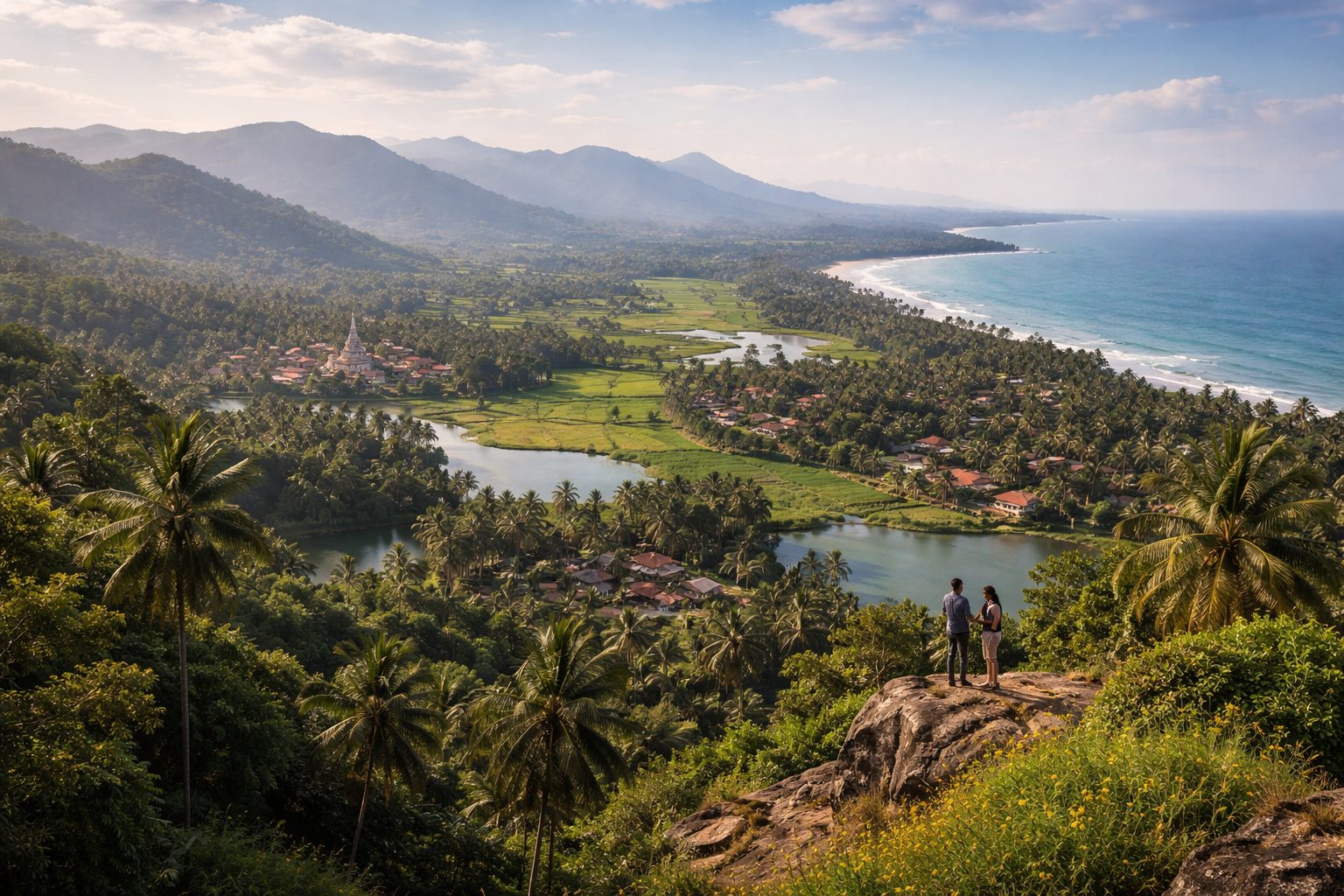
What immediately stands out about the south is how different it feels from northern India. The languages, the architecture, the food, the classical arts, even the temperament of daily life all follow their own trajectory. The Dravidian cultural tradition runs deep here, and you sense it everywhere, from the way temples are built to the way families celebrate milestones.
The region has also emerged as an economic powerhouse. Cities like Bengaluru and Hyderabad anchor the country’s technology and pharmaceutical industries, while Chennai and Kochi drive manufacturing and trade. Despite rapid modernization, the south has managed to hold onto cultural practices that are thousands of years old.
Geographic and Cultural Diversity in South India
The geography of south india is genuinely varied. The Western Ghats form a long mountain spine along the western edge, running from Maharashtra down to Kerala. These hills contain some of the world’s most biodiverse ecosystems, dense rainforests, grasslands, and river systems that feed the entire peninsula. The Eastern Ghats, though less dramatic, run parallel on the opposite side.
Between these ranges lies the Deccan Plateau, a flat interior region that covers much of Karnataka, Andhra Pradesh, and Telangana. This plateau has a drier climate and a landscape of rocky terrain, red soil, and scrub forest. Then there are the coastal plains on both sides, low-lying strips where rice paddy fields, coconut groves, and fishing villages define the landscape.
Culturally, each state has a distinct identity, even neighboring ones. Tamil culture, with its ancient Sangam literature and temple traditions, differs significantly from Kannada culture in Karnataka, which blends Vijayanagara heritage with modern cosmopolitanism. Malayalam-speaking Kerala has developed a reputation for high literacy, progressive governance, and a unique syncretic spirituality. Telugu culture in Andhra and Telangana is known for its expressive classical arts and robust cuisine.
The religious landscape is equally layered. Hinduism predominates, but it takes forms here that you won’t find elsewhere in India. There are also significant Muslim communities, particularly in Hyderabad and coastal Kerala, as well as Christian communities in Kerala dating back nearly two thousand years. This mix shapes how festivals are celebrated, how neighborhoods are organized, and how food evolves.
Major States in South India
Tamil Nadu: The Land of Temples
Tamil Nadu is probably the most immediately recognizable face of south india to most travelers. The state contains over 33,000 temples, many of them massive, multi-tiered gopurams (gateway towers) that dominate the skylines of small towns and large cities alike. The Brihadeeswara Temple in Thanjavur, built in the 11th century, is a UNESCO World Heritage site and still leaves visitors speechless.
The capital Chennai is a major port city and the cultural gateway to Dravidian civilization. It’s a place of contradictions: classical Carnatic music concerts happen blocks away from film studios producing the latest Tamil cinema. The film industry here, often called Kollywood, is genuinely massive and influential.
Tamil is one of the world’s oldest living languages, with a literary tradition spanning more than 2,000 years. That alone sets Tamil Nadu apart. The pride people have in the language is not nationalist posturing; it reflects a genuine, ancient identity.
Key attractions include:
- Madurai’s Meenakshi Amman Temple
- The ancient port town of Mahabalipuram
- Ooty and Kodaikanal hill stations
- The heritage town of Chettinad, famous for its mansions and cuisine
Kerala: God’s Own Country
Kerala earns its nickname. The state’s natural beauty is almost embarrassingly generous: backwaters lined with coconut palms, tea gardens draped across misty hills, spice plantations filling the air with cardamom and pepper, and beaches that remain calmer and less crowded than most Indian coastal destinations.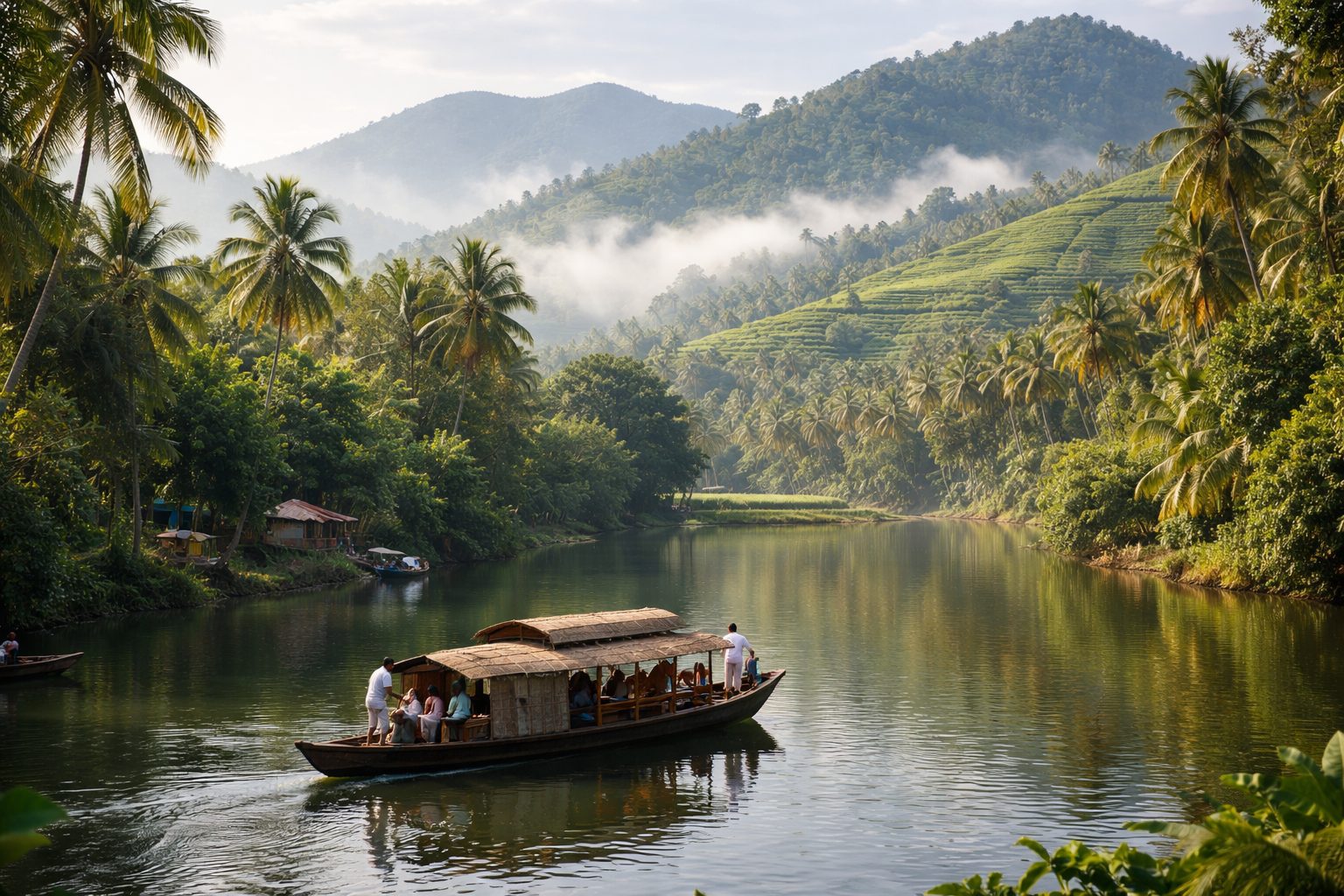
Beyond the scenery, Kerala has a story worth paying attention to. The state achieved near-universal literacy decades before most of the developing world and pioneered a development model that prioritized social welfare alongside economic growth. Life expectancy here is among the highest in India. Healthcare and public education are accessible in ways that still impress demographers.
Ayurveda, the ancient Indian system of medicine, is practiced with real depth in Kerala. This isn’t just wellness tourism branding. There are practitioners here who have inherited generations of knowledge, and authentic treatments are available alongside the commercial spas.
Things you shouldn’t miss:
- Alleppey backwaters by houseboat
- Munnar’s tea estates
- Kovalam and Varkala beaches
- The ancient spice markets of Fort Kochi
- Kathakali and Mohiniyattam performances in Thrissur
Karnataka: The Silicon Valley of India
Karnataka sits at a fascinating intersection of old and new. Bengaluru, the state capital, is India’s technology hub and one of Asia’s most significant startup ecosystems. The city has a genuinely international character, attracts talent from across India and the world, and moves at a pace that feels more Silicon Valley than traditional India.
But Karnataka is far more than Bengaluru. The ruins of Hampi, once the capital of the Vijayanagara Empire, spread across boulder-strewn hillsides in a way that makes you feel the weight of what was once a city of 500,000 people. Mysuru, with its magnificent palace and clean streets, is one of India’s most pleasant cities to spend time in.
The state’s coffee culture is worth its own trip. Coorg produces some of the finest arabica coffee in Asia, and the estates there are open to visitors. The coffee plantations in the hills are quiet, fragrant, and a genuine break from the city.
Notable destinations:
- Hampi ruins
- Mysuru Palace
- Coorg coffee country
- Jog Falls
- Badami cave temples
Andhra Pradesh: The Spice Bowl of India
Andhra Pradesh has a reputation that precedes it, mostly built on the sheer heat of its cuisine. It’s not an exaggeration to call this the spiciest food culture in India. The use of red chillies is fearless and defining.
The state stretches along the southeastern coast with significant coastline along the Bay of Bengal. Visakhapatnam, the major port city on this coast, is both an industrial hub and a gateway to some undervisited beaches. The capital Amaravati is a new planned city, and the state is in the middle of a significant period of infrastructural development.
Tirupati, home to the Venkateswara Temple, draws more pilgrims annually than almost any religious site in the world. The numbers are staggering. On a given day, tens of thousands of devotees climb the hill or take a bus up to seek blessings.
Key highlights:
- Tirupati Venkateswara Temple
- Araku Valley
- Visakhapatnam beaches
- Lepakshi temple complex
- The Buddhist ruins at Nagarjunakonda
Telangana: The Land of Nizams
Telangana became India’s newest state in 2014 after a long political movement for separate statehood. Hyderabad, the joint capital shared with Andhra Pradesh for a decade, is arguably its most compelling asset.
Hyderabad carries the legacy of the Nizams, the rulers who governed this territory from the 17th to 20th centuries and accumulated extraordinary wealth. The Charminar, the Golconda Fort, and the Salar Jung Museum all reflect that history. The city also has a major contemporary tech presence and is home to the offices of many global companies.
The culture here is distinctly composite. Urdu-speaking Muslim culture has blended over centuries with Telugu Hindu traditions to produce something genuinely unique, visible in the food, the architecture, the language people actually speak in the markets, and the festivals that fill the calendar.
Highlights to explore:
- Charminar and the old city bazaars
- Golconda Fort
- Ramoji Film City
- Warangal fort ruins
- Nagarjuna Sagar dam and lake
Historical Significance of South India
The history of south india is long, layered, and frequently underrepresented in mainstream historical narratives that tend to focus on the north. The Sangam Age in Tamil Nadu, dating roughly from 300 BCE to 300 CE, produced a body of secular literature, love poetry and war poetry both, that is sophisticated and moving even today.
The great Dravidian dynasties, the Cholas, the Pallavas, the Chalukyas, the Rashtrakutas, and later the Vijayanagara Empire, built temple complexes and administrative systems that were remarkable by any standard. The Chola navy was active across Southeast Asia, influencing the architecture and culture of Cambodia, Thailand, and Indonesia.
When the Mughals dominated northern India, the Vijayanagara Empire in the Deccan resisted and maintained a Hindu cultural and political tradition for two centuries. The empire fell at the Battle of Talikota in 1565, but its legacy lives in the ruins of Hampi and in many cultural practices that persist in the region.
Colonial history also unfolded differently here. The Portuguese arrived in Kerala in 1498, and their presence shaped coastal culture. The British, French, and Dutch all competed for trading posts along these coasts. Pondicherry, now a Union Territory, still carries visible French influence in its grid of colonial buildings and bilingual street signs.
Culinary Delights of South India
Food is one of the most direct ways to understand the south. The cuisine here operates from a different pantry than the north. Rice replaces wheat as the primary grain. Coconut, tamarind, curry leaves, mustard seeds, dried red chillies, and fresh green chillies are foundational ingredients. The heat and the sourness are real.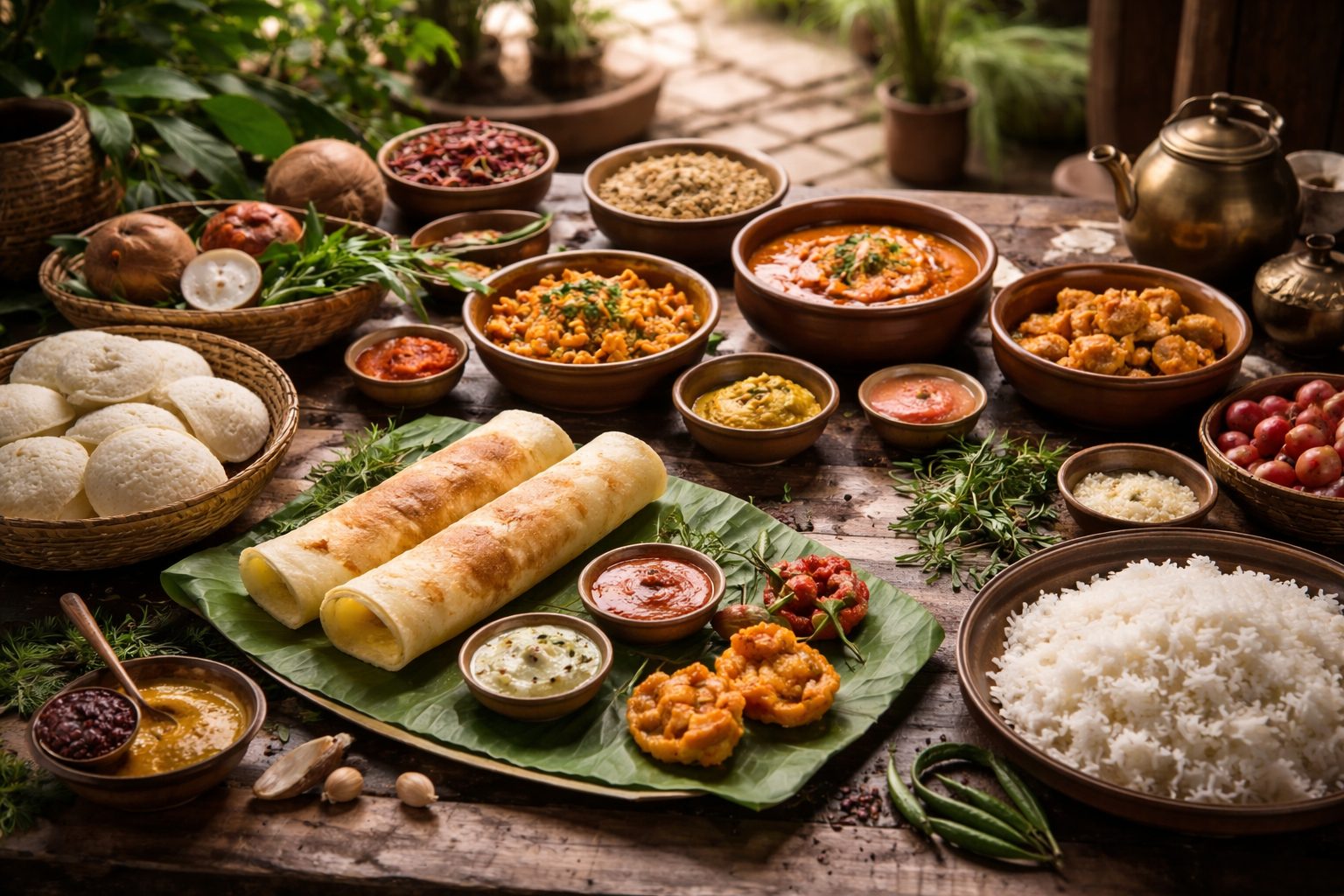
Traditional Dishes of Tamil Nadu
Tamil Nadu’s food is deeply tied to its agricultural rhythms. The classic meal, a full Tamil Nadu lunch served on a banana leaf, is a study in balance. You’ll have rice at the center, flanked by sambar (a lentil soup with vegetables), rasam (a thin tamarind broth), multiple vegetable preparations, papad, pickles, and curd.
Some dishes to seek out:
- Chettinad chicken curry, fragrant with kalpasi and marathi mokku spices
- Pongal, a savory rice and lentil porridge eaten at breakfast
- Idli with sambar and coconut chutney
- Murukku, a crunchy rice-flour snack
- Filter coffee, served in a traditional stainless steel tumbler and davara
Famous Foods of Kerala
Kerala’s cuisine reflects its geography. Coconut milk appears in curries, stews, and desserts. Seafood is central, with fish molee, prawns in coconut gravy, and crab preparations that take advantage of the coastal abundance.
Appam with stew is a breakfast combination I recommend to everyone: the lacy, fermented rice crepe paired with a mild, coconut milk-based vegetable or chicken stew is one of those dishes that’s difficult to describe but immediately memorable.
- Kerala sadya: a vegetarian feast served on a banana leaf during Onam
- Puttu with kadala curry
- Karimeen pollichathu (pearl spot fish cooked in banana leaf)
- Beef fry with porotta
- Payasam (rice pudding with jaggery and coconut milk)
Snacks and Street Food in Karnataka
Karnataka has a distinct snack culture, particularly around breakfast and evening tiffin. The Udupi cuisine tradition, which originated in the coastal Karnataka town of Udupi, spread across India and gave the country its most recognizable South Indian dishes: masala dosa, idli, vada, and rava upma.
Bengaluru’s street food scene layers this tradition with influences from across India. Bisibele bath, a comforting rice and lentil dish cooked with tamarind and a spice powder, is deeply local. So is the akki roti, a rice flour flatbread cooked on a tawa.
Coastal Cuisine of Andhra Pradesh
Andhra cuisine is genuinely, unapologetically hot. The combination of red chilli, tamarind, and coconut that characterizes the coastal style produces flavors that are complex and overwhelming in equal measure if you’re not prepared.
Gongura, a sour leaf used in chutneys, dals, and meat preparations, is a signature ingredient you won’t find used this way anywhere else. Andhra prawn curry, made with fresh seafood and a deep red masala, is the kind of dish you remember for years. The rice here is typically short-grain and eaten with generous quantities of sambar, rasam, and pickle.
Festivals Celebrated in South India
Pongal: The Harvest Festival
Pongal is Tamil Nadu’s most important festival, celebrated in January to mark the end of the winter solstice and the beginning of the sun’s northward journey. Over four days, families cook the traditional sweet pongal (a rice and milk preparation) until it boils over, a symbol of abundance and prosperity.
Jallikattu, the traditional bull-taming sport, is associated with Mattu Pongal, the third day of the festival. The practice is culturally significant to many Tamil communities and has been the subject of considerable political controversy.
Onam: A Celebration of Unity
Onam is Kerala’s state festival, held in August or September during the Malayalam month of Chingam. The festival commemorates the mythological return of King Mahabali, who is believed to visit Kerala once a year during this time.
The ten-day celebration includes:
- Pookalam, elaborate flower carpets laid at household entrances
- Vallamkali, the famous snake boat races in Alleppey and Kottayam
- Onam sadya, the multi-course vegetarian feast
- Traditional games and music
Onam transcends religious boundaries in Kerala. Hindu, Muslim, and Christian communities all participate, which is part of what makes it genuinely inclusive.
Ugadi: The New Year Festival
Ugadi marks the New Year in Karnataka, Andhra Pradesh, and Telangana, falling in March or April according to the Hindu lunar calendar. The festival is marked by a traditional dish called Ugadi Pachadi, a mixture of six tastes: sweet, sour, bitter, salty, spicy, and astringent. The six tastes represent the range of experiences that the coming year will bring.
Homes are decorated with fresh mango leaves tied across doorways, and people wear new clothes, visit temples, and listen to predictions for the year ahead from the regional almanac.
Popular Tourist Destinations in South India
Historical Sites and Temples
South india has an extraordinary density of historical monuments. The temple architecture here is unlike anything else in the world. The Dravidian gopuram towers, encrusted with thousands of painted stone figures of gods, demons, and celestial beings, are a visual language all their own.
Top historical sites:
- Brihadeeswarar Temple, Thanjavur (UNESCO World Heritage)
- Shore Temple, Mahabalipuram (UNESCO World Heritage)
- Hampi ruins, Karnataka (UNESCO World Heritage)
- Meenakshi Amman Temple, Madurai
- Golconda Fort, Hyderabad
- Padmanabhapuram Palace, Kerala
- Lepakshi, Andhra Pradesh
Natural Attractions: Hill Stations and Beaches
The hill stations of south india offer respite from the coastal heat and plains temperatures. Ooty in the Nilgiris has a cooler climate and a charming colonial-era character. Munnar in Kerala is planted with tea estates that turn the hillsides a brilliant, manicured green. Coorg is wet, forested, and ideal for anyone who wants to slow down.
The beaches range from the busy and social to the genuinely remote:
| Beach | State | Character |
|---|---|---|
| Marina Beach, Chennai | Tamil Nadu | Urban, long, crowded |
| Kovalam | Kerala | Scenic, lighthouse, relatively calm |
| Varkala | Kerala | Clifftop location, good surf scene |
| Radhanagar, Havelock | A&N Islands | Remote, pristine, clear water |
| Rushikonda | Andhra Pradesh | Clean, less touristed |
| Om Beach, Gokarna | Karnataka | Hippie trail, beautiful coves |
Wildlife Sanctuaries in South India
The Western Ghats are a biodiversity hotspot, and several of the best wildlife sanctuaries in India sit within south india’s borders.
- Bandipur National Park, Karnataka: tiger reserve with good sightings
- Nagarhole National Park, Karnataka: connected to Bandipur, excellent biodiversity
- Mudumalai National Park, Tamil Nadu: part of the Nilgiri Biosphere Reserve
- Periyar Tiger Reserve, Kerala: lake-centered sanctuary with boat safaris
- Anamalai Tiger Reserve, Tamil Nadu: dense forests with elephants and gaurs
The Nilgiri Biosphere Reserve, which connects several of these parks, is the largest protected area in South and Southeast Asia. Elephants move freely across state borders through wildlife corridors, which is both ecologically important and occasionally inconvenient for drivers on forest roads.
Cultural Practices and Traditions
Dance and Music Forms of South India
Classical arts in south india are not museum pieces. They’re living traditions, taught in academies, performed in temples, and transmitted from guru to student in a way that has continued for centuries.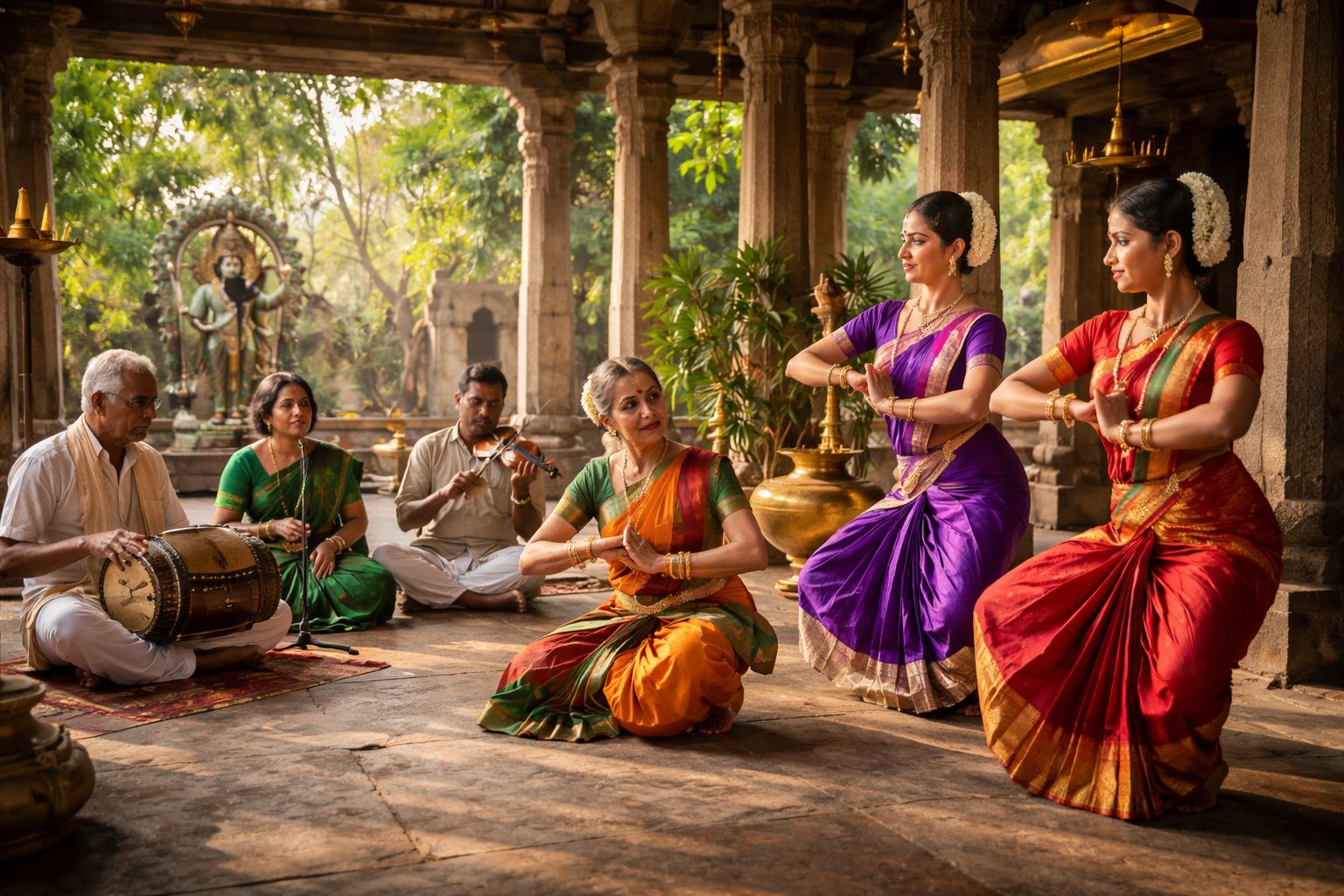
Bharatanatyam, originating in Tamil Nadu, is one of the oldest classical dance forms in India. It combines precise footwork, hand gestures (mudras), and facial expressions to narrate mythological stories. It’s technically demanding and visually arresting.
Other classical dance forms include:
- Kathakali (Kerala): elaborate makeup and costumes, storytelling through gesture
- Mohiniyattam (Kerala): lyrical, feminine style associated with temple dancers
- Kuchipudi (Andhra Pradesh): combines dance and drama, known for its expressive quality
- Yakshagana (Karnataka): narrative theatre with costumes, music, and improvised dialogue
Carnatic music, the classical music of the south, is a parallel tradition of equal depth. The system of ragas and talas differs from Hindustani music and has its own centuries-long lineage of composers and performers. The music season in Chennai, held from December to January, is one of the world’s most concentrated classical music events.
Art and Handicrafts of the Region
The handicrafts of south india reflect the same depth as the performing arts. Kanchipuram silk sarees, woven in a town near Chennai, are widely considered the finest silk sarees in India. The weaving process is labor-intensive, and the zari (gold or silver thread) borders are genuinely distinctive.
Other significant crafts:
- Tanjore painting: classical Tamil art form using gold foil and semi-precious stones
- Bidriware: metal craft from Bidar in Karnataka, black metal inlaid with silver
- Kondapalli toys: wooden toys from Andhra Pradesh, painted in bright traditional colors
- Channapatna toys: lacquered wooden toys from Karnataka
- Aranmula Kannadi: hand-cast metal mirrors from Kerala, a unique and rare craft
Bronze casting in the Chola tradition, using the lost-wax process, continues in parts of Tamil Nadu. The bronze Natarajas produced here are among the most recognized sculptural forms in Indian art history.
Economic Contributions of South India
The economic weight of south india within the broader Indian economy is significant and growing. The region contributes disproportionately to India’s software exports, pharmaceutical manufacturing, automobile production, and textile industries.
Bengaluru established itself as India’s technology capital in the 1990s, drawing on a strong foundation of engineering colleges and the early presence of public sector research institutions. Today it hosts global offices of companies across every technology sector. Hyderabad developed a parallel technology hub, with a particular strength in pharmaceutical research and development.
Chennai is the center of India’s automobile industry, earning it the nickname “the Detroit of Asia.” Companies like Hyundai, Ford, Renault-Nissan, and BMW have manufacturing facilities in the city’s vicinity. The port also handles a significant share of India’s container traffic.
Kerala’s economy runs partly on remittances. There is a long tradition of Keralites working in the Gulf countries, and the money sent home has funded consumption, housing, and education for decades. The state also generates significant tourism revenue and has a growing services sector.
The agricultural economy remains important. South india produces most of India’s spices, including pepper, cardamom, turmeric, and chilli. Karnataka and Tamil Nadu are among the country’s top coffee and tea producers.
Educational Institutions and Opportunities
South india has a well-earned reputation for prioritizing education. The literacy rates here are among the highest in India, with Kerala consistently achieving near-universal literacy for both men and women.
Some of the country’s most prestigious engineering and medical institutions are located in this region:
- Indian Institute of Technology, Madras (Chennai)
- Indian Institute of Science, Bengaluru
- National Institute of Technology, Warangal
- Indian Institute of Technology, Hyderabad
- Christian Medical College, Vellore
- Jawaharlal Nehru University campus institutions
The concentration of technology companies in Bengaluru and Hyderabad has created strong pipelines between local universities and the industry. This creates genuine career opportunities for graduates without the need to relocate to other cities.
Private engineering colleges are extremely numerous in the south, particularly in Tamil Nadu and Andhra Pradesh. The supply of engineering graduates from these states has fueled not just domestic industry but also significant emigration to the United States, the United Kingdom, and Australia.
FAQs About South India
What is the best time to visit South India?
October to March is generally the most comfortable time to visit most of south india, when temperatures are cooler and the monsoon has passed. Kerala’s backwaters and hill stations are pleasant year-round, though the June-September monsoon brings heavy rain to the west coast. Summer months (April-June) can be intensely hot in the interior.
What are the key languages spoken in South India?
The four major Dravidian languages are Tamil (Tamil Nadu), Malayalam (Kerala), Kannada (Karnataka), and Telugu (Andhra Pradesh and Telangana). Urdu is widely spoken in Hyderabad. English is used extensively in urban and professional settings across the region.
How to travel around South India?
The region has a well-developed train network, and Indian Railways connects all major cities and many smaller towns. Flights between the five state capitals are frequent and often affordable. Within cities, auto-rickshaws and app-based taxis are reliable. For hill stations and rural areas, renting a car or hiring a driver is the most practical option.
South india rewards patience and curiosity in roughly equal measure. The more time you spend here, the more layers you find, historical, culinary, linguistic, natural. It’s a region that has been shaping civilization for millennia and continues to do so on its own terms.