
India is a country that hides some of its most extraordinary architecture underground. Or rather, underground and in plain sight, if you know where to look. The famous stepwells in India are among the most visually striking structures on earth, and yet most travelers walk right past them in favor of temples or palaces. I think that’s a genuine shame, because once you stand at the rim of a well like Chand Baori and look down into hundreds of descending geometric steps, you realize you’re looking at something that no photograph fully prepares you for.
These structures were not built to impress visitors. They were built to solve a problem: water scarcity in a hot, dry subcontinent where monsoons were seasonal and unreliable. The fact that they became so ornate, so deeply carved, so architecturally refined, says a lot about how ancient Indian societies treated the intersection of necessity and beauty. They didn’t just dig holes. They built monuments.
Introduction to Stepwells
Definition and Purpose of Stepwells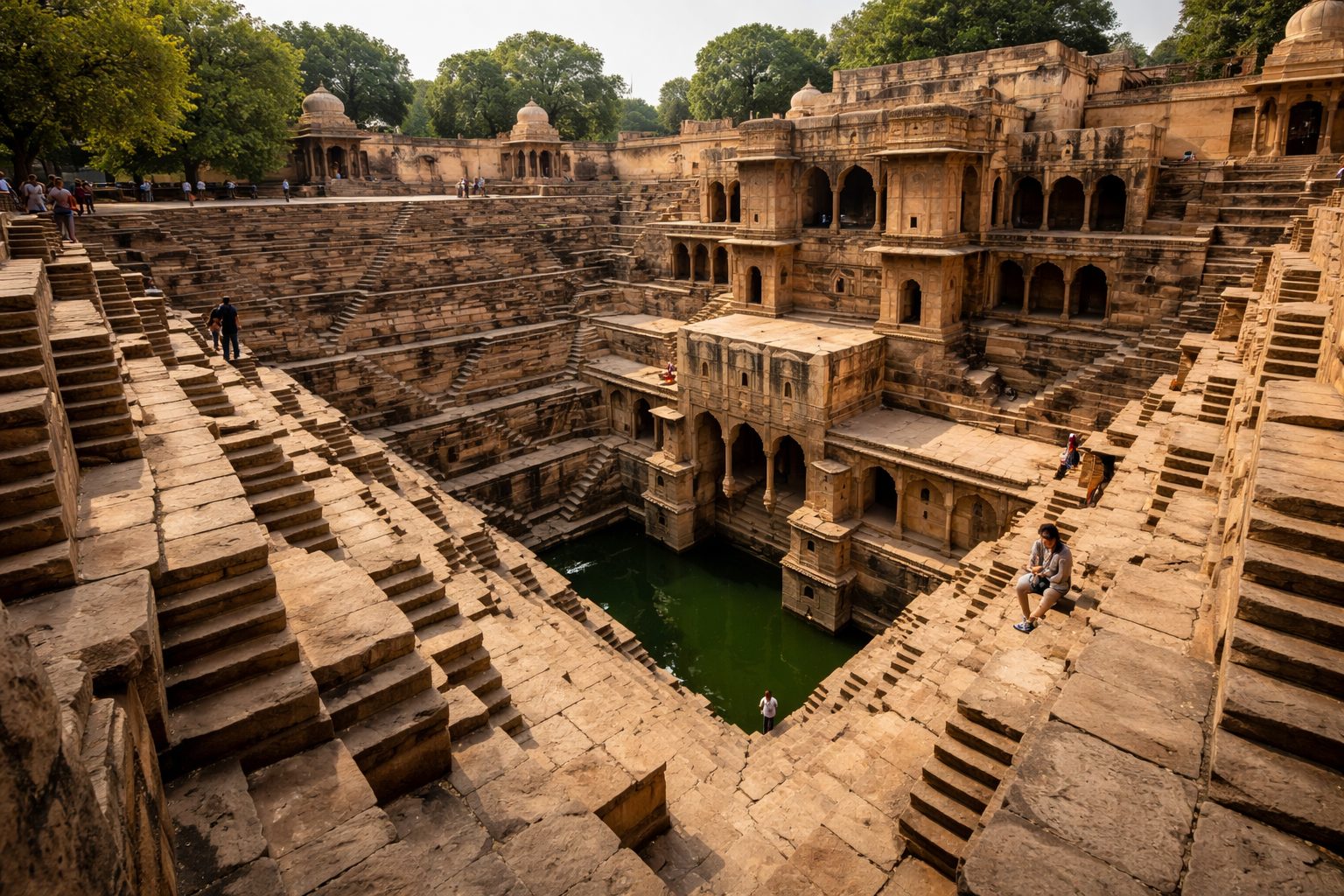
A stepwell, known in Hindi as a vav or baoli, is an inverted structure. Instead of building upward, the construction goes downward in a series of stepped corridors and landings that lead to a water source at the bottom. The steps allow people to reach the water regardless of how high or low the water table sits at any given time of year.
The practical function was straightforward. In regions where rainfall was concentrated in a few months and the rest of the year was dry, a stepwell offered year-round access to groundwater. The stepped design meant that even if the water receded to forty feet below ground, you could still walk down to reach it.
But the function went beyond water collection. Stepwells were social spaces. The underground chambers stayed cool even in extreme heat, making them gathering spots for communities. Some served as rest stops for traders traveling long routes. Others were connected to temples and played ceremonial roles during religious festivals. The deeper levels often featured carved niches, sculptures, and pavilions where people could sit, pray, or simply escape the heat.
- Water storage and retrieval during dry seasons
- Community gathering spaces and social hubs
- Resting points along ancient trade routes
- Ceremonial and religious locations
- Underground cooling spaces during hot months
Historical Significance of Stepwells in India
The oldest known stepwells in India date to the Indus Valley Civilization, roughly 3000 BCE. The Great Bath at Mohenjo-daro is often cited as an early precursor to the stepwell tradition, though the classic form as most people recognize it developed later, particularly during the 7th to 16th centuries CE in Gujarat and Rajasthan.
Stepwell construction reached its architectural peak between the 10th and 15th centuries. During this period, craftsmen from Gujarat and Rajasthan developed the multi-story vav, with elaborate carved panels depicting Hindu deities, mythological scenes, geometric patterns, and erotic carvings similar in spirit to those found at Khajuraho. The structures were often commissioned by queens and noblewomen, which is reflected in names like Rani ki Vav, which translates literally to “Queen’s Stepwell.”
After the widespread introduction of Persian-style wells and later colonial-era pipe systems, stepwells gradually fell out of regular use. Many were filled with rubble, collapsed from neglect, or became open dumps. The revived interest in recent decades, driven by UNESCO recognition and growing architectural tourism, has brought many of them back into public awareness.
Famous Stepwells in India
The range of famous stepwells in India is wider than most people expect. They vary dramatically in scale, architectural style, and state of preservation. Some are UNESCO World Heritage Sites drawing thousands of visitors per year. Others sit in small towns with almost no tourist infrastructure at all.
Stepwell 1: Chand Baori, Abhaneri
Chand Baori is the one that usually stops people mid-sentence when they first see it. Located in the small village of Abhaneri in Rajasthan, about 95 kilometers from Jaipur, it was built between the 8th and 9th centuries during the reign of King Chanda of the Nikumbha dynasty.
The numbers are genuinely staggering. The well is roughly 20 meters deep, features 3,500 narrow steps arranged in a perfect geometric pattern on three sides, and descends 13 stories into the earth. From the top, looking down, the steps form a triangular visual funnel that looks almost mathematically impossible. It’s one of the deepest and largest stepwells ever constructed.
The fourth side features a multi-story arcade with ornate columns and balconies that were used by royalty and nobles to watch events and enjoy the cool air rising from below. There’s also a small shrine to Harshat Mata, the goddess of joy, adjacent to the well.
Chand Baori has appeared in several Bollywood films and the Hollywood movie “The Dark Knight Rises,” though you’d need to be paying close attention to recognize it. The village of Abhaneri itself is quiet and rarely crowded, which makes visiting Chand Baori a more intimate experience than many major sites.
Stepwell 2: Rani ki Vav, Patan
Rani ki Vav in Patan, Gujarat, is the one that earned UNESCO World Heritage Site status in 2014, and it deserved the recognition. Built in the 11th century by Queen Udayamati in memory of her husband King Bhimdev I of the Solanki dynasty, it stands as probably the most elaborately sculpted stepwell in India.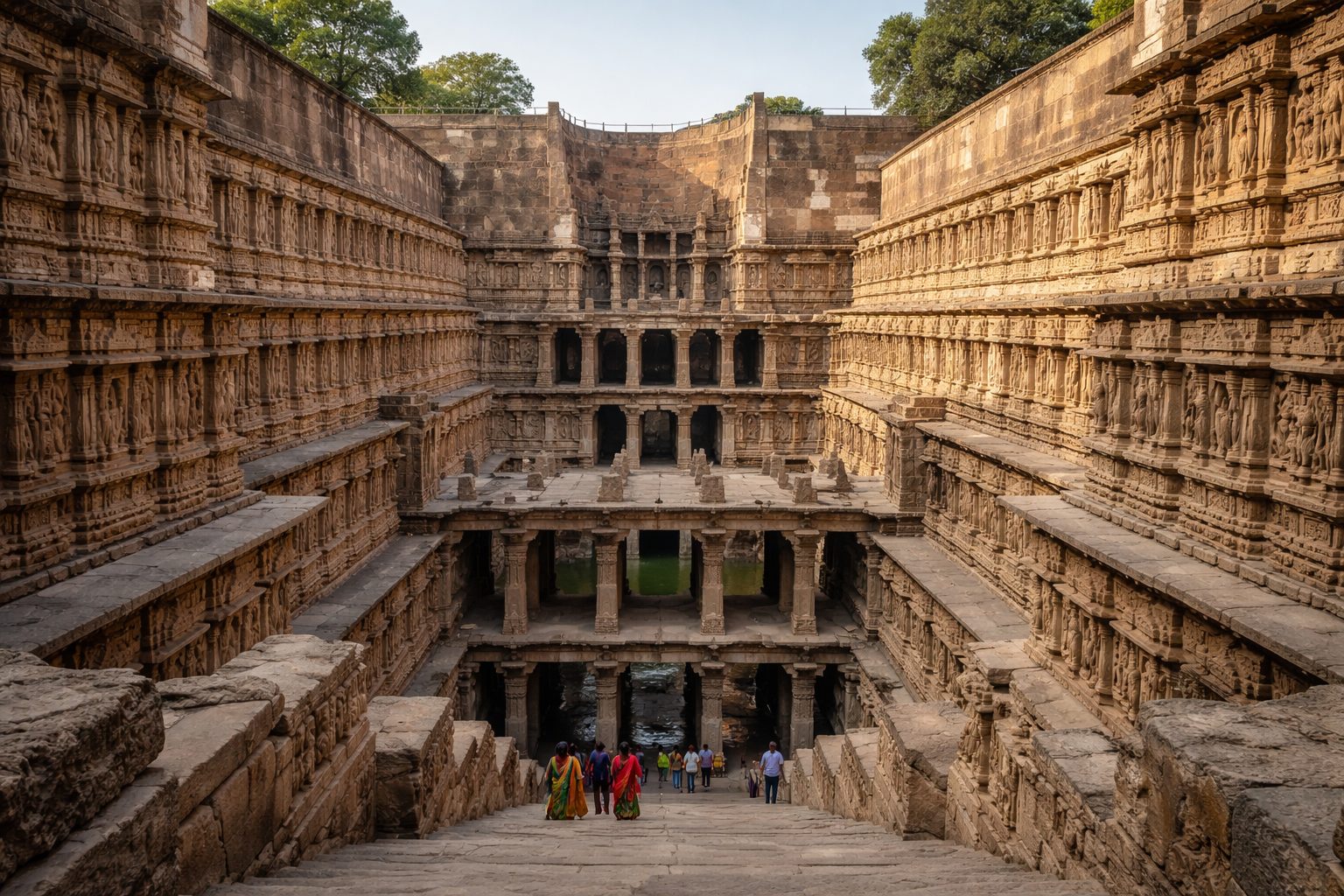
The structure is a seven-story inverted temple-well, roughly 64 meters long, 20 meters wide, and 27 meters deep. The walls and columns feature more than 500 large principal sculptures and over 1,000 minor ones, depicting primarily forms of Vishnu, including his ten avatars, along with apsaras, nayikas, and intricate geometric friezes.
For centuries after the Solanki dynasty’s decline, the well was buried under silt deposited by flooding from the Saraswati River. Excavation work in the 1940s began revealing its scale, and restoration continued through the 20th century. The current state of preservation is remarkably good given that much of it spent hundreds of years underground.
What makes Rani ki Vav stand apart from other famous stepwells in India is the density and quality of its carving. You can spend hours at the lower levels just studying individual panels. The artistry is comparable to the finest temple sculpture in India, which makes sense, since the craftsmen who built it likely worked on both.
Stepwell 3: Adalaj Stepwell, Gujarat
Adalaj Stepwell, located about 18 kilometers north of Ahmedabad, represents a fascinating blend of Hindu and Islamic architectural traditions. Built in 1499 CE by Queen Rudabai, wife of the Vaghela chieftain Veer Singh, it was later completed under the patronage of the Sultanate ruler Mohammad Begda after he conquered the region and reportedly fell in love with the queen.
The story behind Adalaj carries a tragic dimension. According to tradition, Rudabai agreed to marry Begda on the condition that he complete the stepwell, and once it was finished, she walked into the well and drowned rather than submit to the marriage. Whether historically accurate or not, the story gives the stepwell a resonance that visitors often find difficult to shake.
Architecturally, Adalaj descends five stories and features three separate entrances that converge into a single stepped corridor at the lower levels. The carved niches display Hindu imagery, while the overall structural language shows clear Islamic influence in its arched alcoves and decorative motifs. The fusion style is called Indo-Saracenic and it’s unusually visible here.
The light inside Adalaj changes dramatically depending on the time of day and time of year. Morning light falls through the openings at specific angles and illuminates carved panels that stay in shadow the rest of the day. This is one stepwell where arriving early genuinely pays off.
Stepwell 4: Hauz Khas, Delhi
Hauz Khas is a different kind of structure from the others on this list. More accurately described as a reservoir than a classic stepwell, it sits at the center of the upscale Hauz Khas Village neighborhood in South Delhi. Sultan Alauddin Khalji originally constructed it in the late 13th century to supply water to his new city, Siri.
The reservoir was later expanded and restored by Feroz Shah Tughlaq in the 14th century, who added a madrasa, a mosque, and his own tomb around its banks. The water has long since dried up, but the stepped embankments remain, along with the Tughlaq-era monuments that give the complex a layered historical character.
Today Hauz Khas is known as much for its surrounding café and boutique culture as for its history, but the ancient complex itself is worth visiting separately from the commercial district. The deer park adjacent to the complex adds a pleasant green buffer. It’s a more accessible entry point into stepwell culture for visitors who are already in Delhi.
Stepwell 5: Qutub Shahi Tombs, Hyderabad
The stepwells associated with the Qutb Shahi complex in Hyderabad are less widely known but worth mentioning in the context of South Indian water heritage. The Qutb Shahi sultans who ruled from Golconda built elaborate water management systems throughout their territory, including hauz tanks and stepped water features connected to their garden complexes.
The Naya Qila area near Golconda Fort contains several stepped water features that reflect the fusion of Persian hydraulic engineering with local South Indian building traditions. These aren’t as deeply excavated as Rajasthani or Gujarati examples, but they demonstrate how the stepwell concept adapted across different regional traditions and dynasties.
For anyone interested in the breadth of famous stepwells in India, the Deccan examples represent an often-overlooked chapter in the story. Hyderabad and the surrounding region have water heritage structures that rarely appear in mainstream travel coverage, which makes them appealing for visitors who want something off the usual circuit.
Architectural Features of Stepwells
Design Elements of Stepwells
The defining structural feature of a stepwell is the combination of a vertical water shaft with horizontal access corridors. The steps are not just access ramps. They’re load-bearing structural elements that support the walls of the shaft and the various platforms and chambers built into the sides.
Most classic stepwells follow a roughly similar layout:
- An entrance at ground level, often with a gateway or porch
- A primary stepped corridor descending toward the water
- Landings at various levels with rest areas, niches, or shrines
- Subsidiary corridors or galleries at the deeper levels
- A circular or octagonal well shaft at the lowest point where the actual water was drawn
The stepped corridors were typically oriented to take advantage of natural light. Openings at ground level would be positioned so that sunlight penetrated the deeper levels during specific hours. In some wells, the architectural arrangement creates natural light wells that illuminate carvings at depths of 15 to 20 meters.
Column design varied significantly by region and period. Early Gujarati stepwells from the 10th and 11th centuries feature heavy, rounded columns with bracket capitals. Later examples introduced thinner columns with more elaborate profiles. Islamic-influenced wells often incorporated arched openings rather than post-and-lintel construction.
Cultural Influences on Stepwell Architecture
The architecture of stepwells reflects the same cultural currents that shaped Indian temple and palace construction. In Gujarat and Rajasthan, the Solanki and Paramara dynasties were major patrons of both temple construction and stepwell building, and the same workshops often handled both. This is why many stepwells feature the same sculptural programs you’d expect to find on the exterior walls of a contemporary Hindu temple.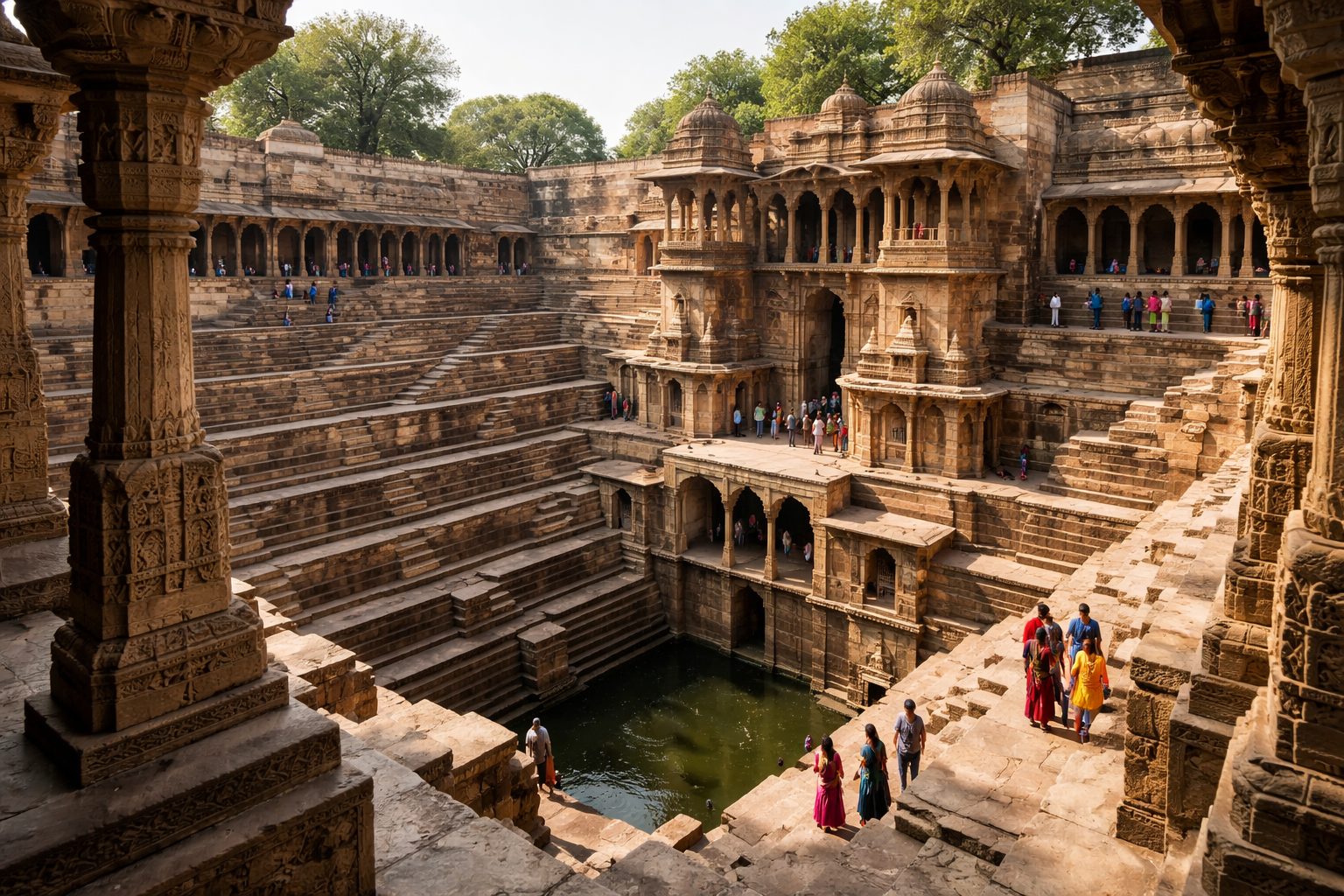
The integration of water and religious symbolism runs deep. Water is considered sacred in Hindu cosmology, connected to purification, fertility, and the divine feminine. Building a stepwell was therefore not just a civic act but a religious one. The carved figures in many wells are not merely decorative. They carry specific iconographic meanings connected to water deities, fertility goddesses, and cosmic serpents associated with underground water sources.
When Islamic patronage entered the picture during the Delhi Sultanate and Mughal periods, the decorative vocabulary shifted. Figural sculpture gave way to geometric patterns and calligraphy. But the basic structural typology of the stepwell survived largely intact, because it worked. The functional efficiency of the form transcended the aesthetic preferences of any particular dynasty or religion.
Comparison of Major Stepwells
Size and Depth Comparison
| Stepwell | Location | Depth | Stories | Period |
|---|---|---|---|---|
| Chand Baori | Abhaneri, Rajasthan | ~20 meters | 13 | 8th-9th century |
| Rani ki Vav | Patan, Gujarat | ~27 meters | 7 | 11th century |
| Adalaj Stepwell | Adalaj, Gujarat | ~15 meters | 5 | 15th century |
| Hauz Khas | Delhi | Reservoir | N/A | 13th-14th century |
| Agrakund | Rajasthan | ~10 meters | 5 | Medieval |
Chand Baori is widely cited as the deepest stepwell in India, though precise measurements vary slightly between sources. Rani ki Vav is technically less deep but covers a larger surface area and contains considerably more carved sculptural work. Size alone is a misleading measure. Some smaller stepwells have architectural refinement that exceeds much larger ones.
Visitor Experience Comparison
The experience of visiting different stepwells varies more than most travel guides acknowledge.
Chand Baori is remote enough that even on busy days it doesn’t feel overcrowded. The village around it is quiet, and the adjacent Harshat Mata temple adds context to the visit. You’re allowed to walk down the steps to lower levels, though you can’t reach the bottom. The geometric view from the top is the main draw, and it rewards time spent simply standing and looking.
Rani ki Vav draws more organized tourism than Chand Baori, partly because of its UNESCO status. There are entry fees, guided tour options, and a standard museum-style visit structure. The sculptural detail rewards a slower approach. Hiring a knowledgeable local guide makes a real difference here because the iconographic layers are not immediately obvious.
Adalaj is easy to reach from Ahmedabad and is one of the more accessible major stepwells. It’s popular with school groups and domestic tourists on weekends. The light inside changes meaningfully through the day, and weekday mornings tend to offer the best combination of light and low crowd density.
Preservation and Restoration Efforts
The preservation status of Indian stepwells is uneven. UNESCO designation has helped a small number of high-profile structures attract consistent conservation funding, but the majority of India’s estimated 3,000+ historical stepwells receive little systematic attention.
The Archaeological Survey of India manages many of the most prominent stepwells, including Chand Baori and Rani ki Vav. For the major sites, stabilization and documentation have improved significantly since the 1990s. Rani ki Vav in particular underwent extensive restoration work before its UNESCO nomination and the quality of that work is visible in the condition of the sculpture.
The challenge for lesser-known stepwells is more complicated. Without visitor revenue or institutional support, structures in private ownership or under local village administration often receive minimal maintenance. Some have been intentionally filled in because they became health hazards or because the land was more valuable for other uses. Several active conservation organizations now work specifically on stepwell documentation and restoration, but the scale of the need outpaces available resources.
Practical Tips for Visiting Stepwells
Best Time to Visit Famous Stepwells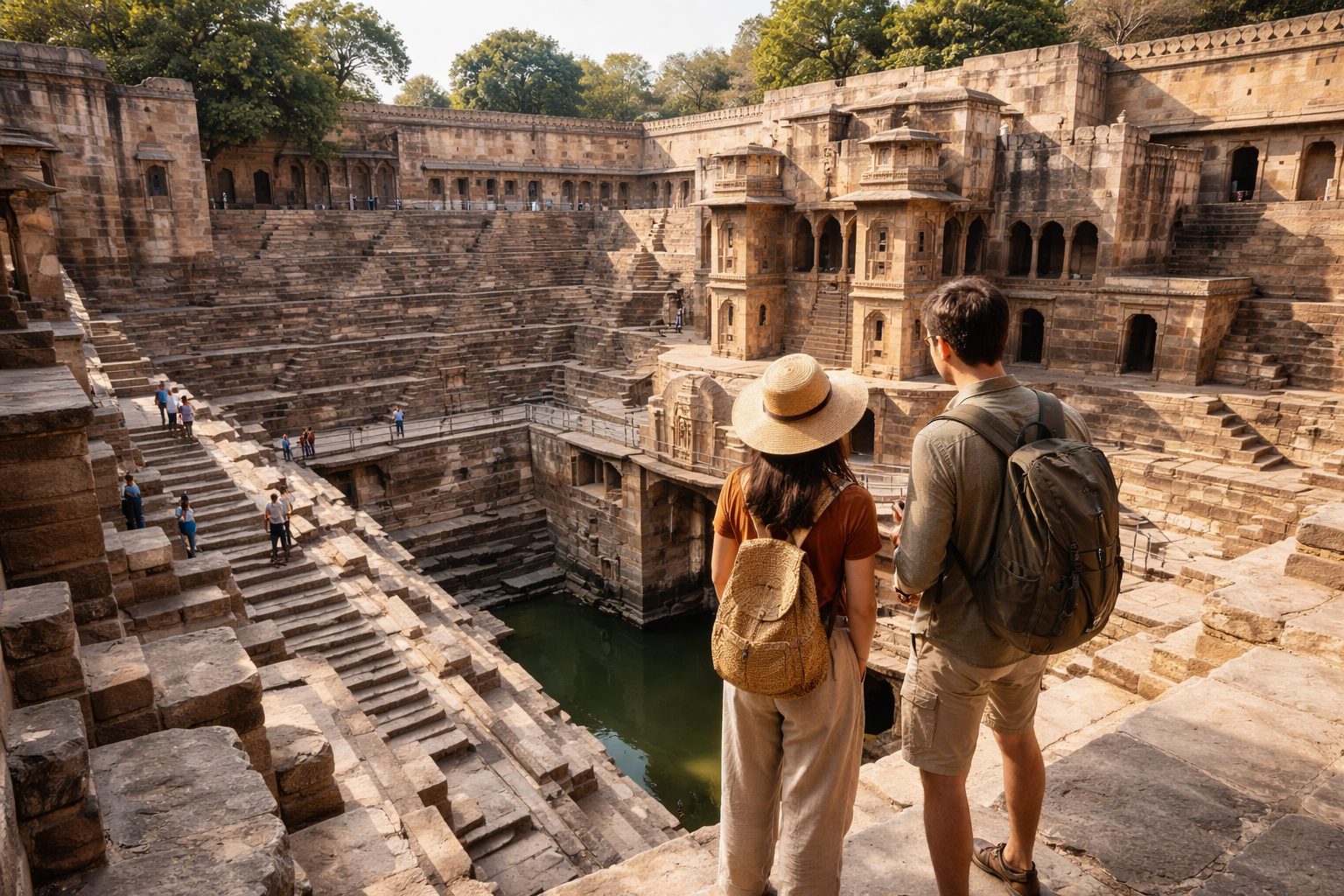
The timing question depends partly on what you prioritize. The cool season between October and February is generally the best time for comfort, especially for the Rajasthan and Gujarat stepwells, where summer temperatures regularly exceed 40 degrees Celsius. Visiting a 20-meter-deep stepwell is considerably more pleasant when the ambient temperature is in the mid-20s.
That said, the monsoon season between July and September has its own appeal. Some stepwells fill partially with water during monsoon months, which gives you a sense of how they functioned. Rani ki Vav and Adalaj both look striking with seasonal water at the lower levels, and the greenery surrounding many structures is at its best. The trade-off is that the humidity can be intense and some sites become slippery.
For photography, early morning light is almost universally better at stepwells. The wells are oriented and designed to capture morning light, so the carved panels catch the light most dramatically in the first two or three hours after sunrise. Midday light tends to be harsh and flat inside the stepped corridors.
Travel Tips and Accessibility
- Chand Baori is about 95 kilometers from Jaipur, accessible by road in roughly 2 hours. There’s no direct bus, so hiring a driver or taking a shared taxi from Jaipur is the practical option. The village has minimal food and accommodation options, so most visitors do a day trip.
- Rani ki Vav in Patan is about 125 kilometers from Ahmedabad. Regular buses and trains connect the two cities. Patan also has the famous Patola textile heritage, so pairing the two visits makes logistical sense.
- Adalaj is the easiest major stepwell to reach, being just 18 kilometers from Ahmedabad with regular public bus connections.
- Wear shoes with good grip. Stepwell stairs can be narrow, uneven, and occasionally wet. Flip flops are a genuinely bad idea at deeper wells.
- Carry water, especially in dry months. The ambient temperature inside the wells is cooler than outside, but the descent and ascent can be physically demanding.
Photography Tips for Stepwell Visits
Stepwells present specific photographic challenges that are worth thinking about before you arrive.
The contrast between bright sky and shadowed interiors is extreme. If you’re shooting with a smartphone or a camera in auto mode, you’ll often get either blown-out highlights or underexposed lower steps. Shooting in RAW format and adjusting exposure manually, or using HDR mode carefully, helps manage this.
The geometric patterns are the main visual subject at Chand Baori specifically. A wide-angle lens captures the full depth of the well from the top, but a longer focal length can compress the steps and create striking abstract images. Both approaches work. The most arresting shots usually involve finding an unusual angle rather than the standard view from the main entrance.
For the sculptural work at Rani ki Vav and Adalaj, a macro or telephoto setting helps isolate individual carved panels. The details in the lower galleries are often more refined than the upper levels, which get more wear from visitors and weather. Bring a small flashlight if you want to see the carvings in the deeper alcoves clearly.
Conclusion
The Importance of Preserving Stepwells
The famous stepwells in India represent something that’s genuinely rare in world heritage: architecture that was purely practical in origin and yet achieved profound aesthetic results. Nobody set out to build monuments. They set out to solve a water problem. And in the process, over several centuries and across multiple dynasties, they created structures that reward study on levels ranging from pure engineering to fine sculpture to community sociology.
What I find most compelling about stepwells is how they push back against the idea that utility and beauty are in tension. Every major stepwell demonstrates that people who built for function saw no reason to stop there. They kept carving, kept refining the column profiles, kept adding galleries and shrines and rest areas. The practical object became something richer.
Conservation of these structures is not a nostalgic project. It’s a matter of preserving actual knowledge, knowledge about how communities managed water, how craftsmen worked stone, how patrons shaped public space, and how architecture can serve both daily necessity and deep cultural meaning simultaneously. The ones that survive are irreplaceable. The effort to protect them is worth understanding and, where possible, supporting.
Frequently Asked Questions (FAQs)
What is the history of stepwells in India?
Stepwell construction in India spans roughly 4,000 years, from early examples connected to Indus Valley settlements to elaborate medieval structures built by Rajput, Solanki, and Sultanate patrons. The classical period of stepwell architecture ran from approximately the 7th to 15th centuries CE, concentrated primarily in Gujarat and Rajasthan. Decline followed the introduction of more efficient well and pipe technologies during the colonial period.
How do stepwells function?
Stepwells work by providing a graduated access path to underground water. As the water table rises and falls seasonally, users simply walk to whatever level the water has reached. The stepped design eliminates the need for ropes or mechanical systems for ordinary water collection and allows communities to access groundwater even during extended dry periods.
Are stepwells safe to visit?
Most major stepwells managed by the Archaeological Survey of India are safe for visitors, with barriers and maintained steps. Some smaller or lesser-maintained stepwells can have slippery surfaces, unstable steps, or inadequate barriers at lower levels. Wearing proper footwear and following any posted safety guidelines is strongly recommended, especially at less-managed sites.
What are the major festivals associated with stepwells?
Several stepwells remain connected to Hindu festivals, particularly those associated with water deities and seasonal observances. Navratri celebrations in Gujarat often include rituals at stepwells. Local harvest and water festivals sometimes incorporate processions to historical baolis. The specific festivals vary by region and the religious character of individual stepwells.
How can I find lesser-known stepwells in India?
The National Water Heritage Atlas of India, compiled by the National Institute of Hydrology, documents thousands of traditional water structures including lesser-known stepwells. Travel forums focused on heritage tourism and the work of organizations like the Intangible Cultural Heritage India network can also point toward understudied examples. Rajasthan, Gujarat, Maharashtra, and the Delhi region have the highest concentrations, but examples exist across most of North and Central India.