Bangkok hit me differently the first time I landed there. I’d read plenty about it, but nothing quite prepares you for the sensory overload, the warmth of the people, or the sheer scale of the city. This bangkok travel guide is built from real time spent navigating its streets, temples, traffic, and night markets — not from a tourism brochure. Whether you’re planning your first visit or your fifth, there’s always something new to uncover in this city.
Bangkok is one of Southeast Asia’s most visited capitals, and for good reason. It layers ancient temple culture over a buzzing modern metropolis, serves some of the world’s best street food at almost no cost, and moves at a pace that somehow feels both exhausting and exhilarating. This guide covers everything from getting here to getting around, where to sleep, what to eat, and how to avoid the classic tourist pitfalls.
Introduction to Bangkok
Overview of Bangkok
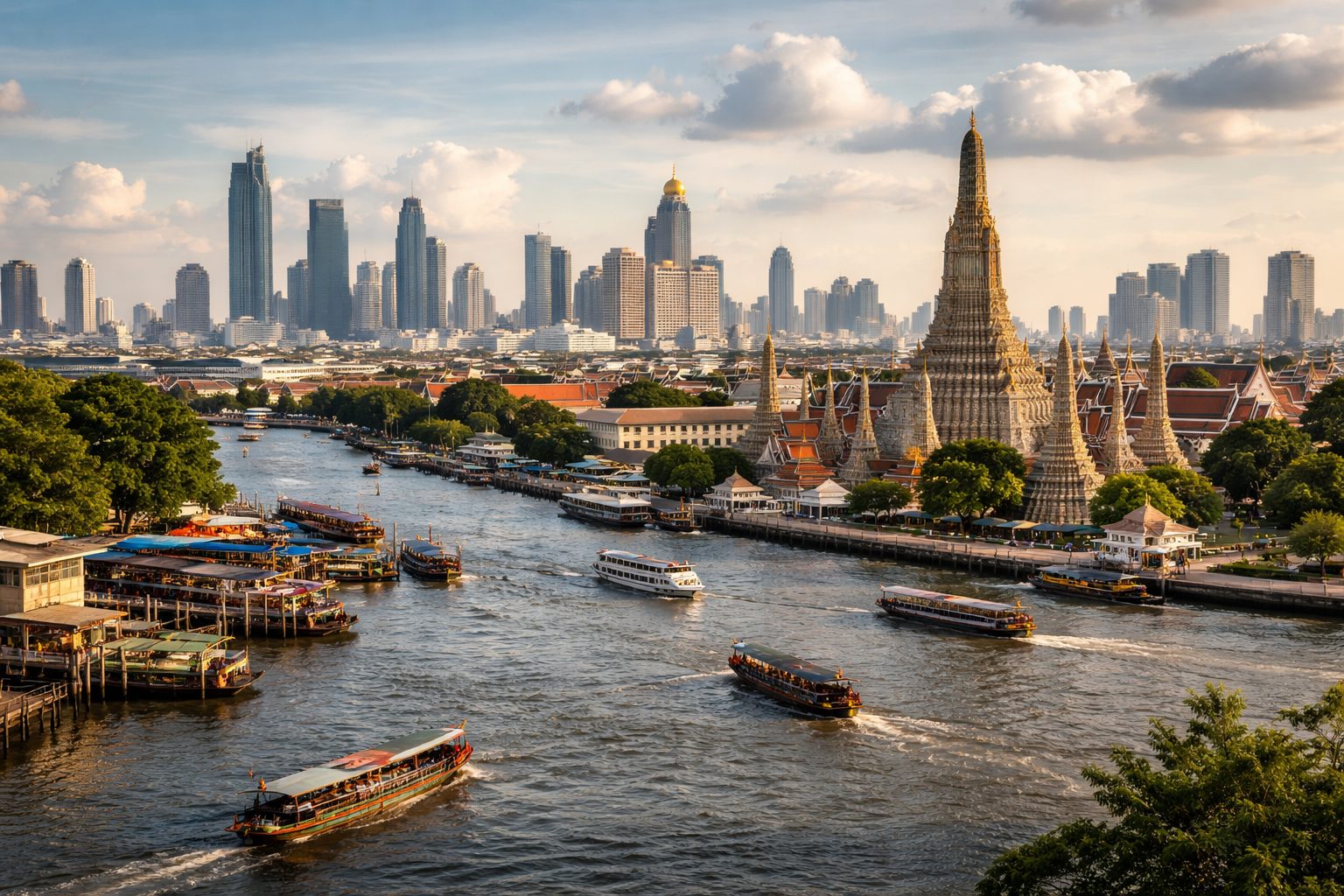
Bangkok — officially known as Krung Thep Maha Nakhon — is the capital and largest city of Thailand. It sits on the Chao Phraya River delta and is home to roughly 11 million people in the city proper, with the greater metro pushing well beyond that. It’s a city of contrasts: gleaming skyscrapers beside crumbling shophouses, monks walking past luxury malls, tuk-tuks weaving around BTS trains.
The city functions as Thailand’s economic, cultural, and political hub. You’ll find world-class hospitals, excellent international schools, a growing arts scene, and food that rivals anywhere on earth. It can feel chaotic and deeply human all at once. That tension is exactly what makes it worth visiting.
Historically, Bangkok became the capital in 1782 under King Rama I, who established the Chakri dynasty. The Grand Palace and Wat Phra Kaew, built around that same period, still stand as the symbolic heart of the city. But Bangkok has never stopped growing. The BTS Skytrain opened in 1999 and fundamentally changed how people move through the city. Today it keeps expanding, and so does Bangkok itself.
Best Time to Visit Bangkok
The short answer: November through February is the sweet spot. Temperatures sit around 25 to 30 degrees Celsius, humidity drops to manageable levels, and you won’t get caught in sudden downpours. These months also coincide with major festivals and the peak tourist season, so expect crowds and higher prices.
March through May is hot — genuinely brutal hot, often hitting 38 to 40 degrees. If you can handle it and want cheaper flights and hotels, it’s doable. Just stay hydrated and plan indoor activities for midday.
June through October is monsoon season. Rain comes hard and fast, usually in short afternoon bursts, though some years see longer periods of flooding. It’s not as bad as people think — the city doesn’t shut down — and you’ll find deals everywhere. If budget matters more than weather, consider traveling between June and August.
Getting to Bangkok
Flights to Bangkok
Bangkok has two main airports. Suvarnabhumi Airport (BKK) handles the majority of international flights and sits about 30 kilometers east of the city center. Don Mueang Airport (DMK) is the hub for low-cost carriers like AirAsia, Nok Air, and Lion Air — it’s older and smaller but perfectly functional.
Most major airlines fly directly into Suvarnabhumi from Europe, North America, Australia, and across Asia. Flight times vary considerably:
- From London: roughly 11 to 12 hours direct
- From New York: around 17 to 20 hours with a connection
- From Sydney: approximately 9 hours direct
- From Dubai: about 6 hours
Book early for the best fares, especially for November through February travel. Google Flights and Skyscanner both do a solid job of tracking price trends. Midweek departures often cost less.
Visa Requirements for Bangkok
Citizens of many countries can enter Thailand visa-free for stays up to 30 or 60 days depending on nationality and entry point. As of recent updates, Thailand has expanded its visa exemption program significantly. Always verify current rules with the Royal Thai Embassy before you travel, as policies do change.
If you need a visa, the Tourist Visa (TR) allows a 60-day stay, extendable by 30 days at an immigration office inside Thailand. You can also apply for a Thailand ELITE visa if you plan to spend extended time in the country — it’s an investment but removes a lot of bureaucratic friction.
Passport validity is a key thing many travelers overlook. Your passport must be valid for at least six months beyond your planned entry date.
Transportation in Bangkok
Public Transportation Options
The BTS Skytrain is your best friend in Bangkok. It’s clean, air-conditioned, punctual, and covers a large swath of the city — from the old backpacker district of Sukhumvit up through Siam and over toward the river. The MRT (subway) complements it well, connecting areas like Lumphini Park, Chatuchak Weekend Market, and Silom. A single journey typically costs between 16 and 59 baht depending on distance.
The Chao Phraya Express Boat is one of the more pleasant ways to move around. It connects several riverside attractions — the Grand Palace, Wat Arun, Pak Khlong Talat flower market — and the commuter lines run frequently. It’s cheap, often around 15 to 40 baht, and genuinely enjoyable.
Buses are the cheapest option but the least foreigner-friendly. Routes are complicated, stops aren’t always labeled in English, and traffic slows everything down. If you enjoy figuring things out on the ground and have time to spare, buses can be an adventure. Otherwise, stick to rail and water.
Taxis and Ride-Sharing Services
Grab is the dominant ride-sharing app in Bangkok and I’d strongly recommend downloading it before you arrive. You get upfront pricing, no negotiation needed, and a record of your trip. It covers both car and motorbike options. Motorbike taxis (via Grab or flagged down on the street) are faster in heavy traffic but you’re exposed to fumes and the riding style can be, let’s say, spirited.
Metered taxis are plentiful and generally honest — make sure the driver uses the meter. A common trick is for drivers to quote a flat rate instead of running the meter, particularly outside tourist spots or the airport. Just say “meter, please” and most will comply. If they refuse, find another cab.
Tuk-tuks are fun for short trips and a genuine Bangkok experience, but agree on a price first. They’re usually more expensive than a metered taxi for the same distance. Think of it as paying a small premium for the novelty.
Bicycle and Walking Tours
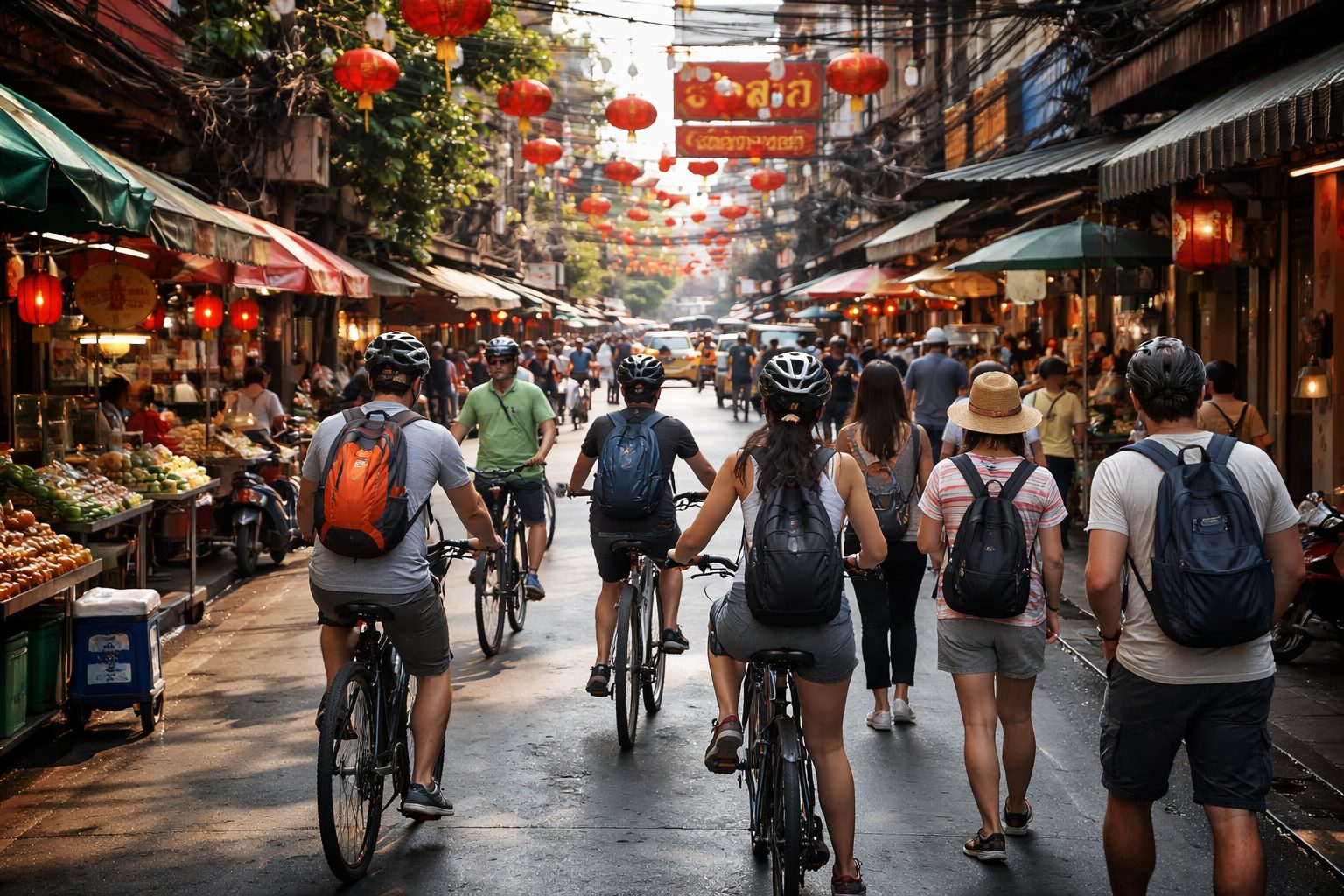
Bangkok isn’t always easy to walk in — the heat, traffic, and uneven sidewalks make it tough for long stretches — but certain neighborhoods reward exploration on foot. Chinatown (Yaowarat), the old town around Banglamphu, and the riverside areas near the Grand Palace are all walkable and dense with things to see.
Cycling has become more viable as the city has added dedicated lanes in some areas. Companies like Bangkok by Bike and Grasshopper Adventures offer guided cycling tours that take you through canal-side communities and back alleys that most visitors miss entirely. Early morning is the best time — cooler, quieter, better light for photos.
If you’re going to explore on foot, wear light clothing, carry water, and plan to duck into air-conditioned temples, cafes, or shops every 20 to 30 minutes. It makes a big difference.
Accommodation in Bangkok
Best Neighborhoods to Stay
Sukhumvit is the most popular area for international travelers. It runs along the BTS line, has countless dining options at every price point, and covers a huge range of vibes — from backpacker guesthouses near On Nut to five-star properties near Asok and Phrom Phong. It’s convenient, if not always the most atmospheric.
Silom and Sathorn suit business travelers and those who prefer a quieter, slightly more polished environment. It’s well-connected by BTS and MRT, close to Lumphini Park, and has some excellent dining. The area around Patpong has a reputation for nightlife — it’s tamer than it used to be but still lively.
Banglamphu (near Khao San Road) is where budget travelers have always congregated. It’s noisy, funky, and has easy access to the old city temples. If you want to meet other backpackers and don’t mind the chaos, it’s fine. If you prefer quiet, look elsewhere.
Riverside, near the Chao Phraya, offers some of Bangkok’s most atmospheric hotels and easy access to heritage sites. It’s a bit cut off from the BTS but the boat is a good substitute.
Top Hotels and Hostels
Bangkok has accommodation at every level, and quality is generally high for the price. A few notable options across the spectrum:
- Mandarin Oriental Bangkok: one of Asia’s legendary hotels, with a heritage wing dating back over a century. Service is exceptional.
- The Peninsula Bangkok: sleek, riverside, impeccably run.
- SO/Bangkok: stylish, central, excellent rooftop pool.
- Lub d Bangkok: a well-run hostel chain with locations in Silom and other areas — clean, social, affordable.
- NapPark Hostel: popular in the Banglamphu area, good reputation among solo travelers.
Boutique hotels have boomed in Bangkok over the last decade. Properties in the Ari neighborhood or around the new riverside developments often offer genuine design quality at mid-range prices.
Budget vs. Luxury Stays
Bangkok genuinely delivers at both ends. A dorm bed in a decent hostel runs 300 to 600 baht per night. A private room in a budget guesthouse is typically 600 to 1,200 baht. Mid-range hotels in good locations can be found for 1,500 to 3,500 baht. And the luxury tier — which in Bangkok means genuinely world-class — starts around 5,000 baht and climbs steeply from there.
| Category | Approximate Nightly Cost (THB) | What to Expect |
|---|---|---|
| Budget dorm | 300 – 600 | Basic but clean, shared facilities |
| Budget private | 600 – 1,200 | Simple rooms, often with AC |
| Mid-range | 1,500 – 3,500 | Good facilities, often a pool |
| Upscale | 3,500 – 6,000 | Strong design, better service |
| Luxury | 6,000+ | Exceptional service, prime location |
Booking through Agoda often yields the best prices for Bangkok specifically — it’s strong in Southeast Asia. Always check for non-refundable vs. flexible rates if your plans might shift.
Top Attractions in Bangkok
Must-Visit Temples
Wat Phra Kaew and the Grand Palace are the non-negotiable starting point. The Temple of the Emerald Buddha sits within the palace complex and remains one of the most sacred sites in Thailand. Dress code is strict — shoulders and knees covered, no exceptions. If you arrive underprepared, wrap-arounds are available to rent at the entrance.
Wat Pho, just a short walk from the Grand Palace, houses the massive Reclining Buddha — 46 meters long and covered in gold leaf. It’s also the birthplace of traditional Thai massage as a formal practice, and there’s a massage school on-site where you can get a legitimate session for a very reasonable price.
Wat Arun, the Temple of Dawn, is best viewed from across the river at sunset or illuminated at night. The detail in the ceramic mosaic work that covers its central prang is extraordinary up close. Take the ferry across from the Wat Pho pier — it’s a 3-baht crossing.
Other temples worth visiting:
- Wat Saket (the Golden Mount) — great city views from the top
- Wat Suthat — impressive architecture, less crowded than the major tourist spots
- Wat Benchamabophit (the Marble Temple) — elegant and peaceful, particularly beautiful at dusk
Historical Landmarks
The area around Rattanakosin Island contains the densest concentration of historical sites. Beyond the temple complex, you have the National Museum of Bangkok, which is underrated and gives real context to Thai history and art. The Lak Mueang (City Pillar Shrine) is a less-visited but genuinely interesting spiritual site right next to the Grand Palace.
Chinatown, or Yaowarat, is one of the oldest parts of the city — the Chinese community has been central to Bangkok’s commercial history since its founding. Walking through Yaowarat at night, with the neon signs and the food stalls spilling onto the streets, is one of those Bangkok experiences that’s hard to replicate anywhere else.
The Democracy Monument and the area around Ratchadamnoen Avenue tell a more recent story about Thai political history, if you’re interested in that layer of the city.
Modern Attractions and Shopping
Bangkok has become a serious shopping destination. Siam Paragon, CentralWorld, and EmQuartier are flagship malls that cover fashion, dining, entertainment, and everything between. Terminal 21 is worth a look for its airport-themed architecture and the mix of mid-range brands. ICONSIAM on the riverside is spectacular architecturally and houses a large indoor floating market on its ground floor.
For markets: Chatuchak Weekend Market is enormous — more than 8,000 stalls covering clothes, plants, antiques, art, food, and things you didn’t know you needed. Go in the morning before it gets too hot. The Or Tor Kor Market nearby is a great complement — it’s a fresh market with some of the highest-quality produce in the city.
The rooftop bar scene has improved dramatically. Lebua at State Tower (the Sky Bar from The Hangover Part II), Vertigo at Banyan Tree, and Octave Rooftop Bar all offer strong views. Prices are Bangkok-expensive for drinks — which still means reasonable by global standards.
Bangkok Food Scene
Traditional Thai Cuisine
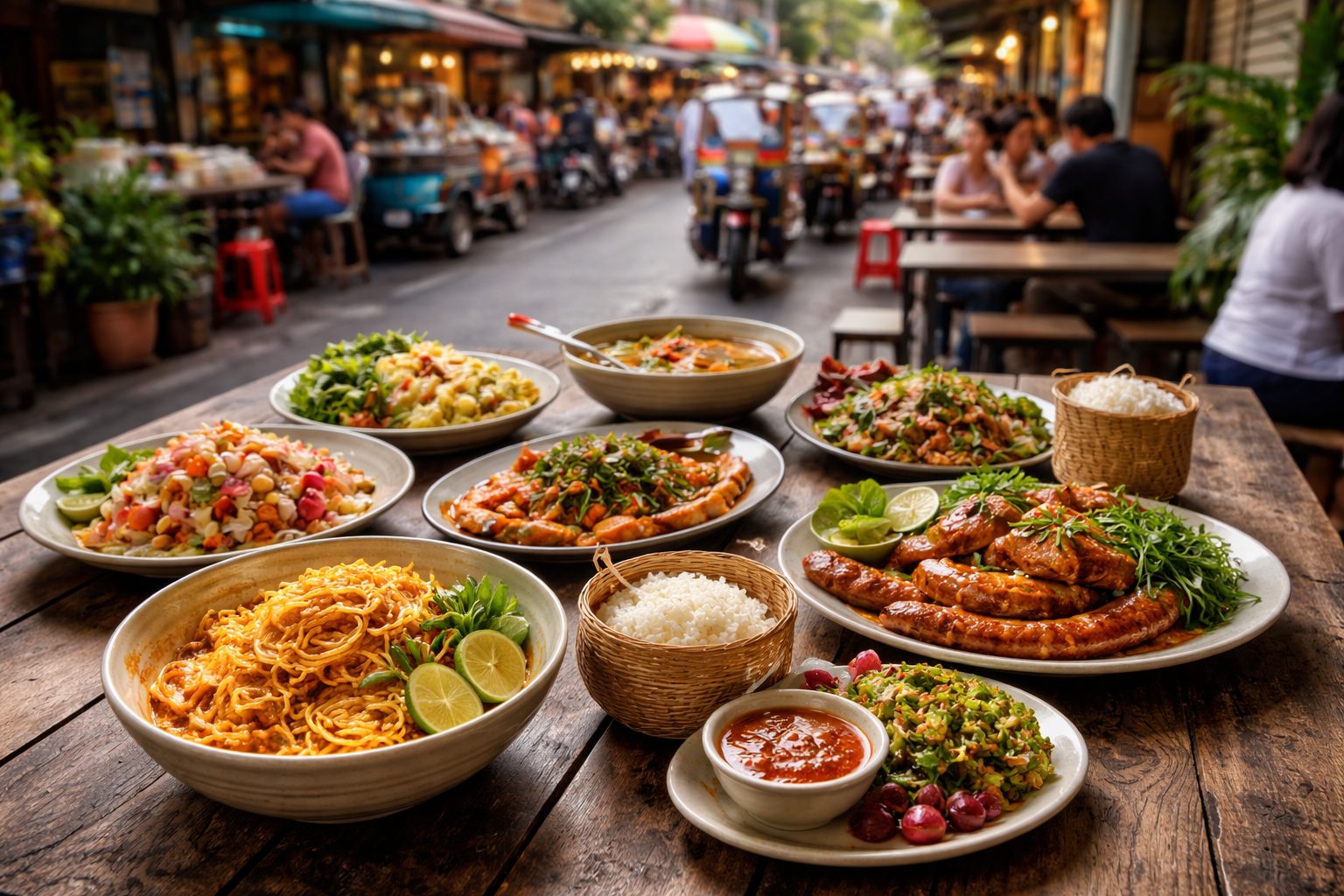
Thai food in Bangkok is not a monolith. The city serves dishes from every region of the country, and each has its own character. Northern Thai food (khao soi, sai ua sausage) is richer and more herb-forward. Southern Thai cooking is often fiery and coconut-heavy. Northeastern Isan food — larb, som tam, sticky rice — is pungent and bold. Central Thai cuisine, which is what most people associate with Thai food globally, balances sweet, sour, salty, and spicy in a way that’s remarkably sophisticated.
A Bangkok food education should include:
- Tom yum goong: hot and sour prawn soup with lemongrass
- Pad krapao: stir-fried basil with meat, ideally topped with a fried egg
- Khao man gai: poached chicken over rice with rich broth
- Massaman curry: slow-cooked, mildly spiced, often with beef or chicken
- Kaeng khiao wan: green curry, aromatic and fresh
Don’t make the mistake of eating only in tourist restaurants. The cooking in small, family-run shophouses is often far better.
Street Food to Try
Bangkok’s street food scene is the real backbone of how the city eats. The government cleared many street food vendors from major footpaths in 2017, which caused genuine concern — but the scene has adapted and plenty of great street food remains, particularly in residential areas, markets, and side streets.
Must-try street food items:
- Pad Thai at a proper wok station — not the tourist version, the real thing
- Mango sticky rice from a dessert cart in season (April through June is peak)
- Grilled pork skewers (moo ping) from morning market vendors
- Boat noodles — small bowls, deep flavor, eat several
- Roti with condensed milk or banana — a Thai-Muslim street snack that shouldn’t be missed
- Yen ta fo — pink noodle soup that looks alarming and tastes wonderful
- Oyster omelette (hoi tod) — crispy, eggy, rich
Yaowarat (Chinatown) at night is one of the best street food strips in the world. Arrive hungry.
Popular Restaurants and Cafes
Bangkok’s restaurant scene has genuinely matured. There are now multiple Bangkok restaurants on the World’s 50 Best list and the Asia’s 50 Best list. Gaggan (Indian progressive cuisine) made history staying on global best lists for years. Nahm and Bo.lan have done serious work in elevated traditional Thai cooking. Le Du uses Thai ingredients in a modern framework and has been widely praised.
But you don’t need to spend big to eat brilliantly. The Ekkamai and Thonglor neighborhoods on Sukhumvit have a cluster of excellent independent restaurants — Japanese, Korean, Italian, Thai — at reasonable prices. The Ari neighborhood has a lively cafe culture and some strong independent dining. Silom has a solid selection of quick lunch spots that the local office crowd uses.
For coffee specifically, Bangkok has developed a serious specialty coffee scene. Roots, Casa Lapin, Graph, and Ceresia are all worth visiting if you care about good espresso or filter coffee.
Cultural Experiences in Bangkok
Festivals and Events
Songkran, the Thai New Year, runs from April 13 to 15 and has become a massive event in Bangkok. The water festival tradition turns streets into water fights — you will get soaked. Silom Road and Khao San Road are the epicenters. If you don’t want to participate, stay indoors or leave the city. If you embrace it, it’s genuinely joyful.
Loy Krathong, usually in November, is quieter and more beautiful. People release small floating offerings (krathong) made of banana leaves and flowers onto rivers and canals to honor the water spirits. The Chao Phraya on Loy Krathong night is genuinely magical.
The Bangkok Art Biennale runs in odd-numbered years and has grown into a significant event, spreading installations across the city in heritage buildings, temples, and museums. The Wonderfruit festival near Pattaya, while not in Bangkok proper, draws an international crowd and is worth knowing about.
Local Customs and Etiquette
Thailand has a genuine respect culture, and a little awareness goes a long way:
- The wai (pressing palms together, slight bow) is the traditional greeting. As a visitor, you don’t always need to initiate, but returning one is respectful.
- Remove shoes before entering temples, homes, and some shops. Look for shoes at the door as your cue.
- The monarchy is held in high regard and criticism — in public or even seemingly in jest — can have serious legal consequences under lese-majeste laws. This is not a gray area.
- Dress modestly at temples. Shoulders and knees covered is the standard expectation.
- Don’t touch a monk if you’re a woman. Don’t pass objects directly to them.
- Losing your temper in public, called “losing face,” is genuinely uncomfortable for everyone involved. Thais resolve problems quietly and indirectly. A calm approach gets much better results.
Art and Music Scene
Bangkok’s contemporary art scene has expanded considerably. The Bangkok Art and Culture Centre (BACC) near the National Stadium BTS stop is the main public gallery and hosts rotating exhibitions alongside permanent collections. The Jam Factory, near the river, combines creative studios, galleries, and a bookshop in a converted factory space — it’s one of the more atmospheric spots in the city.
Live music is spread across the city. Jazz bars in Silom, indie venues in Ekkamai, and rooftop bars with live sets on Sukhumvit. Venue closure and relocation is a fact of life in Bangkok, so checking current listings before you go is wise. Fat Gut’z and Parking Toys have been reliable spots for local music scenes, though verify before you visit.
The club scene is centered largely around RCA (Royal City Avenue) and the Thonglor area. Bangkok has a genuine electronic music community, and international DJs regularly stop through.
Day Trips from Bangkok
Ayutthaya Historical Park
Ayutthaya was the capital of the Siamese kingdom from the 14th to the 18th centuries, when it was sacked by the Burmese and left in ruins. Today the UNESCO-listed historical park contains the remnants of palaces, temples, and giant Buddha statues — many headless, their heads removed by looters over the centuries.
It’s roughly 80 kilometers north of Bangkok and easily reached by train (about 1.5 hours, departing from Hua Lamphong station), minivan from Victory Monument, or private car. I’d recommend arriving early, renting a bicycle or tuk-tuk at the site, and giving yourself a full day. The key sites — Wat Mahathat, Wat Phra Si Sanphet, Wat Chai Watthanaram — are spread across a large area.
The image of a Buddha head grown into the roots of a bodhi tree at Wat Mahathat is iconic. It’s crowded in the morning but worth seeing.
Damnoen Saduak Floating Market
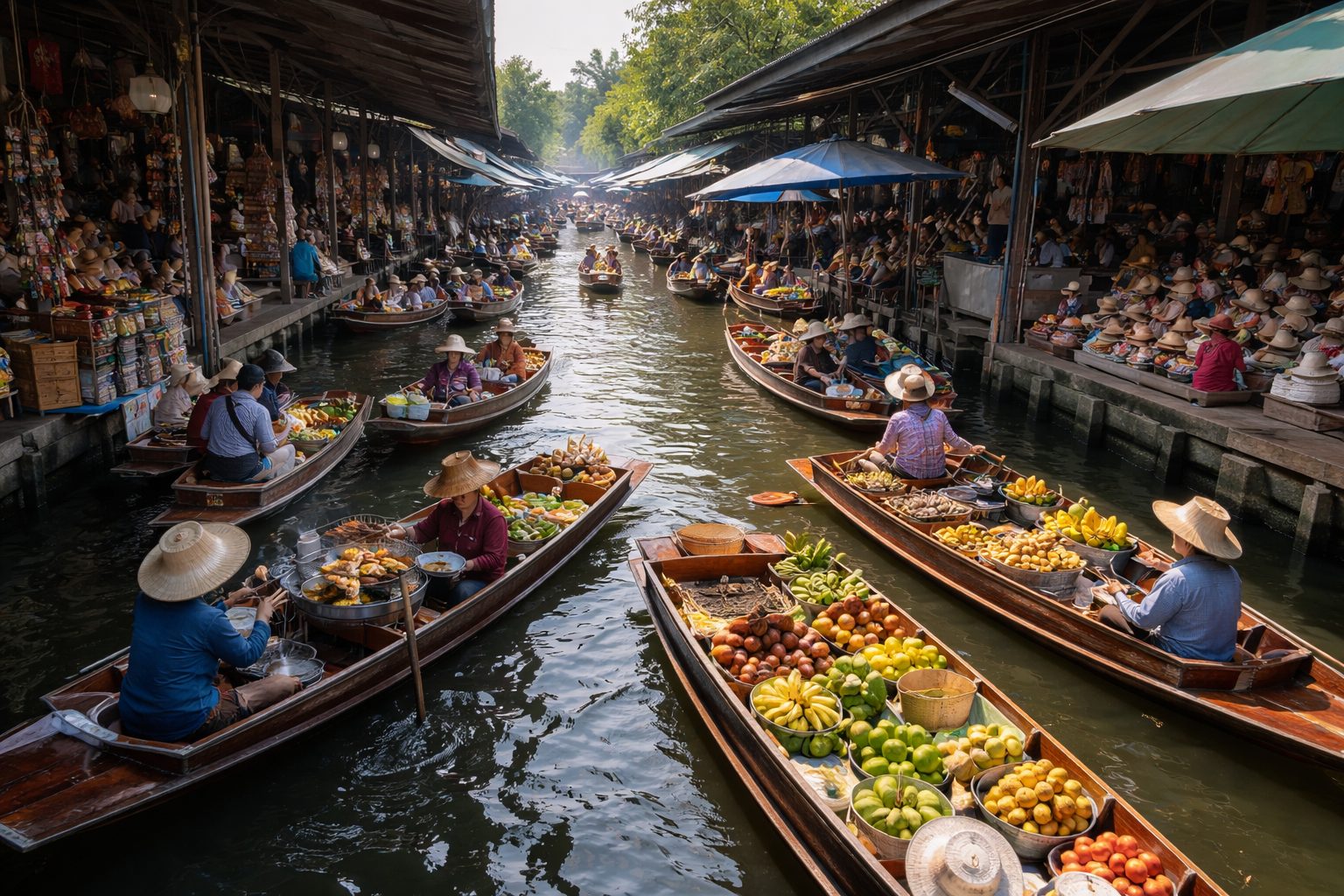
This is probably the most photographed floating market in Thailand — and also the most commercialized. Vendors in wooden boats sell fruit, souvenirs, and food along the canal network about 100 kilometers southwest of Bangkok. It’s undeniably photogenic, particularly in the early morning when the mist sits on the water.
Go with realistic expectations. It’s touristy. The prices are inflated. But it’s also a functioning market with genuine atmosphere if you’re there early — by 9 AM it gets crowded. Most organized tours depart Bangkok around 6 AM to catch it at its best.
Amphawa Floating Market, closer to Bangkok and running on weekends only, is a more authentic alternative. Less international tourist infrastructure, more Thais visiting for the weekend. Worth considering as a substitute or addition.
Kanchanaburi and the River Kwai
Kanchanaburi sits about two hours west of Bangkok and carries significant historical weight. The Death Railway, built by Allied prisoners of war and Asian laborers under brutal conditions during World War II, ran through here. The Bridge over the River Kwai is the most recognized symbol of that history, and the JEATH War Museum and the Allied War Cemetery provide sober, important context.
Beyond the history, Kanchanaburi is beautiful. The surrounding area has waterfalls (Erawan National Park is excellent), limestone hills, and a slower pace that contrasts sharply with Bangkok. You can stay overnight and make more of it, or cover the main sites in a long day trip.
The train from Bangkok’s Thonburi station is one of the more scenic rail journeys in the region.
Safety Tips for Travelers
Health Precautions
Bangkok is generally safe from a health standpoint, but a few things are worth knowing. Tap water is not safe to drink — stick to bottled or filtered water. Ice in restaurants is generally made from purified water and is fine, but at very basic street stalls, it’s worth being aware.
Stomach issues are common for first-time visitors to Southeast Asia, usually from a combination of different bacteria in the food environment rather than anything sinister. Eat at busy stalls where food turns over quickly. Avoid pre-cut fruit left sitting in the heat.
Mosquito-borne diseases including dengue fever are present in Thailand, though Bangkok is lower risk than rural areas. Still, use repellent, especially if you’re heading out at dusk. Malaria risk in Bangkok proper is effectively zero, but increases in some border regions.
Travel insurance is non-negotiable. Bangkok has excellent private hospitals — Bumrungrad International, Bangkok Hospital, and Samitivej are all world-class — but they’re not cheap for major procedures without coverage.
Scams to Avoid
Bangkok has its classic scams and they’ve been running for decades:
- The Grand Palace is closed today / for a Buddhist holiday / for cleaning: it’s almost never true. This is an opener to redirect you to a gem shop with inflated prices. Just go to the palace entrance.
- Tuk-tuk drivers offering very cheap city tours that happen to include a lot of stops at shops where the driver earns commission. Not inherently dangerous, just a waste of time.
- Gem scams: someone befriends you and explains that there’s a tax-free sale at a jewelry shop today only. The gems are overpriced or fake.
- Fake travel agents selling tours at prices that seem too good — and often are.
The pattern with most Bangkok scams is an unsolicited friendly stranger who seems extraordinarily helpful. It’s not that Bangkok locals aren’t genuinely friendly — many are. But random extreme helpfulness near tourist sites is worth approaching with some skepticism.
Emergency Contacts in Bangkok
Key numbers to save before you travel:
- Tourist Police: 1155 (English-speaking, specifically for visitors)
- General Emergency: 191
- Fire and Ambulance: 199
- Bumrungrad International Hospital: +66 2 066 8888
- Your country’s embassy or consulate — look this up before you go and save the number
The Tourist Police line (1155) is genuinely useful and the officers speak English. For anything involving crime or a dispute, contact them rather than trying to navigate the general police system without a translator.
Budgeting for Bangkok
Daily Expenses in Bangkok
Bangkok is one of Southeast Asia’s most affordable major cities for travelers, though prices have risen noticeably in recent years. A realistic daily budget varies enormously based on your style:
- Backpacker / budget: 800 – 1,500 THB per day (covering dorm accommodation, street food, public transport, occasional attraction entry)
- Mid-range: 2,500 – 5,000 THB per day (private hotel room, restaurant meals, occasional taxi)
- Comfortable / upscale: 5,000 – 12,000 THB per day
- Luxury: 12,000 THB and up, no ceiling
Attraction entry fees are relatively modest. The Grand Palace complex costs 500 THB. Most temples cost 50 to 200 THB. Transport on the BTS or MRT for a full day’s travel rarely exceeds 200 THB.
Money-Saving Tips
- Eat where locals eat. Street food and market stalls consistently beat tourist restaurants on both price and quality.
- Use the BTS and MRT instead of taxis for longer journeys. Buy a Rabbit Card (for BTS) for small discounts and convenience.
- Negotiate at markets, but only at markets — fixed-price shops and restaurants have fixed prices.
- Visit temples in the morning before the heat peaks and before tour groups arrive.
- Book accommodation in advance for peak season; last-minute bookings are expensive and options shrink.
- Drink fresh-squeezed juices and Thai iced tea from street stalls instead of buying bottled drinks at convenience store prices.
- Free attractions are genuinely excellent — walking around Chinatown, the riverside, and neighborhood markets costs nothing.
Currency and Payment Methods
Thailand’s currency is the Thai Baht (THB). At time of writing, rough reference rates are approximately 35–36 THB to the US dollar and around 42–44 THB to the Euro, but check current rates before traveling.
ATMs are everywhere in Bangkok. Most accept international cards but charge a foreign withdrawal fee — usually 220 THB per transaction, sometimes more. To minimize fees, withdraw larger amounts less frequently. Some banks in your home country reimburse ATM fees; check before you go.
Credit cards are accepted at hotels, malls, and most restaurants catering to tourists. Street food stalls and markets are almost always cash only. Carry small bills — vendors often don’t have change for 1,000 THB notes.
Currency exchange booths (SuperRich and similar) typically offer better rates than airport kiosks or hotel desks. The SuperRich locations in central Bangkok are well-known for competitive rates.
FAQs about Bangkok Travel
What Should I Pack for Bangkok?
Pack light, breathable clothing — linen and lightweight cotton are your friends. You’ll want at least one outfit that covers shoulders and knees for temple visits; a light scarf works as a versatile cover-up. Comfortable walking shoes matter more than you might think, as does a small daypack for carrying water and essentials. Sunscreen, a portable phone charger, and a basic stomach remedy are worth having. Most things you forget can be bought cheaply in Bangkok.
How to Avoid Tourist Traps?
Walk away from anyone who approaches you near a major tourist site with an offer that seems helpful or unusually generous. Do your research on standard prices before you go — knowing that a tuk-tuk ride across town should cost 80 to 150 THB prevents you from paying 400. Eat where you see Thais eating. Use Grab for transport to avoid fare disputes entirely.
Is Bangkok Safe for Solo Travelers?
Bangkok is generally very safe for solo travelers, including solo women. The city is well-lit, well-policed in tourist areas, and has a strong hospitality culture. The main risks are opportunistic scams rather than physical danger. Standard precautions apply: don’t flash expensive items, be aware of your surroundings at night, and trust your instincts. The solo travel infrastructure — hostels, tours, transport — is excellent.
Conclusion
Recap of Bangkok Travel Insights
This bangkok travel guide covers the essentials, but Bangkok itself always has more to offer than any guide can contain. The logistics are manageable: good transport links, clear visa processes, accommodation at every budget, and food that rewards curiosity. The cultural depth — temples, history, festivals, local customs — gives the city real substance beyond surface-level tourism. And the practicalities around safety and budgeting make it accessible for all kinds of travelers.
Encouragement to Explore Bangkok
What makes Bangkok worth coming back to isn’t any single thing. It’s the combination: the chaos that somehow works, the food that keeps surprising you, the people who take genuine pride in their city, and the way ancient and modern coexist without either canceling the other out. Use this bangkok travel guide as a starting point, then let the city show you what it wants to. Bangkok tends to have its own plans for visitors, and that’s usually part of the appeal.