Turkey offers one of the widest ranges of travel experiences of any country on earth, which is why it’s both thrilling to plan a trip here and slightly overwhelming. The things to do in turkey span ancient ruins that rival anything in Greece or Italy, natural landscapes that include cave cities, cotton-white mineral terraces, and mountain valleys, a coastal scene with warm sea and dramatic cliff scenery, and a culinary culture that’s one of the world’s genuine greats. The country bridges Europe and Asia geographically and culturally, and that intersection produces something that’s distinctly, powerfully its own.
I’ve spent substantial time in Turkey across different trips and seasons, and the consistent experience is that it rewards depth. The Grand Bazaar is interesting for an hour; Istanbul as a city is transformative over several days. Cappadocia visited on a day trip is impressive; Cappadocia explored on foot over three or four days reveals something genuinely extraordinary. The best things to do in turkey are the ones you approach with time and curiosity.
Introduction to Turkey’s Attractions
Overview of Turkey’s Cultural Heritage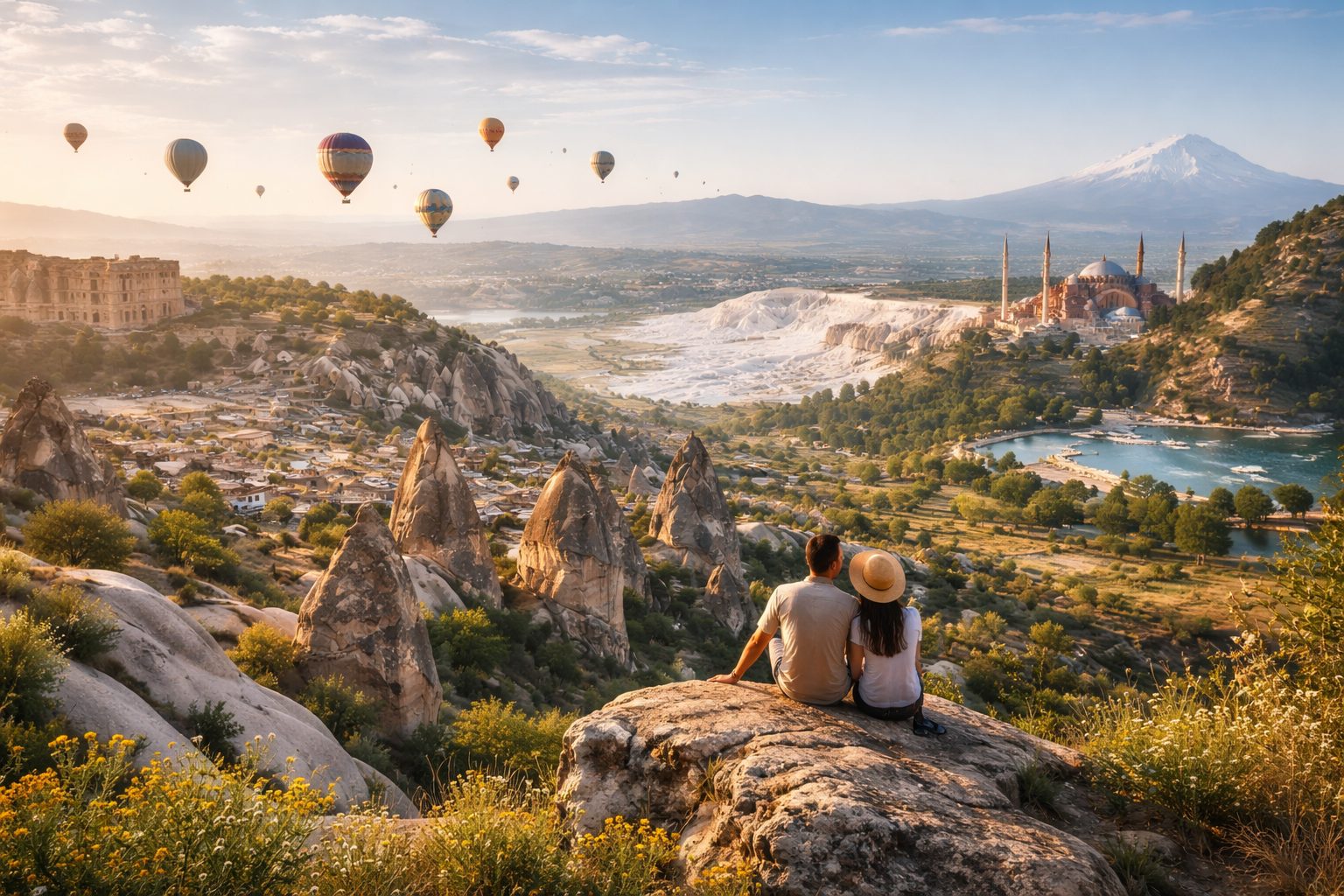
Turkey’s cultural heritage is the product of being, for thousands of years, among the most contested and inhabited territory on earth. This is where Hittites built an empire 3,500 years ago. Where Aegean Greeks established colonies that became Ephesus and Pergamon. Where Alexander the Great marched through on his way east. Where successive Roman, Byzantine, Seljuk, and Ottoman empires headquartered their power. The things to do in turkey related to this history could fill a lifetime of travel.
Istanbul alone contains: the Hagia Sophia (built 537 CE as a Christian cathedral, converted to a mosque, then a museum, now a mosque again), the Blue Mosque, the Topkapi Palace (where Ottoman sultans ruled an empire for 400 years), the Grand Bazaar (built in the 15th century and still functioning), the Basilica Cistern (a 6th-century underground water cathedral), and Galata Tower (built in 1348). That’s a partial list of a single city.
Outside Istanbul, ancient sites are scattered across the country in extraordinary density. Western Turkey along the Aegean coast was one of the most urbanized regions of the ancient world, and the ruins that survive, from Ephesus to Troy to Pergamon to Aphrodisias, represent some of the best-preserved Greco-Roman urban archaeology anywhere.
Natural Wonders of Turkey
The natural landscape provides an equally compelling set of things to do in turkey. Cappadocia’s volcanic landscape, shaped by millions of years of eruption and erosion into thousands of “fairy chimneys,” is unique on earth. Pamukkale’s white calcium carbonate terraces cascading down a hillside, fed by thermal springs, look like snow fields in summer. The Aegean and Mediterranean coasts offer dramatic scenery where mountains meet the sea.
Turkey’s eastern regions, less visited, contain landscapes of extraordinary scale: Mount Ararat (5,137 meters), the volcanic Lake Van, the Tigris and Euphrates headwaters, and the cave churches of the Euphrates valley.
Historical Sites to Explore
Ancient Ruins: Ephesus and Pergamon
Ephesus is the most visited ancient site in Turkey and one of the best-preserved Greco-Roman cities in the world. At its height in the 1st and 2nd centuries CE, Ephesus had a population of around 250,000 and served as the capital of the Roman province of Asia. What survives includes the Library of Celsus (one of the ancient world’s great libraries, with a stunning two-story facade), the Great Theatre (capacity 25,000, still used for concerts), the Curetes Street with its column-lined boulevard, elaborate terraced houses of wealthy Romans, public toilets, and a detailed picture of urban Roman life that’s difficult to find anywhere else.
The site is large (budget 3-4 hours minimum) and hot in summer; early morning or late afternoon visits are significantly more comfortable. For context on what you’re seeing, spending time with a guide or a detailed audio guide transforms the experience.
Pergamon (modern Ankara’s twin in scale if not fame) is in the hills above the modern city of Bergama. The Acropolis contains the ruins of the library that rivaled Alexandria’s, the Altar of Zeus (its frieze now controversially in Berlin’s Pergamon Museum), and theatre cut dramatically into the hillside. Below the Acropolis, the Asklepion was one of the ancient world’s most famous medical centers, where Galen, the father of Western medicine, practiced.
The Historical Significance of Istanbul
Istanbul sits at the crossing point of two continents and two seas, which is why it has been one of the world’s most important cities for 2,500 years. As Constantinople, it was the capital of the Roman Empire (from 330 CE) and then the Byzantine Empire for over a thousand years. As Istanbul, it was the capital of the Ottoman Empire from 1453 to 1922.
The concentration of historically significant buildings is extraordinary. Key sites:
-
Hagia Sophia: Justinian’s 6th-century cathedral, an engineering achievement that changed the history of architecture. The dome, 31 meters in diameter and 56 meters above the floor, appeared to defy gravity to contemporary observers. The building served as a Greek Orthodox cathedral until 1453, a mosque from 1453 to 1934, and a museum from 1934 to 2020, when it was reconverted to a mosque. Visitors can enter during non-prayer hours.
-
Topkapi Palace: The primary residence and administrative center of the Ottoman sultans from the mid-15th century to the mid-19th century. The treasury section alone, with its collection of jeweled objects, thrones, and the Topkapi Dagger, is worth substantial time. The harem complex, where the sultan’s household lived, is fascinating for its combination of luxury and political complexity.
-
Grand Bazaar: Built in the 15th century and expanded continuously, the covered bazaar now has around 4,000 shops and 60 streets. It’s commercial and tourist-focused today, but the architecture of the central bedesten (exchange), the variety of goods, and the sheer historical continuity of commerce on this site make it worth more than a passing visit.
-
The Theodosian Walls: The land walls built by Emperor Theodosius II in the 5th century CE, which protected Constantinople for a thousand years. Substantial sections survive and can be walked.
The Rock-Cut Churches of Cappadocia
One of the less-expected things to do in turkey is to spend hours exploring early Christian rock-cut architecture in Cappadocia. When Christianity was adopted by Constantine in the 4th century, the volcanic landscape of this region attracted communities of monks and hermits who carved their churches, monasteries, and dwelling spaces directly into the soft tuff rock.
The Göreme Open Air Museum, a UNESCO World Heritage Site, collects the finest examples in a compact area: the Dark Church (Karanlık Kilise) with extraordinarily well-preserved 11th-12th century frescoes, the Apple Church, the Snake Church, and the Sandal Church, all with different fresco programs and different states of preservation.
But the rock churches extend far beyond the museum: the valley walks around Göreme pass dozens of carved churches, chapels, and storage rooms. The Ihlara Valley south of Göreme has 100+ rock churches carved into a gorge. The underground city of Derinkuyu, 85 meters deep and capable of housing thousands of people, was partly used as Christian refuge during periods of Arab raids.
Natural Attractions
Discovering the Fairy Chimneys of Cappadocia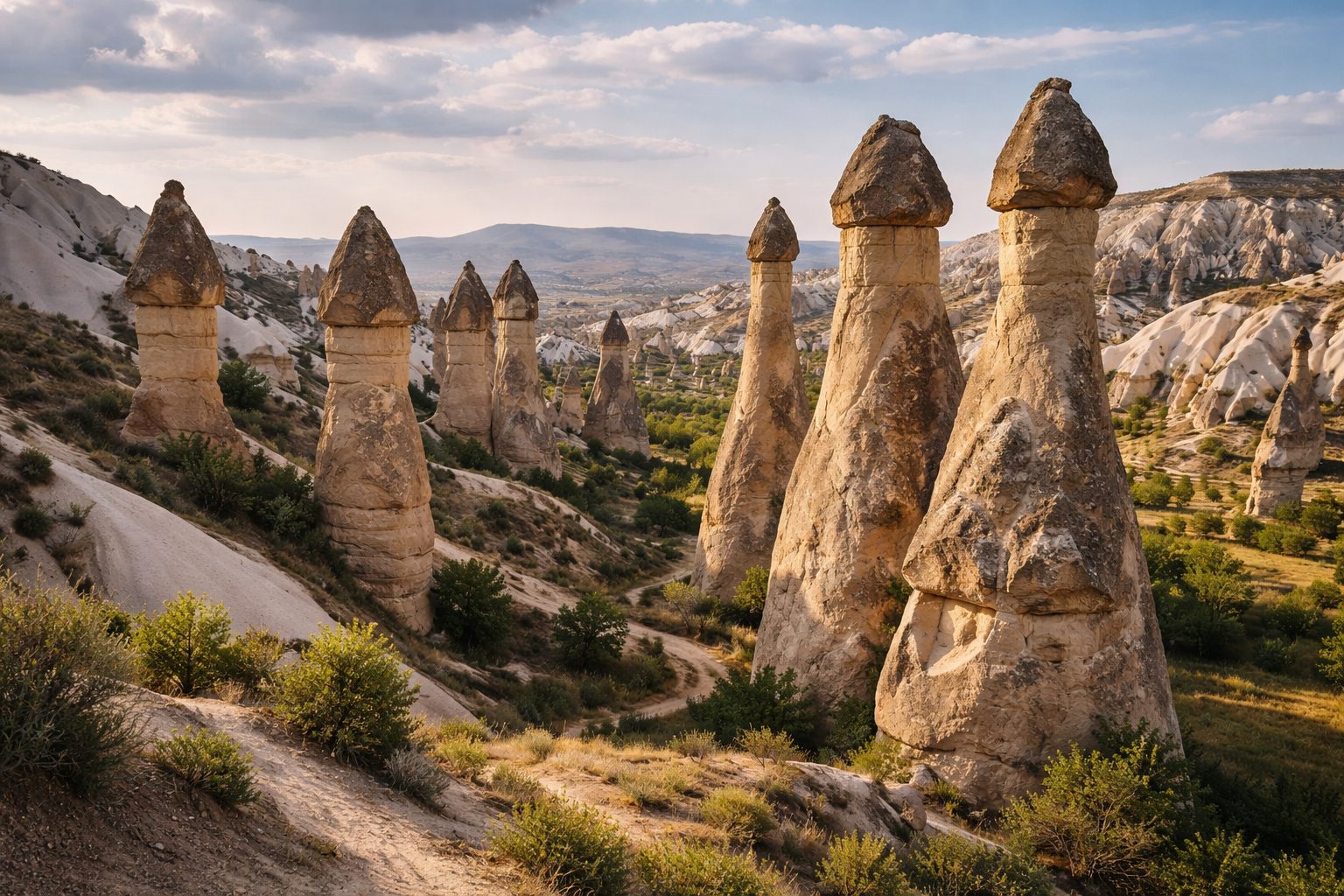
The “fairy chimneys” of Cappadocia are volcanic tuff formations shaped by millions of years of erosion into columns, cones, and towers, many topped with darker basalt caps. The landscape is genuinely otherworldly, and no description or photograph fully prepares you for seeing it in person.
The best way to experience the landscape is a combination of:
-
Hot air balloon flight at sunrise: The classic Cappadocia experience, floating over the valleys as the light warms the landscape below. About 100 balloons lift off most mornings when weather permits. Book in advance and accept that your flight may be cancelled due to wind; it’s common.
-
Valley hikes: The valleys between Göreme and surrounding villages, including the Rose Valley, Red Valley, Pigeon Valley, and White Valley, are excellent hiking terrain. Most are accessible on foot from Göreme or by short taxi ride to the trailheads.
-
Viewpoints: The Uçhisar Castle and various sunset viewpoints around the main towns offer elevated perspectives on the landscape.
-
Horseback riding: Distinctly different from hiking, a horse tour into the valleys gives a different scale of experience.
Pamukkale: The Cotton Castle
Pamukkale, which means “cotton castle” in Turkish, is a natural phenomenon that looks artificial: a hillside covered in cascading white calcium carbonate terraces formed by thermal spring water flowing down the slope and depositing mineral content as it cools. The result looks like frozen white waterfalls or a snow-covered mountain, visible from kilometers away.
The terraces are accompanied by Hierapolis, the ancient Greco-Roman spa city built around the thermal springs, whose ruins sit above the white terraces. The thermal waters in the ancient pool of Hierapolis still flow today, and swimming in this pool, surrounded by submerged ancient marble columns, is one of the more unusual things to do in turkey.
The terraces themselves have been partly closed to protect them from degradation, with visitors only able to walk certain paths barefoot (shoes are removed to protect the calcium carbonate). The best time to visit is early morning or late afternoon for the light; midday crowds and harsh sunlight can be overwhelming.
The Beautiful Beaches of Antalya
The Turkish Riviera around Antalya is one of Europe’s major beach destinations, with an 800-kilometer coastline of coves, bays, and long stretches of sand and pebble beach backed by mountains. The sea is warm (25-28°C in summer), the weather is reliable, and the infrastructure for beach tourism is well-developed.
The beaches near Antalya city include Konyaaltı (a long pebble beach in the city itself) and Lara (wider, sandy). Further along the coast, the bays around Kemer, Çıralı (famous for the eternal flames of the Chimaera nearby), and Olympos offer more natural settings.
For the best beaches, the stretch between Kas and Antalya on the Turquoise Coast offers extraordinary variety: coves accessible only by boat, turquoise water, and the combination of coastal and ancient site tourism.
Culinary Experiences
Traditional Turkish Dishes to Try
Turkish cuisine is one of the world’s great food traditions, recognized by UNESCO as Intangible Cultural Heritage. The things to do in turkey are incomplete without a serious engagement with the food.
Essential dishes:
- Iskender kebab: Thin slices of lamb doner on pide bread, drowned in tomato sauce and browned butter, topped with yogurt. The signature dish of Bursa.
- Meze selection: A spread of cold and hot starters including hummus, baba ghanoush, cacık (yogurt-cucumber-garlic), ezme (spiced tomato), and muhammara (red pepper and walnut paste). The best way to eat in a meyhane (tavern).
- Lahmacun: Thin, crispy flatbread covered in spiced minced meat, fresh herbs, and lemon. Roll it up and eat it as street food.
- Menemen: Scrambled eggs with peppers, tomatoes, and spices, cooked in a copper pan. The defining Turkish breakfast dish.
- Baklava: The real thing, honey-soaked layers of filo with ground pistachio, not the dry version exported elsewhere. Gaziantep’s is considered the finest.
- Simit: Sesame-covered bread rings, sold from street carts, eaten for breakfast or as a snack with tea.
- Balık ekmek: Fresh grilled fish in bread, sold from boats on the Bosphorus waterfront. Quintessentially Istanbul.
Food Markets and Street Food in Istanbul
The street food and market scene in Istanbul is one of its great attractions.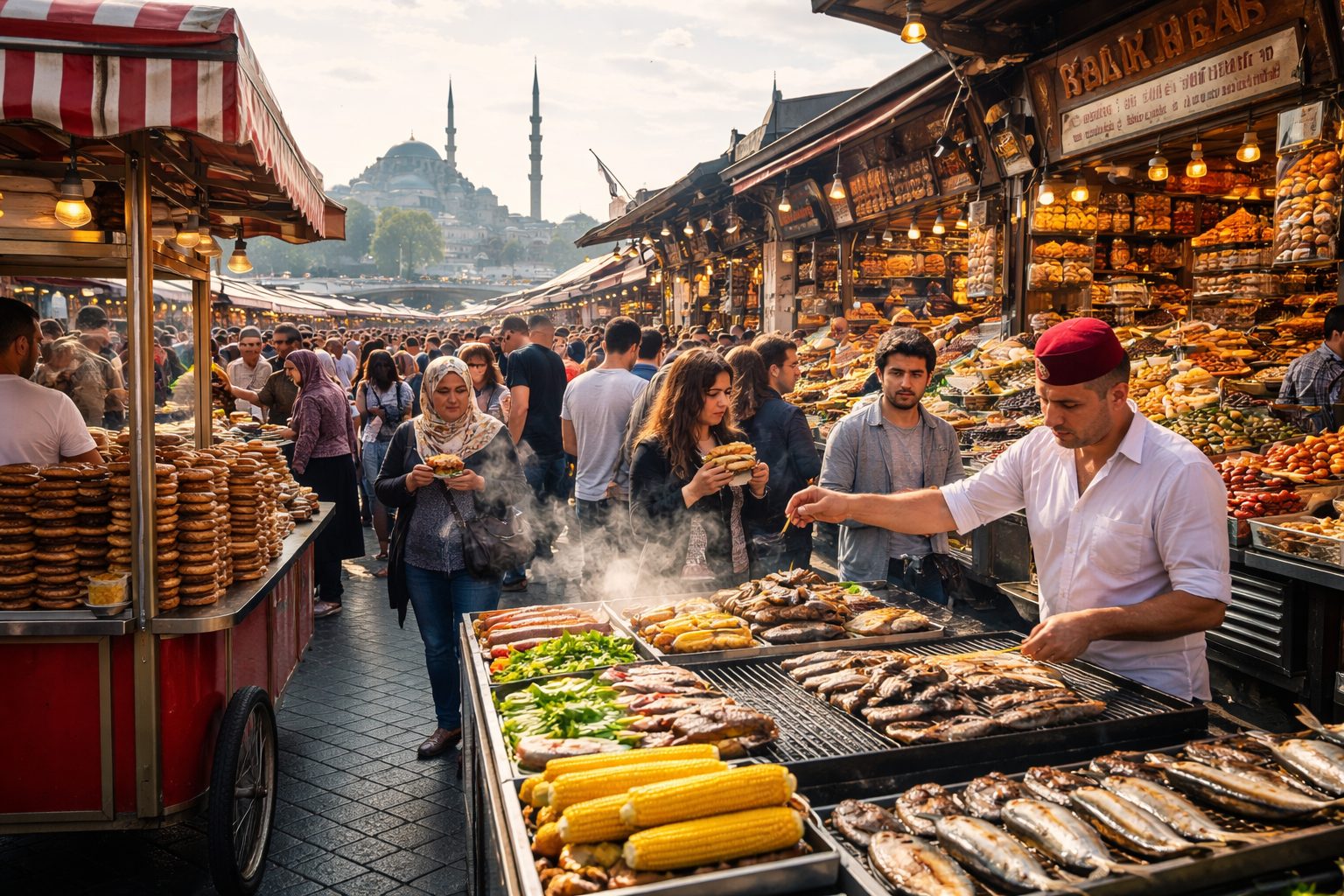
The Spice Bazaar (Mısır Çarşısı), near the waterfront in Eminönü, is where to buy Turkish spices, dried fruits, nuts, and lokum (Turkish delight) in their best form. The surrounding streets are an extension of the market, with vendors of olive oil, cheese, pickles, and fresh produce.
The Kadıköy market on the Asian side of Istanbul is the city’s best general food market: a grid of streets with vendors selling every type of ingredient, a fantastic range of international and Turkish street food, and a lively, local atmosphere very different from the tourist-focused Spice Bazaar.
For evening street food, Karaköy and Beyoğlu offer a mix of traditional and contemporary options: fresh simit from carts, kokoreç (seasoned lamb offal on a spit, genuinely excellent), midye dolma (mussels stuffed with spiced rice), and a newer wave of Istanbul street food businesses.
Wine Tasting in Cappadocia
What surprises most visitors is that Turkey has a long winemaking tradition dating back thousands of years. The volcanic soils of Cappadocia produce some of the most distinctive wines in the country, using indigenous grape varieties like Öküzgözü, Boğazkere, and Emir that aren’t grown anywhere else.
Several Cappadocia wineries offer tastings:
- Kocabağ winery in Ürgüp: One of the region’s oldest modern producers, with a good range of Cappadocian varietals
- Türkmen Bağları: A family producer with excellent white wines from Emir grapes
- Urla, Talay, and Vinkara: Not in Cappadocia specifically, but Turkish wine is worth exploring across the country
September and October are the harvest months, when vineyard visits have an extra dimension of active winemaking to observe.
Adventure Activities
Hot Air Ballooning in Cappadocia
If there’s a single activity that most defines the Cappadocia experience, it’s the balloon flight at dawn. About 50-100 balloons typically lift off on flyable mornings, floating across the valleys as the light shifts from grey to gold. The experience of looking down on the fairy chimneys from a balloon basket, in near-silence except for the occasional gas burner blast, is unlike anything else I’ve done in Turkey.
Reputable operators with good safety records include Kapadokya Balloons and Royal Balloon. Expect to pay in the range of €150-200 per person for a 1-hour flight. Weather cancellations are common; most operators reschedule or refund if conditions aren’t safe to fly.
Book at least a week in advance in peak season (April-October), as flight slots fill quickly.
Hiking the Lycian Way
The Lycian Way is a 500-kilometer waymarked trail running from Fethiye to Antalya along the Mediterranean coast of Turkey, passing through ancient Lycian ruins, small villages, limestone mountains, and coastal forests. It’s been developed over the past 25 years and is now one of the recognized great long-distance walks of the world.
The best sections can be walked independently in 3-5 day segments without completing the whole route:
- Fethiye to Patara: Through the ruins of Tlos, Sidyma, and Patara, with beautiful coastal and mountain scenery
- Kaş region: Dramatic coastline with Lycian rock tombs
- Olympos to Antalya: Through ancient Olympos, past the Chimaera eternal flames, with the possibility of swimming in the sea from various points
Walking season is October-April; summer heat makes the exposed sections genuinely dangerous.
Scuba Diving in the Mediterranean
The Turkish Mediterranean is an excellent diving destination, with clear water, good visibility, and an interesting mix of natural reef and wreck diving. The Bodrum and Fethiye areas have the most developed dive infrastructure.
Highlights:
* Uçanbalık (Flying Fish) rock near Bodrum: A dramatic underwater pinnacle with good fish life
* Various wrecks off the Turquoise Coast, including the Yassıada wrecks with Byzantine-era cargo
* Cave diving around the Aegean coast
* Fethiye Bay: Good visibility and accessible diving for beginners and intermediates
Water temperatures are comfortable for diving in 3mm wetsuit from May through October.
Cultural Experiences
Visiting Local Villages and Markets
One of the most rewarding things to do in turkey is to leave the main tourist circuits and spend time in villages and local weekly markets. Every region has a different character, different food specialties, different crafts.
The Aegean villages around Şirince near Selçuk are known for fruit wines (decidedly unofficial) and old stone houses. The villages of the Kaçkar Mountains in the northeast have a distinctive Laz and Georgian cultural heritage. The Black Sea coast villages have a completely different character from the tourist south.
Local market days (pazar) are weekly affairs in every town, selling fresh produce, textiles, household goods, and often excellent local food at significantly lower prices than tourist restaurants. Finding the local pazar and spending a couple of hours there is a reliably good use of time.
Traditional Turkish Bath (Hamam) Experience
The hamam is a central institution of Turkish social life dating back to Byzantine and Roman bathing traditions. A proper hamam experience involves:
- Entering the warm room (sıcaklık) and relaxing in the heat on the hot marble slab (göbek taşı)
- Being scrubbed by a bath attendant who removes dead skin with a rough kese mitt
- A soap massage, producing extraordinary quantities of foam
- Rinsing and relaxation
Istanbul has many hamams ranging from ancient to modern. The Çemberlitaş Hamamı (1584) and Cağaloğlu Hamamı (1741) are among the historic options, now serving tourists but architecturally magnificent. For a more local experience, neighborhood hamams in residential areas operate at a fraction of the tourist price.
Attending a Whirling Dervishes Ceremony
The Sema ceremony of the Mevlevi Order (Sufi dervishes) is one of Turkey’s most distinctive cultural experiences. The ceremony involves the semazen (dervishes) spinning continuously in white robes as a form of meditation and prayer, representing the soul’s journey toward divine truth.
Genuine religious Sema ceremonies take place at the Galata Mevlevi Lodge in Istanbul (on Sundays) and in Konya, the city of Rumi, particularly around December 17 (the anniversary of Rumi’s death). Tourist-oriented performances are also staged in various locations, though these are more theatrical and less spiritually significant.
Shopping in Turkey
Best Souvenirs to Buy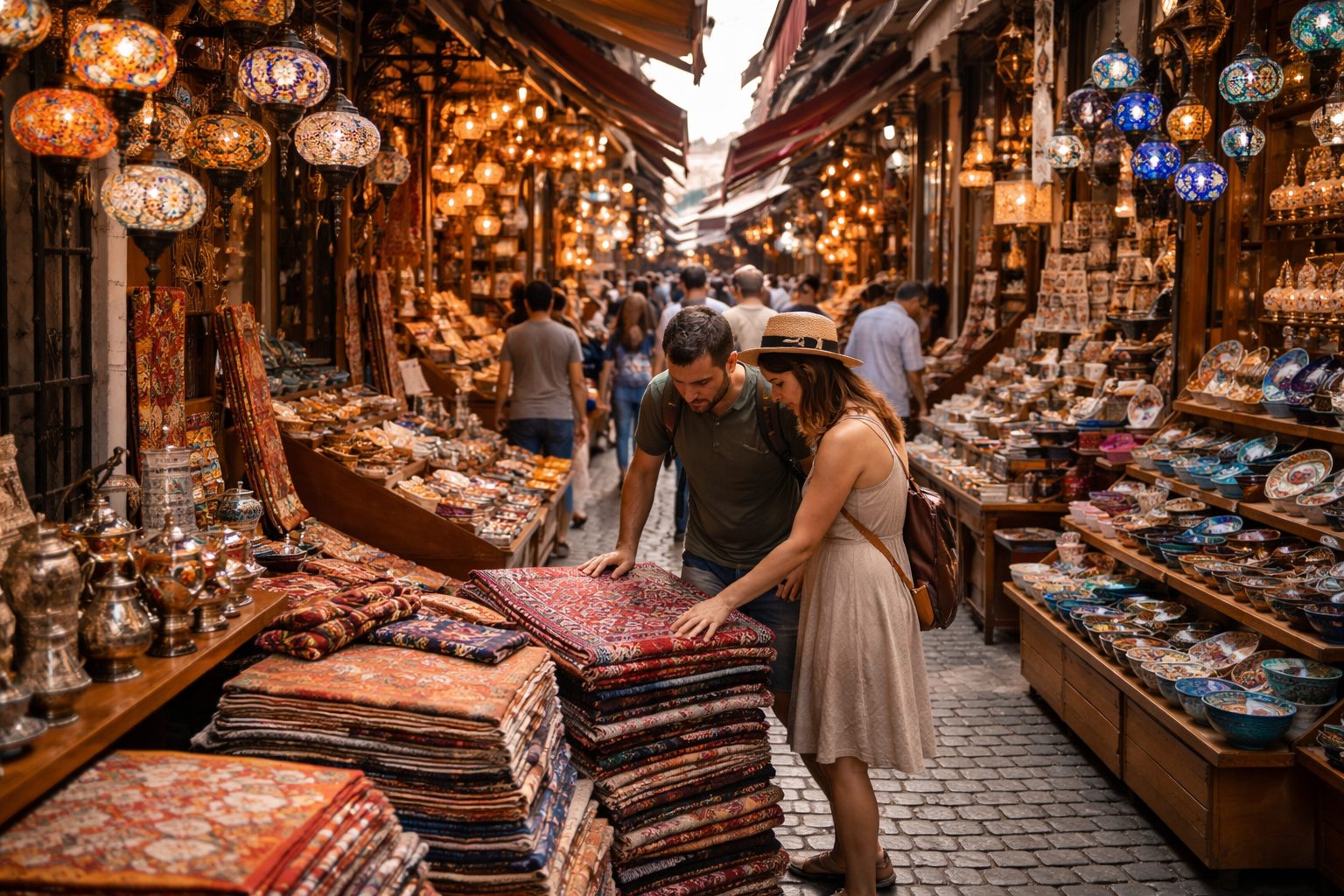
Turkey’s craft traditions are genuine and varied. The best souvenirs:
- Handmade carpets and kilims: Turkey’s most famous export and genuinely beautiful objects when authentic. Buy from reputable shops, understand what you’re buying, and expect to spend time on selection.
- Ceramics: Iznik-style pottery with characteristic blue and white patterns, or the Cappadocian style. Quality varies enormously; the best pieces are from artisan workshops rather than tourist shops.
- Textiles: Handwoven cotton and linen from the Aegean regions, including peştemal (hammam towels) that are actually excellent quality and useful.
- Spices: The Spice Bazaar is the place to buy, but quality varies; look for whole spices and fresh grinding.
- Evil eye (nazar boncuğu): The blue glass amulet is genuinely traditional and the artisan versions in Cappadocia and Istanbul are beautiful objects rather than just tourist trinkets.
- Turkish coffee and tea sets: Good copper cezve (coffee pots) and tulip-shaped tea glasses make practical and authentic gifts.
Grand Bazaar vs. Spice Bazaar: Which One to Visit?
Both are worth visiting, but for different reasons:
| Aspect | Grand Bazaar | Spice Bazaar |
|---|---|---|
| Size | Vast (4,000+ shops, 60+ streets) | Compact (88 arched shops) |
| Main goods | Carpets, jewelry, ceramics, leather | Spices, dried fruit, lokum, tea |
| Atmosphere | Intense, labyrinthine | Fragrant, more manageable |
| Price negotiation | Expected and standard | Some, less aggressive |
| Architecture | Beautiful vaulted ceilings | Elegant Ottoman market hall |
| Crowds | Very busy | Busy but less overwhelming |
| Best for | Browsing, handicrafts | Food souvenirs, authentic goods |
I’d visit the Spice Bazaar first for the sensory experience and to buy food gifts, and then the Grand Bazaar for exploring and browsing, ideally early on a weekday when it’s less packed.
Practical Tips for Travelers
Best Time to Visit Turkey
For the most complete experience covering multiple types of things to do in turkey:
- April-May: Excellent almost everywhere. Mild temperatures, wildflowers, manageable crowds. My top recommendation for a first visit covering Istanbul, Cappadocia, and the Aegean.
- September-October: Equally excellent. Sea still warm for swimming, crowds thinning after August, beautiful light. October specifically for the coast.
- June and early July: Good but getting hot, crowds building.
- July-August: Hot, very crowded, expensive. Best for beach holidays specifically.
- November-March: Quieter and cheaper, but some coastal businesses close. Istanbul and Cappadocia are both excellent in winter for those who don’t need beach weather.
Transportation Options within Turkey
The scale of Turkey means transport choices significantly affect what’s feasible in a given itinerary.
Domestic flights are the key efficiency tool: Istanbul to Cappadocia (1.5 hours vs 12 hours by bus) and Istanbul to Bodrum or Antalya (1.5 hours vs 12-14 hours) make domestic flights genuinely valuable. Turkish Airlines and budget carrier Pegasus both serve these routes.
Long-distance buses connect virtually everywhere and are the budget traveler’s backbone. Comfortable coaches with air conditioning and periodic service are the standard for major routes.
Rental car: Essential for the Turquoise Coast and highly recommended for exploring Cappadocia beyond the standard sites. Driving in Turkey requires adjustment but is manageable.
Urban transit: Istanbul’s metro, tram, and ferry network is excellent. Get an Istanbulkart on arrival.
Safety Tips for Tourists
Turkey is generally safe for tourists and remains a country that values hospitality toward guests. Standard precautions:
- Keep valuables secure in crowded tourist areas (Grand Bazaar, Sultanahmet, ferry terminals)
- Use metered taxis or apps (BiTaksi) rather than unmetered cabs
- The “carpet shop invitation” and variations are social engineering tactics used to get tourists into shops; you’re not obligated to enter or buy
- Road safety is a genuine concern; drive defensively and prefer high-speed trains over night buses for very long journeys
- Check current travel advisories for specific regions; the southeast near the Syrian border requires different consideration than the tourist circuits of western Turkey
FAQs about Visiting Turkey
What are the visa requirements for Turkey?
Many nationalities can obtain an e-Visa online before travel at the official Turkish e-Visa website (evisa.gov.tr). Citizens of some countries can enter visa-free. The e-Visa process is straightforward and takes a few minutes online. Check current requirements for your specific nationality, as they change periodically.
Is Turkey safe for solo travelers?
Yes, Turkey is generally safe for solo travelers, including women traveling alone. Cities have the normal range of urban safety considerations. The main irritants for solo female travelers are persistent male attention in tourist areas, which is annoying rather than dangerous in most cases. Confidence, ignoring unwanted attention, and not accepting unsolicited assistance from strangers who approach you resolves most of these situations.
How to get around major cities in Turkey?
Istanbul: Istanbulkart for metro, tram, and ferry. Essential purchase on arrival.
Ankara: Metro system covers main tourist routes. Taxis and apps for other journeys.
İzmir: Metro along the waterfront, trams, and ferries across the bay.
Bodrum, Antalya, Cappadocia: These are smaller cities or regions where taxis, minibuses, and rental cars are the main options. The Dolmuş (shared minibus) connects towns in tourist areas at low cost.