
Vietnam has always felt like one of those rare places where the food alone justifies the trip. I still remember the first bowl of pho I had in Hanoi at six in the morning, sitting on a plastic stool, watching the city wake up around me. That moment stuck with me, not because it was exotic, but because it was perfect. Simple, precise, deeply satisfying. That’s what the best vietnam food does — it strips everything back to what matters.
Vietnamese cuisine is built on balance. Salty, sour, sweet, and spicy elements meet in every dish without any single flavor dominating. Fresh herbs arrive at the table alongside almost every meal, and that’s not decoration — they’re part of the architecture of the food. This guide covers everything from iconic street staples to regional specialties you won’t find outside a single province, plus practical advice for eating well wherever you are.
Introduction to Vietnamese Cuisine
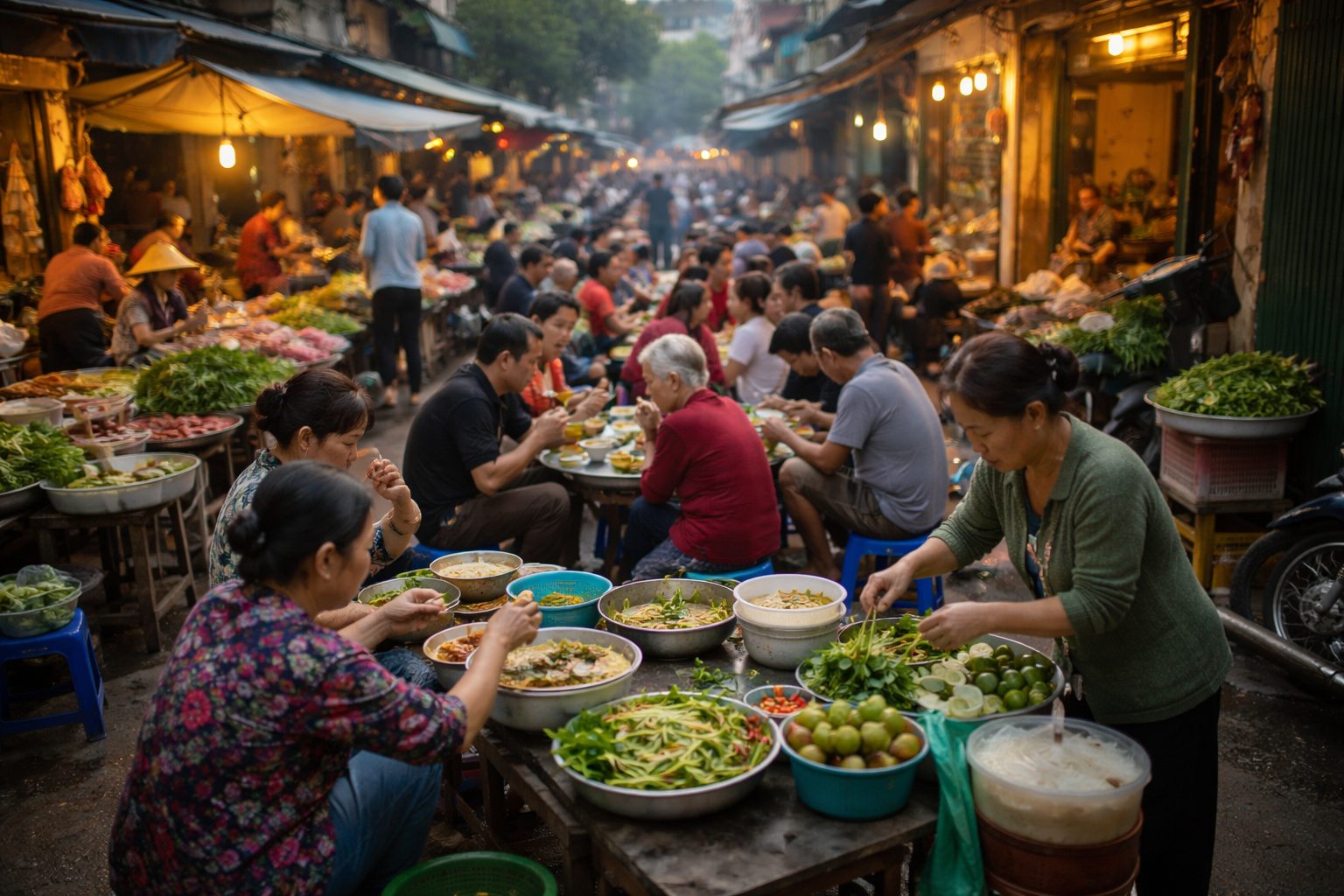
Overview of Vietnamese Food Culture
Food in Vietnam isn’t just sustenance. It’s social ritual, morning routine, neighborhood identity, and family memory all at once. Markets open before dawn. Street vendors set up by 5 a.m. Breakfast is eaten outside, usually at a cart or a small shop that’s been serving the same dish for decades.
The country’s long history shows up clearly on the plate. Chinese influence brought noodles and chopsticks to the north. French colonization introduced baguettes, pâté, and coffee culture. Interactions with Cham, Khmer, and other Southeast Asian cultures shaped the spice palettes of the central and southern regions. The result is a cuisine that’s technically Vietnamese but quietly carries the marks of everyone who passed through.
Meals are rarely solitary. Sharing dishes from the center of the table is the norm, not the exception. Even a simple lunch at a local quan (eatery) tends to involve multiple small plates, a big pot of something, and more rice than you expected.
Importance of Fresh Ingredients in Vietnamese Cooking
Walk through any Vietnamese market in the early morning and you’ll understand why the food tastes the way it does. Produce arrives daily. Herbs like rau ram (Vietnamese coriander), kinh gioi (Vietnamese balm), and perilla are sold in enormous bundles, not small plastic packages. Fish comes whole, still moving. Tofu is made on-site.
This obsession with freshness isn’t just cultural preference — it’s a structural part of how Vietnamese cooking works. Sauces and broths do a lot of heavy lifting, but they only succeed because the base ingredients are good. A pho broth simmered for hours can be undermined by mediocre beef. Fresh spring rolls taste flat without crisp vegetables and fragrant herbs.
Vietnamese cooks also understand timing. Many dishes are assembled at the last moment. A bowl of bun bo Hue isn’t made and held — it’s built to order, hot, and meant to be eaten immediately. That sense of immediacy is part of what makes the best vietnam food feel alive.
Popular Vietnamese Dishes
Pho: The Iconic Noodle Soup
Pho is probably the most recognized Vietnamese dish in the world, and it still manages to be misunderstood. At its core, pho is a broth-based noodle soup — but the broth is the entire point. In Hanoi, where the dish originated, pho bo (beef pho) is made with bones roasted at high heat, then simmered for six to twelve hours with charred ginger, onion, star anise, cinnamon, and cloves. The result is clear, deeply aromatic, and intensely savory without being heavy.
You customize the bowl at the table with bean sprouts, lime, fresh chili, and herbs. Northern-style pho tends to be simpler, cleaner, and less garnished than the southern version. In Ho Chi Minh City, the broth is sweeter, and the herb plate is much more generous.
Eating pho is a morning ritual for many Vietnamese people. If you show up at a famous pho shop at 10 a.m. hoping for a bowl, you may find it’s already sold out.
Banh Mi: The Vietnamese Sandwich
The banh mi is a direct legacy of French colonization, and one of the most successful culinary fusions in history. A short baguette — lighter and crispier than the French original, thanks to the addition of rice flour — gets loaded with a combination of fillings that vary by vendor and region.
Common versions include:
- Banh mi thit: cold cuts, pâté, mayo, cucumber, pickled daikon and carrot, fresh chili, cilantro
- Banh mi trung: scrambled or fried eggs
- Banh mi chay: vegetarian, often with tofu or mushroom-based fillings
- Banh mi xa xiu: Chinese-style BBQ pork
The best ones come from small shops that have been perfecting their bread for years. The balance of textures — crispy crust, soft interior, crunchy pickles, creamy pâté — is what makes a great banh mi. It should cost somewhere between 15,000 and 40,000 VND at a street vendor. If you’re paying more than that without sitting down, you’re probably at a tourist spot.
Goi Cuon: Fresh Spring Rolls
Goi cuon are what people often mean when they say “fresh spring rolls” — rice paper wrappers filled with shrimp, pork, rice vermicelli, lettuce, and fresh herbs, served at room temperature with a thick peanut dipping sauce or nuoc cham (fish sauce-based dipping sauce).
These aren’t fried. They’re light, refreshing, and honestly one of the better things to eat in hot weather. The filling combinations change depending on the region and the cook, but the herbs are non-negotiable — usually mint and sometimes perilla or chives.
They’re a good benchmark for a Vietnamese restaurant, actually. If the rice paper is thick, gummy, or pre-rolled and sitting in a pile, that’s not a good sign. Fresh goi cuon should be made to order, wrapped tightly but gently, and eaten within minutes.
Bun Cha: Grilled Pork with Noodles
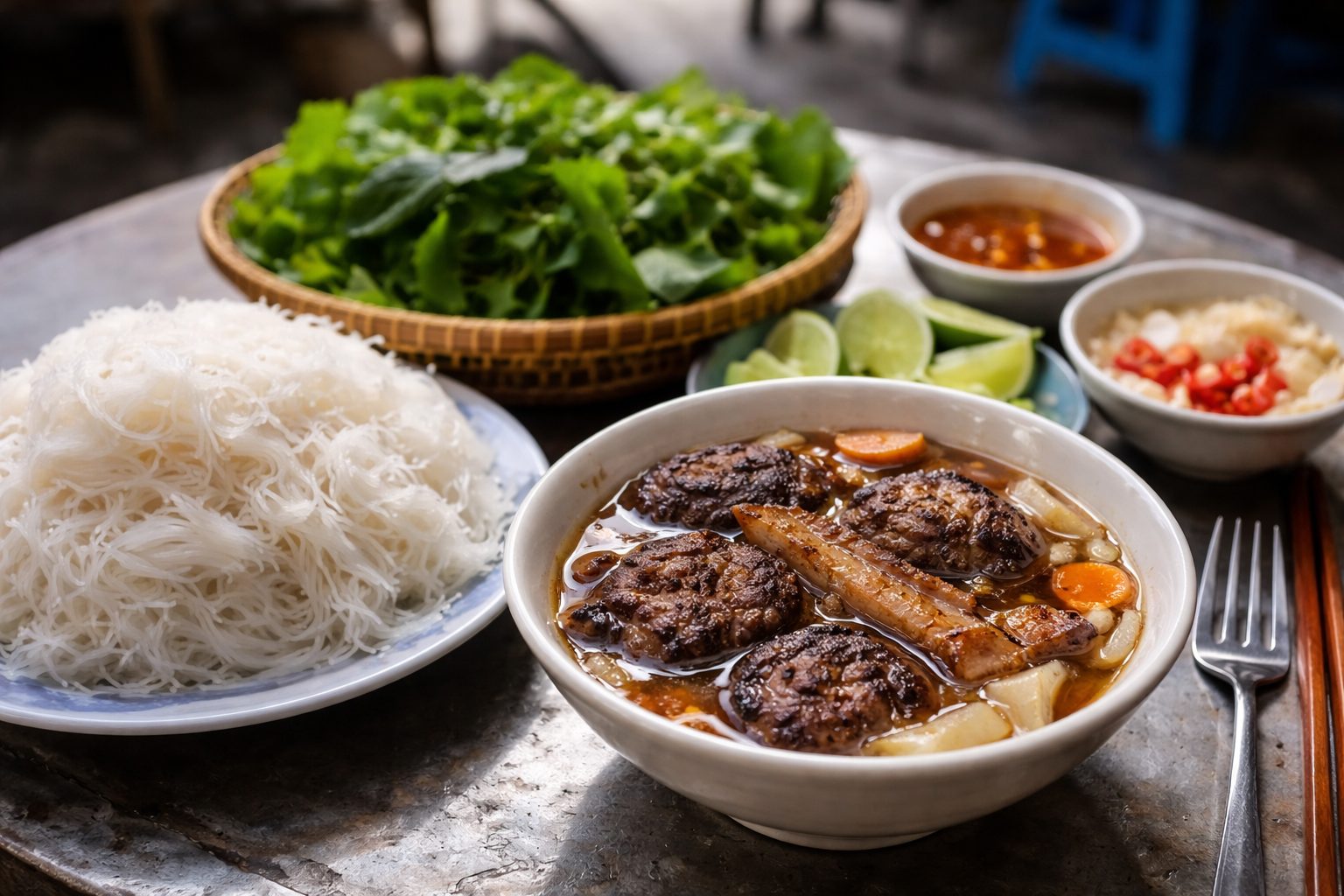
Bun cha is a Hanoi specialty and one of the best things you can eat in the city at lunch. Grilled pork patties and slices of pork belly are served in a light, sweet-and-sour broth alongside a plate of cold rice vermicelli noodles and a large plate of fresh herbs and lettuce.
The technique is simple but precise. The pork is marinated in fish sauce, sugar, and shallots, then chargrilled over charcoal until caramelized at the edges. You dip the noodles and herbs directly into the broth, which balances the smokiness of the meat with brightness from vinegar and lime.
This dish became internationally famous after Anthony Bourdain ate it with Barack Obama in 2016. That attention didn’t change how local shops make it, which says something. The recipe is unchanged because it doesn’t need changing.
Cao Lau: Regional Specialty from Hoi An
Cao lau is one of those dishes that essentially can’t be replicated outside its home. It’s a Hoi An specialty made with thick, chewy noodles — traditionally made with water from specific local wells and ash from a particular kind of wood — topped with slices of char siu-style pork, crispy rice crackers, fresh greens, and a small amount of rich broth.
The noodles have a yellow-brown color and a texture unlike anything else in Vietnamese cuisine. They’re not quite udon, not quite ramen — they’re their own thing. The overall dish is drier than most Vietnamese noodle dishes, almost more of a noodle salad with a sauce than a soup.
If you’re passing through Hoi An, don’t skip this. It’s not flashy, but it’s distinctive in a way that stays with you.
Regional Variations of Vietnamese Food
The country stretches over 1,600 kilometers from north to south, and the food reflects that geography. Climate, local produce, and historical influences create genuinely different culinary traditions across the three main regions.
Northern Vietnam: Unique Flavors and Ingredients
Northern Vietnamese cooking is generally the most restrained of the three regional styles. Broths are clear and carefully seasoned. Sweetness is used sparingly. The focus is on technique and quality of base ingredients rather than layering of bold flavors.
Key dishes from the north include:
- Pho bo and pho ga (chicken pho)
- Bun cha (grilled pork with noodles)
- Cha ca La Vong (turmeric-marinated fish with dill)
- Bun thang (delicate chicken noodle soup)
- Banh cuon (steamed rice rolls)
The climate in the north is cooler and the growing season different, which means vegetables and herbs available in Hanoi markets can differ significantly from what you find in Saigon. Dill, unusual in most Southeast Asian cuisines, appears in northern Vietnamese cooking — most famously in cha ca.
Central Vietnam: Spicy and Bold Dishes
Central Vietnam, particularly around Hue, is where the cooking gets fiery. The region has a history as the imperial capital, and the food reflects both royal refinement and intense local flavor. Dishes from this area tend to be spicier, more complex, and more labor-intensive than northern food.
Notable dishes from central Vietnam:
- Bun bo Hue: spicy beef noodle soup with lemongrass and shrimp paste
- Banh khoai: thick crispy pancakes similar to but distinct from banh xeo
- Com hen: baby clams over rice with a large selection of accompanying condiments
- Mi Quang: turmeric noodles with a small amount of rich broth, peanuts, and herbs
- Banh beo: steamed rice cakes with shrimp and crispy pork fat
The use of mam ruoc (fermented shrimp paste) is especially prominent in central cooking. It gives dishes like bun bo Hue that particular funky, layered depth that’s hard to describe accurately but immediately recognizable once you’ve had it.
Southern Vietnam: Sweet and Fragrant Specialties
Southern Vietnamese food is sweeter, more aromatic, and more influenced by neighboring Cambodia and China than the northern style. The Mekong Delta’s agricultural abundance means the south has access to extraordinary fresh fruit, coconut, and fish.
Southern cooking also reflects a historically more cosmopolitan food culture, partly because Ho Chi Minh City (formerly Saigon) was a major trading hub. More sugar in the cooking. More coconut milk in the curries. More chili on the side.
Dishes to seek out in the south:
- Banh xeo: sizzling, turmeric-yellow crepes stuffed with pork, shrimp, and bean sprouts
- Hu tieu: a noodle soup with a lighter, sweeter broth than pho, often with pork or seafood
- Ca kho to: caramelized fish braised in a clay pot
- Banh mi Saigon: the local version of the sandwich with more herb variety and sweeter pickles
- Lau (hotpot): communal, abundant, and particularly good in the south
Street Food in Vietnam
Street food is where Vietnamese cuisine is most alive. A lot of the best meals I’ve had in Vietnam happened on a sidewalk, not in a restaurant.
Top Street Food Experiences to Try
Some of the best things to eat on the street in Vietnam:
- Banh trang nuong (Dalat-style grilled rice paper): topped with egg, green onion, dried shrimp, and chili sauce, cooked over coals — sometimes called “Vietnamese pizza”
- Xoi (sticky rice): eaten for breakfast, available sweet or savory, topped with everything from coconut and mung bean to fried shallots and pate
- Banh mi from a cart: still the best format for this sandwich
- Che (Vietnamese dessert drinks): sweet soups or drinks made with beans, jellies, fruits, and coconut milk — cold or hot depending on region
- Banh day or banh gio: steamed rice cakes, stuffed or plain, wrapped in banana leaf
- Nem cuon or cha gio: fried spring rolls, particularly good from street carts where they’re fried fresh to order
The variety is enormous. A single block in Hanoi’s Old Quarter might have three different vendors each selling a single dish they’ve been making for twenty years.
How to Enjoy Street Food Safely
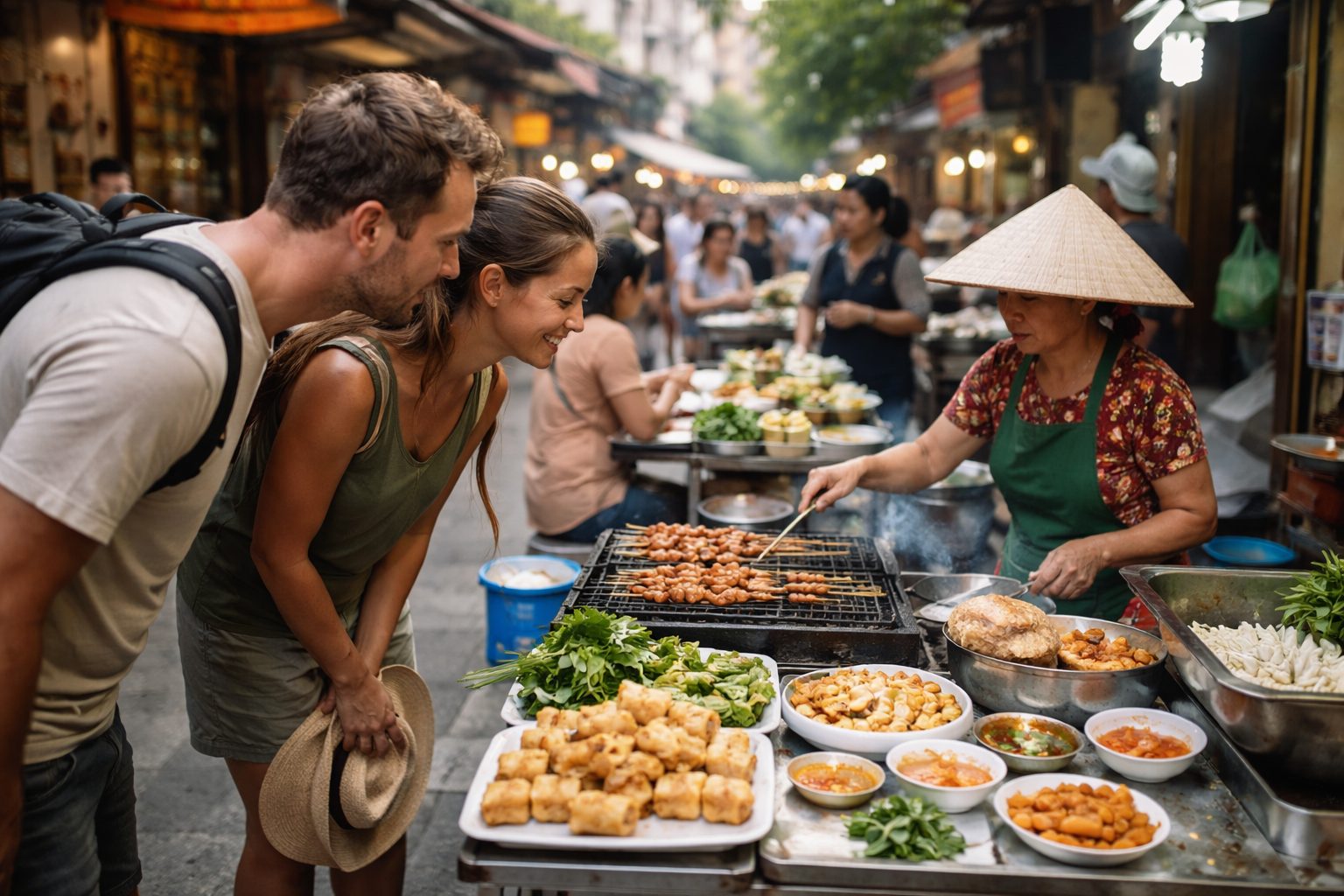
Street food in Vietnam is generally safe, but it helps to know what to look for:
- Go where the locals go. A long queue of Vietnamese people at 7 a.m. is a reliable quality indicator.
- Look for high turnover. Food that’s been sitting isn’t ideal anywhere, but especially in heat.
- Avoid ice unless you’re at an established restaurant or can verify it’s commercially produced.
- Drink bottled or boiled water. Don’t worry too much about this — it’s second nature to most visitors within a day.
- Watch how the vendor handles raw versus cooked food.
- Trust your instincts. If something seems off, move on — there’s always another option within thirty meters.
Upset stomachs in Vietnam are usually caused by adjustment to new bacteria rather than genuinely bad food. Eating smaller amounts at first and staying hydrated makes a real difference.
Vegetarian and Vegan Vietnamese Options
Vietnam’s food culture is more vegetarian-friendly than most people expect, partly because of Buddhist influence. Many Vietnamese people eat vegetarian on the 1st and 15th days of the lunar calendar. This means there’s a well-established tradition of plant-based cooking across the country.
Popular Vegetarian Dishes in Vietnam
- Pho chay: vegetarian pho made with a mushroom and vegetable broth — surprisingly good when done well
- Goi cuon chay: fresh spring rolls with tofu and extra herbs instead of meat
- Com chay: vegetarian rice plates with tofu, mushrooms, and stir-fried vegetables
- Bun rieu chay: vegetarian version of the tomato-based noodle soup
- Banh cuon chay: steamed rice rolls without meat filling
- Dau hu sot ca chua: tofu in tomato sauce, simple but very common and satisfying
Tofu in Vietnam is often freshly made and far better than what you find in most Western grocery stores. It holds its shape, has good flavor, and takes on sauces well.
How to Find Vegan-Friendly Restaurants
The easiest approach is to look for restaurants labeled “com chay” (vegetarian rice) or “quan chay” (vegetarian eatery). These are entirely plant-based establishments and usually inexpensive.
Apps like HappyCow are useful in cities like Hanoi, Ho Chi Minh City, and Da Nang, which all have growing vegan restaurant scenes. It’s worth noting that “vegetarian” in Vietnamese sometimes still includes fish sauce or shrimp paste, so if you’re strictly vegan, it’s worth asking directly.
Learning a few key phrases helps: “An chay” means eating vegetarian, and “khong an thit” means not eating meat.
Best Places to Eat Vietnamese Food
Must-Visit Restaurants in Ho Chi Minh City
Ho Chi Minh City’s food scene is enormous and moves fast. A few places consistently worth visiting:
- Pho Hoa Pasteur: a long-running institution on Pasteur Street, serving solid pho bo since 1960
- Banh Mi Huynh Hoa: regularly cited as one of the best banh mi in the city, loaded with fillings and always busy
- Quan Bui: a sit-down restaurant with an excellent selection of southern Vietnamese dishes in a comfortable setting
- Nha Hang Ngon: a garden restaurant with vendors cooking regional dishes from across the country — good for exploring variety in one place
- Di Mai: upscale Vietnamese cooking that respects tradition without being a museum piece
The Ben Thanh Market area is touristy but still has some good options if you know where to look. The surrounding streets are more interesting for eating than the market itself.
Best Eateries in Hanoi
Hanoi rewards walking and following your nose more than any other Vietnamese city I’ve been to. A few specific places:
- Pho Thin Bo Ho Tay: a barebones shop on Lo Duc Street known for its distinct style of pho — stir-fried beef, richer broth
- Bun Cha Huong Lien: the shop where Obama and Bourdain ate, still serving excellent bun cha at very local prices
- Cha Ca Thang Long: one of the best places to try cha ca La Vong, the turmeric-dill fish dish unique to Hanoi
- Banh Cuon Gia Truyen Thanh Van: famous for banh cuon, steamed rice rolls with minced pork and mushroom filling
- Quan An Ngon: similar concept to Nha Hang Ngon in Saigon — regional dishes from a wide menu in one place
The Old Quarter and Hoan Kiem Lake area have plenty of places, but I’d also suggest exploring Tay Ho (West Lake) district for a more local feel.
Hidden Gems in Da Nang
Da Nang sits between Hoi An and Hue, which means it benefits from the culinary influence of both. It’s often overlooked as a food destination but shouldn’t be.
- My Quang 1A: a simple, reliable spot for Mi Quang, the region’s signature turmeric noodle dish
- Banh Trang Cuon Thit Heo: rice paper rolls with boiled pork and vegetables, a Da Nang specialty that doesn’t get the attention it deserves
- Be Man: excellent banh xeo and other central Vietnamese favorites
- Con Market (Cho Con): the city’s main market, good for breakfast eating and for picking up fresh produce and local snacks
- Madame Lan: a well-regarded restaurant serving central Vietnamese food in a more polished setting
Da Nang is also the easiest base for day trips to Hoi An, which means you can eat cao lau for lunch and be back on the beach by evening.
Cooking Vietnamese Food at Home
Essential Ingredients for Vietnamese Cooking
Getting the right pantry together makes a significant difference. The essentials:
- Fish sauce: the cornerstone of Vietnamese savory cooking. Look for brands like Red Boat or Phu Quoc for a cleaner flavor.
- Rice noodles: in various widths for different dishes
- Rice paper wrappers: for fresh spring rolls
- Shrimp paste (mam tom or mam ruoc): pungent, powerful, essential for central Vietnamese dishes
- Hoisin sauce and oyster sauce: used in marinades and dipping sauces
- Star anise, cinnamon, cloves, and cardamom: for pho broth
- Dried shrimp: used as a seasoning in many dishes
- Rice vinegar and lime juice: for brightness and balance
Fresh ingredients that make the biggest difference:
- Lemongrass, galangal, and ginger
- Thai basil, Vietnamese mint, and perilla
- Bird’s eye chili
- Banana blossoms (for certain salads and soups)
Most of these are available at Asian grocery stores, and increasingly at regular supermarkets in larger cities.
Popular Vietnamese Recipes to Try at Home
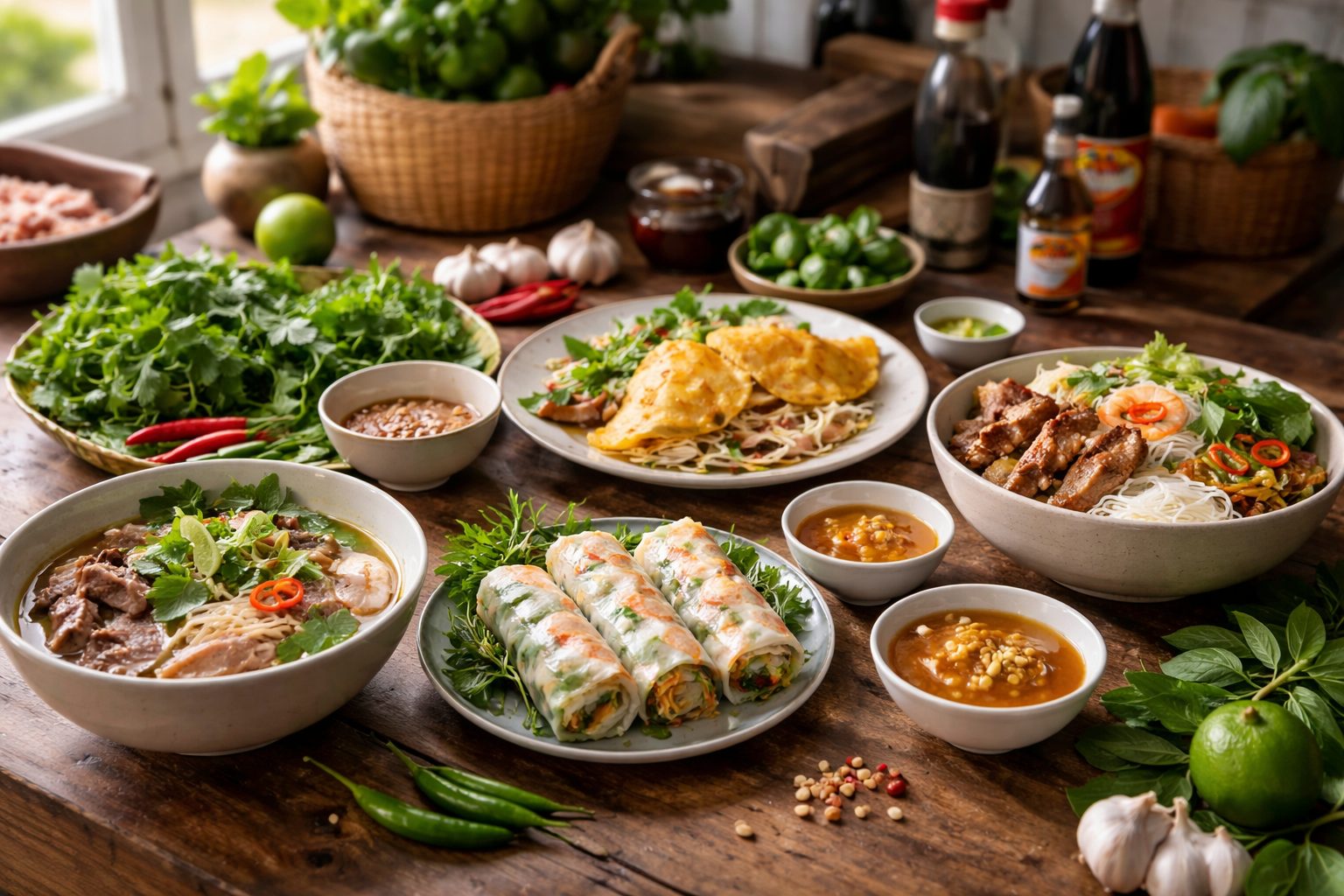
For people new to cooking Vietnamese food at home, I’d suggest starting with:
- Fresh spring rolls (goi cuon): forgiving, no cooking involved except for the shrimp, and the technique is easy to learn
- Pho broth: takes time but isn’t technically difficult — roast the bones, simmer slowly, season carefully
- Bun cha: requires a grill or a grill pan, but the marinade is simple and the dish comes together quickly
- Banh xeo: the crepe technique takes a few tries to get right, but once you have it, it’s satisfying to make
- Vietnamese caramel ginger fish (ca kho to): one of the great weeknight dishes — easy, deeply flavored, excellent with plain rice
Start with one dish at a time rather than trying to cook an entire Vietnamese meal from scratch on the first attempt.
Cooking Tips from Vietnamese Chefs
A few things professional Vietnamese cooks consistently emphasize:
- Don’t rush the broth. Pho and bun bo Hue need long, slow cooking to develop properly.
- Taste constantly. Vietnamese cooking relies on balance, and that balance shifts depending on the exact fish sauce, the sweetness of the sugar, the acidity of your lime. Adjust as you go.
- Use fresh herbs generously. They’re not a garnish — they’re part of the dish.
- Char your aromatics. Before adding ginger and onion to a pho broth, char them directly over a flame or under a broiler. This step makes a real difference.
- Don’t over-sauce. Vietnamese food tends toward restraint in sauce application. Better to serve sauces on the side and let people adjust.
Health Benefits of Vietnamese Food
Nutritional Aspects of Common Dishes
Vietnamese food has a reputation as one of the healthier Southeast Asian cuisines, and there’s real substance to that claim. The cooking style tends to use less fat than Chinese or Thai cooking. Steaming, poaching, and quick stir-frying are common methods. Fried dishes exist but aren’t the default.
A bowl of pho, despite taking hours to make, is relatively light — mostly broth, noodles, and lean protein. Fresh spring rolls are low in calories and high in vegetables and herbs. Even banh mi, which contains pâté and mayo, is smaller and more balanced than most Western sandwiches.
The heavy use of fresh vegetables, herbs, and lean proteins gives the diet a naturally balanced macronutrient profile. Fiber intake from vegetables, rice, and legumes is typically high.
The Role of Herbs and Spices in Vietnamese Cuisine
Herbs in Vietnamese cuisine serve a functional, not merely aesthetic, role. Many have genuine medicinal properties that traditional Vietnamese medicine recognized long before modern nutritional science caught up.
Some notable examples:
- Vietnamese coriander (rau ram): traditionally used to reduce inflammation and aid digestion
- Perilla (tia to): high in antioxidants, anti-inflammatory
- Lemongrass: antimicrobial properties, used both fresh and as a tea
- Ginger: widely documented benefits for digestion and nausea
- Star anise: contains shikimic acid, which has antiviral properties and is used in flu medication
- Turmeric (curcumin): extensively studied for anti-inflammatory effects
The cumulative effect of eating these herbs regularly — as Vietnamese people do, in large quantities with most meals — likely contributes to the generally good health outcomes in populations that follow a traditional Vietnamese diet.
The Influence of Vietnamese Food Globally
Vietnamese Food Trends Around the World
The global profile of Vietnamese food has expanded enormously in the last two decades. Pho restaurants exist in most major cities worldwide. Banh mi shops have proliferated in North America, Europe, and Australia. Vietnamese coffee — strong, dark, often served over ice with condensed milk — has developed a significant following outside Vietnam.
This expansion has been driven partly by Vietnamese diaspora communities establishing restaurants in their adopted cities, and partly by growing mainstream interest in Southeast Asian cuisines. The best vietnam food that’s now available globally has pushed chefs and restaurateurs to look at lesser-known dishes beyond pho and banh mi.
Dishes like bun bo Hue, cao lau, and Mi Quang are appearing on menus outside Vietnam with increasing frequency. This is a good development — it means more people are encountering the actual range of Vietnamese cuisine rather than its most exported version.
Fusion Dishes Inspired by Vietnamese Cuisine
Vietnamese culinary techniques and flavor profiles have influenced fusion cooking in interesting ways. Some examples that have worked well:
- Pho-spiced ramen collaborations that bring Vietnamese aromatics into Japanese broth traditions
- Banh mi-influenced sandwiches using baguette construction but non-Vietnamese fillings and pickles
- Vietnamese-French bistros, particularly in cities with large Vietnamese diaspora populations, that blend classical French technique with Vietnamese ingredients
- Viet-Cajun crawfish: a genuinely Louisiana invention that emerged from Vietnamese immigrant communities in New Orleans, now a major part of local food culture
The fusion that works best tends to draw on specific Vietnamese techniques — the broth-making, the herb use, the balance principles — rather than just using “Vietnamese flavors” as a vague aesthetic direction. When cooks understand what makes best vietnam food distinctive at a structural level, the resulting fusions are usually more interesting.
FAQs about Vietnamese Food
What are the staple ingredients in Vietnamese cuisine?
Fish sauce, rice, and fresh herbs are the three pillars. Beyond those, rice noodles in various forms, pork, chicken, seafood, tofu, lemongrass, ginger, and a wide range of fresh vegetables appear across most regional traditions. Fish sauce functions as salt and umami simultaneously and is used in nearly every savory dish.
How spicy is Vietnamese food?
It varies significantly by region. Northern Vietnamese food is generally mild. Central Vietnamese food, particularly from Hue, can be quite spicy. Southern food sits somewhere in between. Chili is almost always served on the side, so you control the heat level yourself in most cases.
What are the best drinks to pair with Vietnamese dishes?
Bia hoi (fresh draught beer) is the classic pairing for street food. Vietnamese iced coffee with condensed milk (ca phe sua da) works well with banh mi and lighter dishes. For richer soups and grilled dishes, plain jasmine tea or a cold Saigon or Hanoi beer is usually right. Fresh sugarcane juice (nuoc mia) is excellent with fried or grilled food.
Can you find authentic Vietnamese food outside Vietnam?
Yes, with some effort. Cities with large Vietnamese diaspora communities — Houston, San Jose, Paris, Melbourne, London — tend to have very good Vietnamese restaurants. The key is to look for places where Vietnamese people are actually eating, not places designed primarily for non-Vietnamese customers. The menu should include regional dishes, not just pho and spring rolls.
How has Vietnamese cuisine evolved over the years?
The base culinary traditions are quite stable, but Vietnamese food has always absorbed and adapted external influences — from Chinese cooking in the north, French cuisine during the colonial period, and more recently global food culture. Younger Vietnamese chefs are experimenting with modern presentations while keeping traditional flavors intact. A new generation of Vietnamese-American and Vietnamese-Australian chefs is also bringing the cuisine to new audiences in ways that honor its origins without fossilizing it.