There’s something about train travel that flying simply can’t replicate. The way the landscape unfolds at a pace you can actually absorb, the gentle rhythm of the tracks, the freedom to walk around, have a proper meal, and watch the world change through a wide window. I’ve taken a fair number of trains across different continents, and I can say without hesitation that the best scenic train rides are among the most memorable travel experiences you can have. This guide covers the top routes worldwide, what makes each one worth taking, and the practical knowledge you need to plan your own journey.
Introduction to Scenic Train Rides
Scenic train travel has been a fixture of serious travel culture for over a century. The earliest luxury rail journeys were the domain of European aristocrats and wealthy explorers, but that’s changed considerably. Today, scenic rail routes exist on every inhabited continent, and many of them are surprisingly accessible, both in terms of booking and price.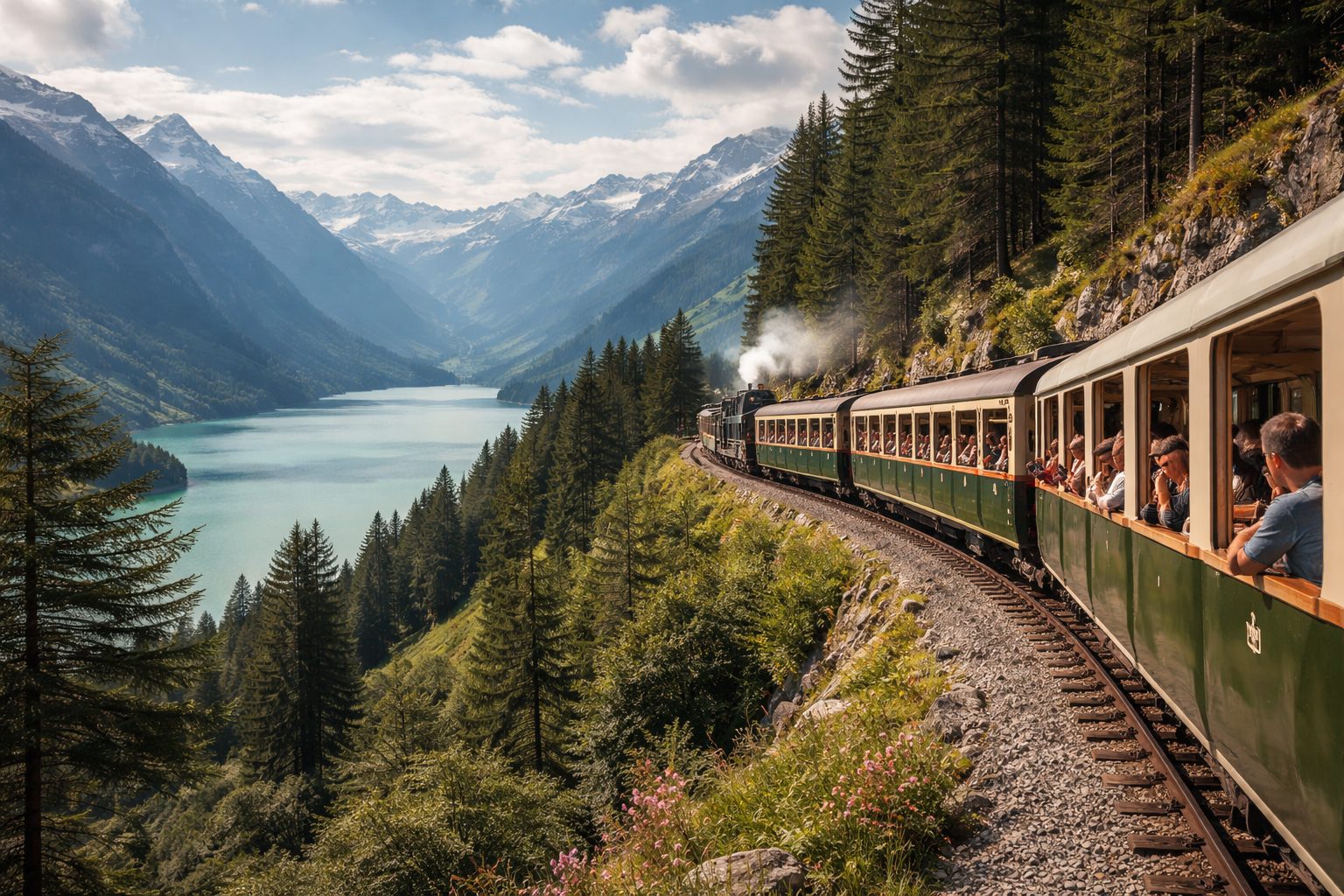
What separates a scenic train ride from an ordinary rail commute is intentionality. These routes are designed around the landscape. Engineers routed them through mountain passes, along coastlines, and across wilderness specifically because the views were extraordinary. In some cases, the engineering itself is part of the spectacle.
I think of scenic trains as slow travel done right. You’re not rushing to a destination. The journey is the experience.
Why Choose Scenic Train Rides?
The honest answer is that nothing else comes close for combining comfort with immersive landscape travel. Here’s why scenic rail consistently outperforms other modes of transport for travelers who actually want to see a place.
Proximity to the landscape. You’re at ground level, sometimes within meters of a cliff edge, a glacier, or a river gorge. No altitude, no porthole windows, no distant aerial view.
Freedom of movement. You can stand up, walk to the observation car, grab a coffee, and come back. That’s not possible on a plane, and it matters on a six-hour journey.
Sustainable travel. Train travel produces significantly less carbon per passenger kilometer than flying. For travelers who are thinking about environmental impact, rail is the better choice.
Cultural immersion. Trains stop in small towns that flights skip entirely. You see how people actually live along the route.
The social experience. Shared dining cars and observation decks create conversations with other travelers that you’d never have in a plane seat. Some of my best travel conversations happened over dinner on a moving train.
And there’s a practical point worth making: scenic train rides are often less stressful than airports. No lengthy security lines, no weight restrictions on luggage, no need to arrive two hours early.
Top 10 Best Scenic Train Rides Around the World
1. Glacier Express, Switzerland
The Glacier Express runs between Zermatt and St. Moritz, covering 291 kilometers through the heart of the Swiss Alps. It crosses 291 bridges, passes through 91 tunnels, and climbs to the Oberalp Pass at 2,033 meters above sea level. The journey takes around eight hours, and that’s considered a feature, not a flaw.
The panoramic carriages have windows that extend into the roof, which makes a real difference when you’re passing through narrow gorges or looking up at snowfields. I’d recommend booking a window seat on the south side for the best light in the afternoon.
The dining car serves proper Swiss meals, not just snacks. Multi-course lunches while the Rhone valley rolls past outside is a combination that’s hard to beat.
Key facts:
* Route: Zermatt to St. Moritz (or reverse)
* Duration: Approximately 8 hours
* Best season: Year-round, though summer offers greenery and winter offers snow
2. Rocky Mountaineer, Canada
The Rocky Mountaineer operates through British Columbia and Alberta, offering several routes through the Canadian Rockies. The most popular runs between Vancouver and Banff or Jasper. Unlike most long-distance trains, it only operates during daylight hours, which means you don’t miss a single kilometer of scenery by sleeping through it.
The GoldLeaf service puts you in a two-level glass-domed coach with outdoor viewing platforms. It’s genuinely stunning. The SilverLeaf service is more affordable and still excellent.
This is a two-day journey. You overnight in Kamloops and continue the next morning. The first day through the Fraser Canyon is dramatic in its own right, but the second day through the Rockies is the one most people come for.
Notable stops and scenery:
* Fraser Canyon and Hell’s Gate
* Thompson River confluence
* Spiral Tunnels near Field
* Mount Robson, the highest peak in the Canadian Rockies
3. The Blue Train, South Africa
The Blue Train connects Pretoria and Cape Town, covering about 1,600 kilometers across the South African interior. It’s been running in various forms since 1939 and has built a reputation as one of the most luxurious train experiences in the world. The standard of service and interior design is genuinely high.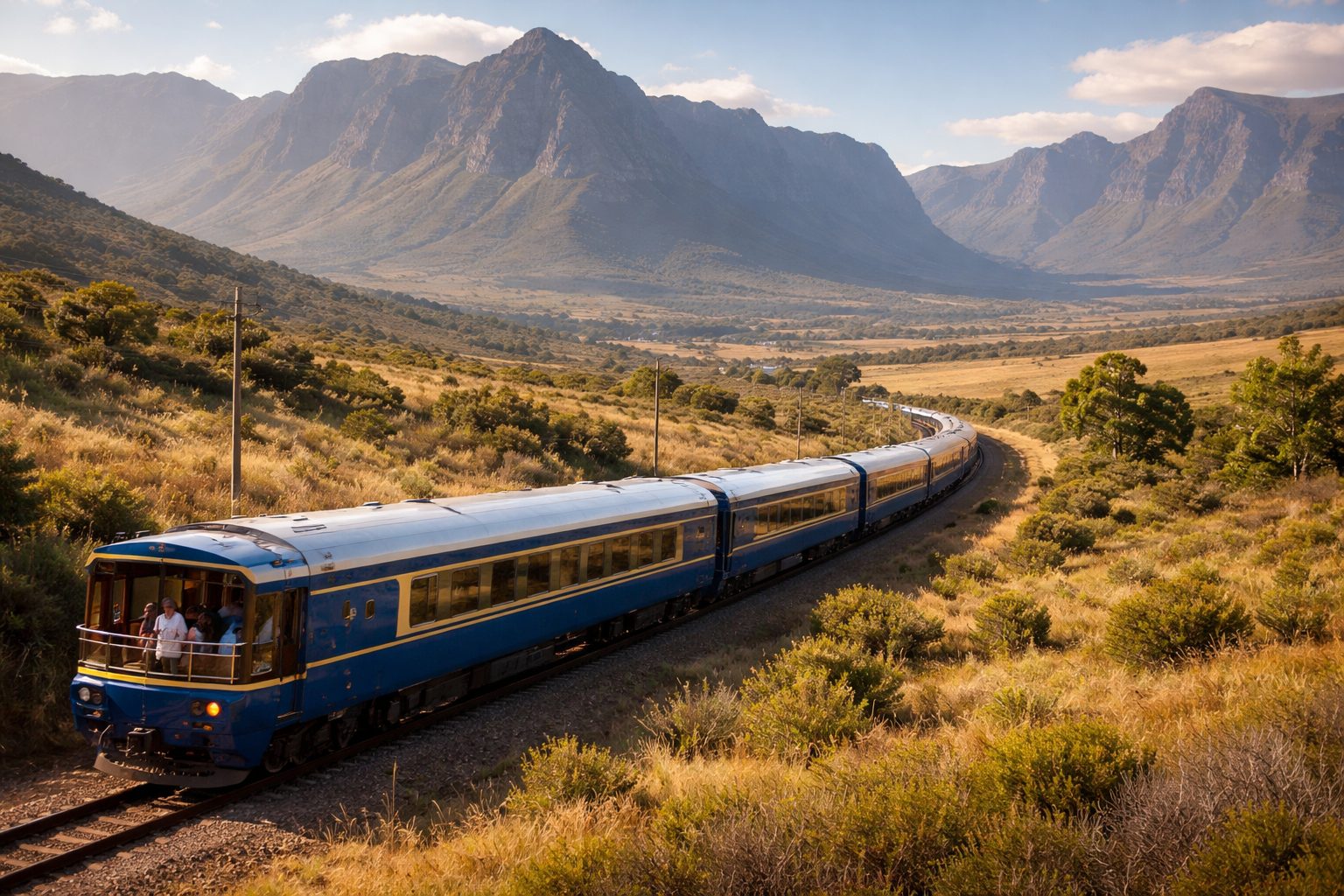
Suites have private bathrooms, double beds, and butler service. The lounge cars and dining car are well-appointed. The food is a serious focus, with South African wines featured prominently.
The landscape shifts considerably over the 27-hour journey: highveld plateau, the Hex River Mountains, then wine country as you approach Cape Town. It’s not wilderness the whole time, but the variety is part of the experience.
One thing to know: this train runs infrequently, so advance booking is essential.
4. The Ghan, Australia
The Ghan runs the length of Australia north to south, from Darwin to Adelaide, covering 2,979 kilometers of some of the most remote landscape on earth. The full journey takes around 54 hours. You pass through the Red Centre, the MacDonnell Ranges near Alice Springs, and the vast flatlands of South Australia.
This is desert travel at its purest. The color of the land changes with the time of day, from pale ochre in the morning to deep red in the late afternoon. The vegetation shifts from tropical at the Darwin end to sparse scrub through the middle to more temperate terrain near Adelaide.
Off-train excursions at Alice Springs and Katherine are included in the premium fares. Katherine Gorge is worth the visit on its own.
It’s worth noting that The Ghan and the Indian Pacific (which runs east-west across Australia) are both operated by Journey Beyond Rail Expeditions, and the two combined make for an extraordinary transcontinental experience.
5. Orient Express, Europe
The Orient Express has multiple incarnations today, but the Venice Simplon-Orient-Express is the classic one. It runs between London and Venice, though various extensions and special itineraries take it further. The carriages date from the 1920s and 1930s and have been restored to a standard that’s both historically faithful and genuinely comfortable.
Art Deco marquetry panels, brass fittings, white-tablecloth dining cars, and mahogany-paneled sleeper cabins. The aesthetic is deliberate and consistent. This is a train designed to make you feel like you’ve stepped back in time.
The route itself passes through Paris, the Alps, and northern Italy. The scenery is strong, particularly through the Swiss and Austrian Alps. But the Orient Express is as much about the train itself as the landscape outside.
Budget note: this is the most expensive option on this list by a significant margin. It’s an indulgence rather than an economical travel choice.
6. Bernina Express, Switzerland
The Bernina Express is often overshadowed by the Glacier Express, but I’d argue it’s the more spectacular of the two. The route runs from Chur to Lugano, crossing the Bernina Pass at 2,253 meters, the highest railway crossing in the Alps. The line is a UNESCO World Heritage Site.
The engineering is extraordinary. The Brusio spiral viaduct, where the train loops around itself to descend a steep grade, is one of the most photographed stretches of railway in the world. The Landwasser Viaduct on the Glacier Express route gets more attention, but the Brusio spiral is more technically impressive.
The contrast between the snowy alpine pass and the palm trees in Lugano, just a few hours later, is genuinely striking. You descend from glaciers into the Italian lakes region in a single journey.
- Total distance: 144 km
- Duration: About 4 hours
- Best months: June to September for clear alpine views
7. Amtrak’s Coast Starlight, USA
The Coast Starlight runs from Los Angeles to Seattle, roughly following the Pacific coast through California, Oregon, and Washington. The full journey takes around 35 hours, and the scenery covers an impressive range: Southern California desert and coast, the Cascades, Pacific cliffs, agricultural valleys, and the approach into Seattle through Puget Sound.
The stretch through coastal California between San Luis Obispo and the Bay Area is the visual highlight. You’re often running right along the ocean, sometimes just above the waterline, for extended stretches.
Amtrak’s Superliner trains have a Sightseeer Lounge car with large windows and upper-level seating that’s worth positioning yourself in during the key scenic sections. The dining car is functional rather than luxurious, but it works.
This is also one of the best value scenic rail journeys on this list. A coach seat is very affordable, and a sleeper berth, while pricier, is still reasonable compared to equivalent European or Australian experiences.
8. The Jacobite, Scotland
The Jacobite runs between Fort William and Mallaig on the West Highland Line in Scotland. It’s a short journey, just 84 kilometers, but it covers terrain that’s dramatic by any standard. Lochs, moorlands, and the hills of the western Highlands make this one of the most photographed rail routes in Britain.
It’s also the train that crosses the Glenfinnan Viaduct, which many people recognize from the Harry Potter films. That’s brought a new audience to what was already a beloved scenic route, and it’s worth pointing out that the viaduct is genuinely impressive even without the film connection.
The Jacobite is a steam-hauled service, which adds considerably to the experience. The sound, the smoke, the slight smell of coal, and the way the train handles gradients all feel different from a diesel or electric service.
This is a summer-only service, running from mid-May to October. Book early, because it sells out.
9. TranzAlpine, New Zealand
The TranzAlpine crosses New Zealand’s South Island from Christchurch to Greymouth, traversing the Southern Alps through Arthur’s Pass. The journey takes around four and a half hours and is considered one of the great rail journeys of the Pacific region.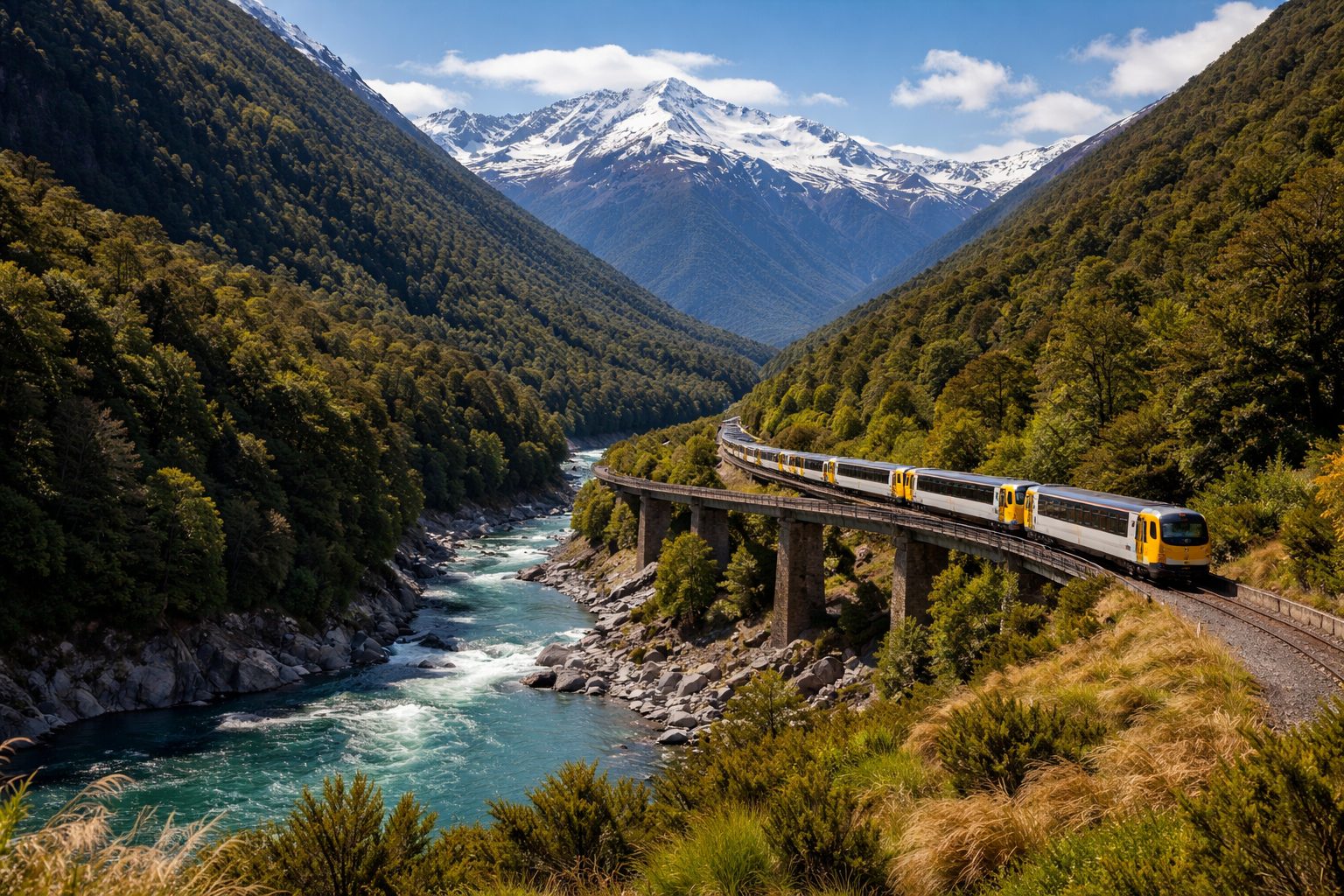
The landscape transitions from the Canterbury Plains to the beech-forested foothills to the open alpine zone near Arthur’s Pass, then descends through the rainforest of the West Coast. The contrast between the dry eastern side of the Alps and the lush, wet western side is a good illustration of how mountain ranges shape climate.
There’s an open-air viewing carriage at the back of the train, which is the best place to be in good weather. New Zealand weather is unpredictable, so the enclosed panoramic carriages are also well-positioned.
The TranzAlpine operates year-round, and the winter journey through snow-covered mountains is particularly striking.
10. Fjords Express, Norway
Norway’s scenic rail network includes several exceptional routes, but the combination of the Bergen Railway and the Flam Railway, sometimes marketed together as the Norway in a Nutshell itinerary, is the one most travelers associate with Norwegian scenic rail. The Flam Railway specifically, known as Flamsbana, descends from Myrdal at 866 meters to the fjordside village of Flam in just 20 kilometers, and the gradient makes it one of the steepest standard-gauge railways in the world.
The scenery is classic fjord country. Waterfalls, deep valleys, snowcapped peaks reflected in still water. The train slows or stops at the Kjosfossen waterfall, where you can get off briefly to photograph the cascade. In summer, it’s theatrical. In winter, parts of the line are frozen and the light is extraordinary.
The Bergen Railway, which connects Oslo and Bergen and crosses the Hardangervidda plateau, is a full day’s journey and worth taking on its own merits. The plateau section in winter is bleak and spectacular in equal measure.
Comparing Scenic Train Rides: Highlights and Unique Features
| Train | Country | Duration | Landscape Type | Best For |
|---|---|---|---|---|
| Glacier Express | Switzerland | ~8 hours | Alpine mountains | First-time alpine rail travelers |
| Rocky Mountaineer | Canada | 2 days | Rocky Mountains | Luxury wilderness experience |
| The Blue Train | South Africa | ~27 hours | Highveld and cape | Luxury travel, wine country |
| The Ghan | Australia | ~54 hours | Desert and outback | Long-distance adventure |
| Orient Express | Europe | ~32 hours | Alpine and Italian | Historic luxury experience |
| Bernina Express | Switzerland | ~4 hours | High alpine pass | Engineering and views combined |
| Coast Starlight | USA | ~35 hours | Coastal California | Budget-friendly long-distance |
| The Jacobite | Scotland | ~2 hours | Highland moorland | Steam heritage and film tourism |
| TranzAlpine | New Zealand | ~4.5 hours | Southern Alps | Compact alpine crossing |
| Fjords Express | Norway | Variable | Fjords and plateau | Dramatic Scandinavian scenery |
A few things stand out when you look at these routes side by side. The Swiss options are shorter but extremely concentrated in terms of visual payoff. The Australian and North American routes are about the sheer scale of landscape over time. The European luxury options like the Orient Express are as much about the train experience as the scenery. And the smaller journeys, like the Jacobite and the Flamsbana, deliver remarkable intensity in a short window.
Tips for Booking the Best Scenic Train Rides
Choosing the Right Season
Season makes an enormous difference to what you’ll actually see. Here’s a rough framework:
- Switzerland (Glacier Express, Bernina Express): June to September for full alpine bloom and clear passes. December to February for snow, though some passes run year-round.
- Rocky Mountaineer: May to October only. July and August are peak season for wildflower meadows. September offers fall colors.
- The Ghan: April to October. The Australian summer (November to March) makes central Australia extremely hot, and flooding can affect the line.
- The Jacobite: Mid-May to October. Peak season is July and August.
- Norwegian fjords: June to August for long days and green valleys. January to March for potential Northern Lights on the Bergen Railway.
- TranzAlpine: Year-round. Winter snow is beautiful. Spring and autumn have cleaner air and fewer crowds.
Understanding Seating Options
Most scenic trains offer tiered seating classes that significantly affect the experience.
On the Rocky Mountaineer, GoldLeaf includes a glass-domed upper deck and outdoor platform. SilverLeaf is enclosed but still has large panoramic windows. The price difference is substantial, but the experience difference is also real.
On the Glacier Express, the panoramic carriages are standard across most fare types, though Excellence Class adds table service and a premium meal package. For most travelers, standard panoramic is sufficient.
On the Orient Express and Blue Train, there aren’t really budget options. You’re booking a suite, and the price reflects that.
On Amtrak’s Coast Starlight, the Sightseeer Lounge is open to all passengers regardless of class. A coach seat is fine for the journey, though a sleeper is significantly more comfortable for 35 hours.
My recommendation: prioritize seating on trains where it makes the most difference, which is generally the day journeys with the most condensed scenery, like the Rocky Mountaineer or the Bernina Express.
Dining Experiences on Board
Dining quality varies considerably across these routes.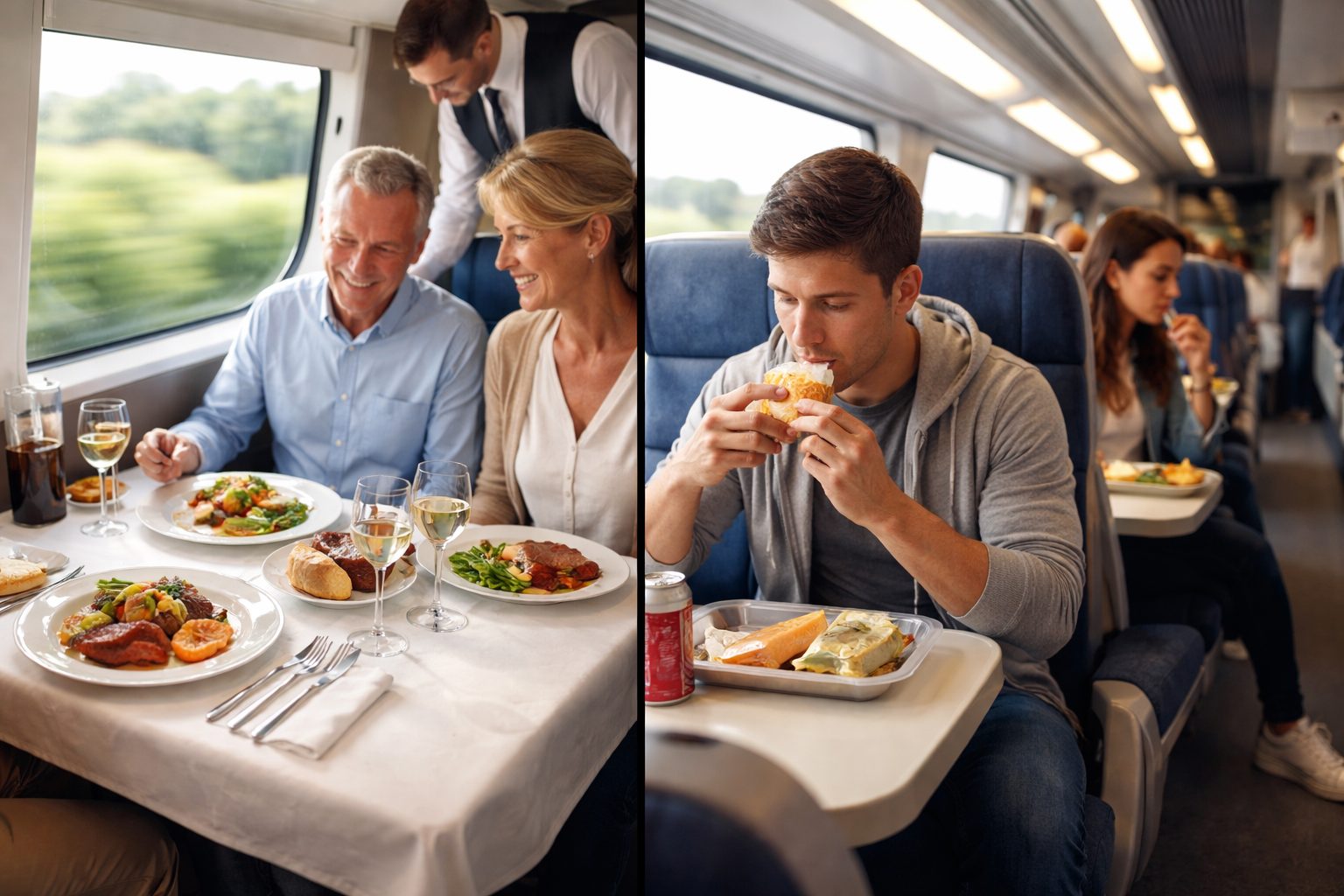
The Blue Train and Orient Express treat the dining car as a central feature. Multi-course meals, formal dress for dinner, wine lists with regional selections. These trains take food seriously.
The Rocky Mountaineer includes meals and wine in both GoldLeaf and SilverLeaf service. The food is good, regionally sourced, and served at your seat as you travel.
The Glacier Express Excellence Class includes a six-course meal. Standard class has a bistro car with lighter options.
Amtrak’s dining car is functional. The food is serviceable but not remarkable. If you’re on a budget, bringing your own food and using the cafe car for drinks is a reasonable strategy.
The Jacobite is a shorter journey and doesn’t offer full dining. There’s a basic buffet service.
For any journey over four hours, I’d strongly recommend checking what’s included in your fare and whether you want to upgrade.
Preparing for Your Scenic Train Journey
What to Pack
Packing for a scenic train journey is different from packing for a flight or a hiking trip. Here’s what actually matters.
- Layers. Train carriages can be cold or warm depending on the season, the heating system, and your proximity to windows. Dress in layers you can adjust.
- Good headphones. Not for blocking out scenery, but for the overnight or long sections where ambient noise (other passengers, the tracks) makes sleep harder.
- A quality camera or phone with a good lens. Windows can cause glare and reflections. A lens hood or polarizing filter helps on trains without anti-reflective glass.
- Download entertainment in advance. Some routes, especially in remote areas of Australia or Canada, have no cell service for extended stretches.
- A compact bag for your seat area. Your main luggage goes in storage. Keep what you need for the journey in a small bag you can access easily.
- Snacks. Even on trains with dining cars, there are waiting times and limited options. Having your own snacks matters on a 30-hour journey.
- A travel pillow and eye mask for overnight segments. These are not optional for sleeping well on a moving train.
For the Ghan or any multi-day journey, think about what you’ll need in your cabin overnight as opposed to what can go in checked luggage.
Safety Considerations
Scenic trains are generally very safe. Rail accidents are rare compared to road transport, and the routes covered in this guide have strong safety records.
A few practical points:
- Follow instructions for platform stops. When the train stops and you’re allowed off, be clear on departure times. Missing your train in a remote location is a real inconvenience.
- Motion sickness. Some people find train travel nauseating, particularly on routes with many curves, like the Bernina Express. If you’re prone to motion sickness, sit facing the direction of travel and focus on the horizon rather than objects close to the track.
- Altitude. The Bernina and Glacier Express routes reach over 2,000 meters. Most people have no problems at this altitude, but if you’re sensitive to altitude changes, be aware.
- Weather delays. Extreme weather can affect schedules, particularly on alpine routes in winter or on the Ghan in the wet season. Build flexibility into your plans around these journeys.
- Secure your valuables. On longer journeys through busy tourist routes, keep your passport, camera, and phone in a bag that’s with you at all times.
Frequently Asked Questions (FAQs)
What are the best scenic train rides in Europe?
Europe has an exceptional concentration of scenic rail routes. The Glacier Express and Bernina Express in Switzerland are the most celebrated, but the Bergen Railway in Norway, the Raetian Railway network in Switzerland, and the Cinque Terre coastal services in Italy are all worth considering. The Orient Express is in a separate category as a luxury heritage experience rather than a standard scenic service.
How much does a scenic train ride cost?
Costs vary enormously. The TranzAlpine in New Zealand and Amtrak’s Coast Starlight in the USA are relatively affordable, with basic seats from $50 to $150. The Rocky Mountaineer’s GoldLeaf service runs from around $1,500 to $2,500 per person for a two-day journey. The Orient Express and Blue Train are premium luxury products, with prices starting from $2,000 and going well above $5,000 per person depending on the route and suite.
Are scenic train rides kid-friendly?
Most of them are. The Glacier Express, TranzAlpine, and Coast Starlight are all genuinely suitable for families with children. The Jacobite is particularly popular with kids due to the Harry Potter connection and the steam locomotive. Luxury trains like the Orient Express and Blue Train are technically open to children but are better suited to adults given the formal environment and the price point.
Can I book scenic train rides online?
Yes, most scenic trains can be booked directly through their official websites or through rail booking platforms. The Rocky Mountaineer, Glacier Express, and TranzAlpine all have straightforward online booking systems. The Orient Express and Blue Train require either direct booking through their websites or through a travel agent, and availability is limited, so booking months in advance is standard practice.
What is the best time of year for scenic train rides?
It depends on the route. For the Swiss alpine trains, June through September offers the best combination of clear weather and full alpine scenery. For the Rocky Mountaineer, September is excellent for fall colors with fewer crowds than peak summer. For Norwegian routes, the summer months of June to August give the longest days and greenest fjords. For Australian and African trains, the cooler months of April to October are preferable for comfort and reliability.
There’s no universally best time, but shoulder seasons, spring and autumn in the Northern Hemisphere, often offer better value, quieter trains, and distinctive light conditions that can make the photography more interesting than the peak summer crowds.
If you’ve never taken a long-distance scenic train journey, I’d suggest starting with something manageable, like the Bernina Express or the TranzAlpine, to get a feel for the format before committing to a multi-day expedition. The principles carry across all of them: slow down, look out the window, and let the landscape come to you. That’s what the best scenic train rides are ultimately about.