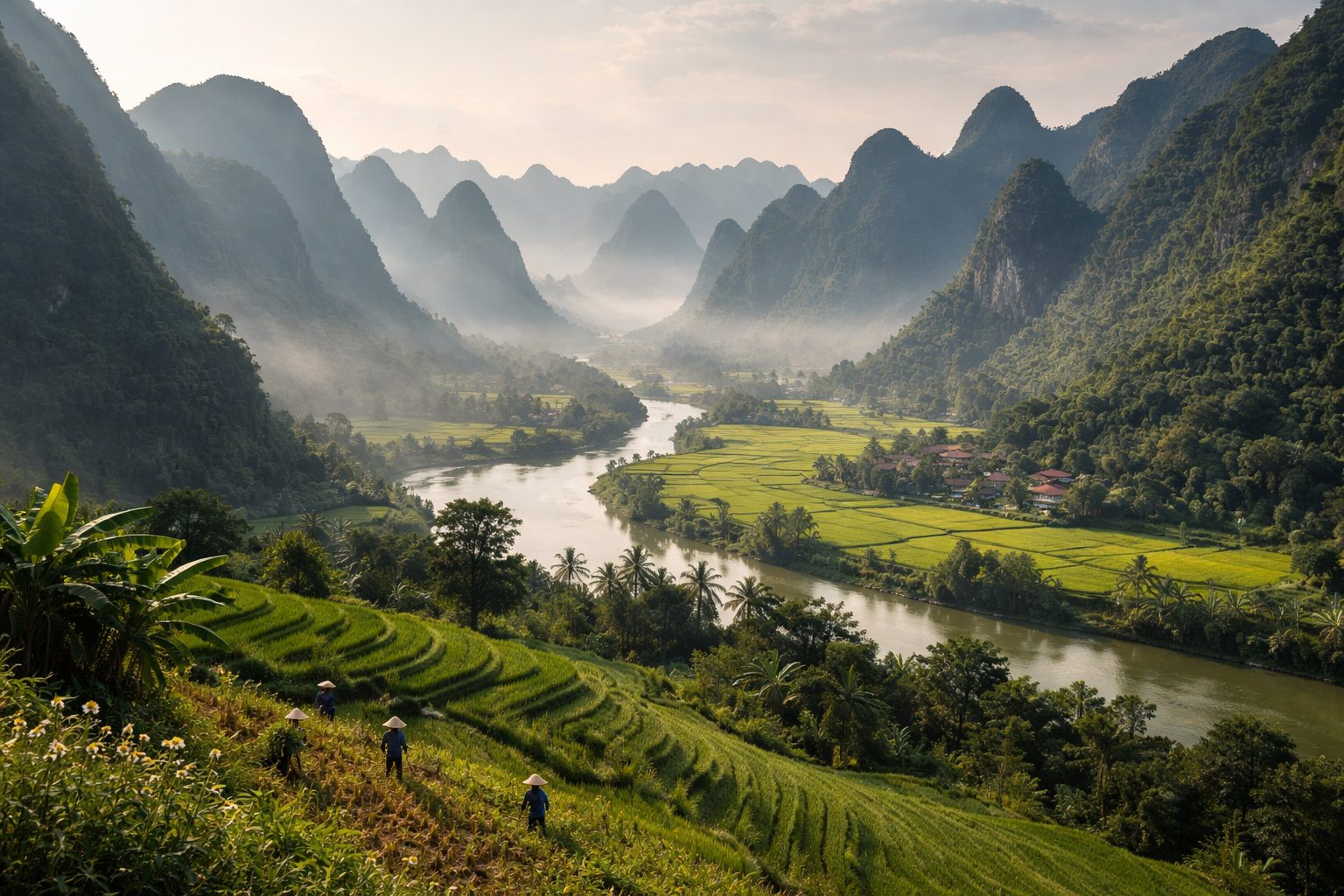
Vietnam doesn’t reveal itself all at once. It unfolds slowly, from the karst towers rising out of emerald water in the north to the sprawling river delta in the south. I’ve spent time across this country, and what strikes me most isn’t any single landscape but the sheer variety packed into one long, narrow strip of land. The natural wonders of vietnam are genuinely diverse in a way that few countries can match. You get coastal drama, mountain stillness, cave systems so vast they have their own weather, and wetland ecosystems teeming with life. If you’re planning a trip here, or just trying to understand what makes this country so compelling to naturalists and travelers alike, this guide covers the full picture.
Introduction to the Natural Wonders of Vietnam
Overview of Vietnam’s Geography
Vietnam stretches roughly 1,650 kilometers from north to south, and that length creates enormous climate and terrain variation. The north is mountainous, shaped by ancient tectonic activity and carved by rivers. The central region holds dense jungle, coastal plains, and a chain of limestone mountains. The south flattens out into delta land and coastline.
The country borders China, Laos, and Cambodia by land, and the South China Sea to the east. That eastern coastline is long and varied, mixing sandy beaches, rocky headlands, and sheltered bays. The geography here isn’t static scenery. It’s an active system that shapes the climate, the biodiversity, and the culture of every region.
The Truong Son mountain range runs through much of the western interior, forming a natural spine. Rivers flow from it in both directions, feeding both the Vietnamese lowlands and neighboring countries. This range is one reason Vietnam holds so much biodiversity. It acted as a refuge for species during past climate shifts.
Importance of Natural Wonders in Tourism
Tourism in Vietnam has grown sharply over the past two decades, and natural attractions are central to that growth. Ha Long Bay alone draws over four million visitors in a strong year. The cave systems of Phong Nha attract growing numbers of adventure travelers. Sapa has become one of Southeast Asia’s most recognized trekking destinations.
But beyond the headline numbers, natural tourism creates livelihoods for communities that have few other economic options. A guide in Phong Nha, a boat operator in the Mekong Delta, a homestay host in Sapa. These aren’t incidental. They’re the human infrastructure built around the natural wonders of vietnam.
There’s also a conservation argument. When a landscape generates income, there’s a stronger case for protecting it. Vietnam has expanded its national park network significantly, partly because international interest has made protection economically rational.
Major Natural Wonders of Vietnam
Ha Long Bay: A UNESCO World Heritage Site
Ha Long Bay is probably Vietnam’s most photographed landscape. Around 1,600 limestone islands and islets rise from the Gulf of Tonkin, most of them uninhabited, many of them hollow with caves. The water between them changes color depending on the season and the light, ranging from grey-green in winter to a brilliant jade in summer.
UNESCO recognized it as a World Heritage Site in 1994, and again in 2000 for its geological values. The formations are karst, shaped over hundreds of millions of years by the dissolution of soluble rock. What you’re looking at when you sail through is a drowned landscape, limestone towers that were once part of a continuous plateau, now separated by rising sea levels.
The best way to experience it is on an overnight boat. Day trips exist, but they don’t give you the early morning calm before the tour boats arrive. Some of the caves worth entering include Thien Canh Son and Sung Sot, both large and well lit. Kayaking into the hidden lagoons is genuinely rewarding, particularly at Vung Vieng or around Cat Ba Island.
What I’d avoid: the most crowded sections near Bai Tu Long Bay can feel overrun during peak months. Bai Tu Long Bay, just to the northeast, gets far fewer visitors and looks almost identical.
Phong Nha-Ke Bang National Park
This is where Vietnam’s underground world becomes almost incomprehensibly large. The Phong Nha-Ke Bang karst system in Quang Binh province contains the world’s largest known cave, Son Doong, and hundreds of other caves ranging from small river passages to vast chambers with their own internal ecosystems.
Son Doong is so large it has its own jungle inside it, its own clouds, and its own weather patterns. Access is tightly controlled, with permits limited to around a thousand visitors per year, and the multi-day expedition costs several thousand dollars. It’s not for everyone. But the park has other options. Paradise Cave is enormous and accessible on a half-day tour. Phong Nha Cave can be reached by boat along an underground river. Tu Lan cave system offers a challenging multi-day adventure.
Above ground, the park covers about 85,000 hectares of mostly intact primary forest. It shelters species that are rare or extinct elsewhere, including the saola, one of the world’s rarest large mammals. The forest is dense and not easy to explore independently, but guided jungle treks are available from the town of Phong Nha.
The Mekong Delta: A Riverine Wonderland
The Mekong River enters Vietnam through Cambodia and fans out into a web of channels, canals, and islands before meeting the South China Sea. This delta is one of the most productive agricultural landscapes on earth and one of the most densely populated river deltas anywhere.
For the visitor, it’s a different pace of Vietnam. Life here happens on and around water. Markets float. Houses stand on stilts or sit directly on boat decks. Coconut palms line every channel. The flat, fertile land produces rice, fruit, fish, and shrimp on a scale that’s hard to grasp until you’re standing in the middle of it.
Ecologically, the delta includes significant wetland habitat. Tram Chim National Park holds one of the last substantial populations of the sarus crane in Southeast Asia. Can Gio Biosphere Reserve, near Ho Chi Minh City, protects mangrove forest that was devastated during the war and has since regenerated significantly.
The delta is changing. Sea level rise, saltwater intrusion, and upstream damming are altering the hydrology in ways that threaten both agriculture and ecosystems. It remains extraordinary to visit now, but it’s a landscape under pressure.
Sapa: Terraced Rice Fields and Mountains
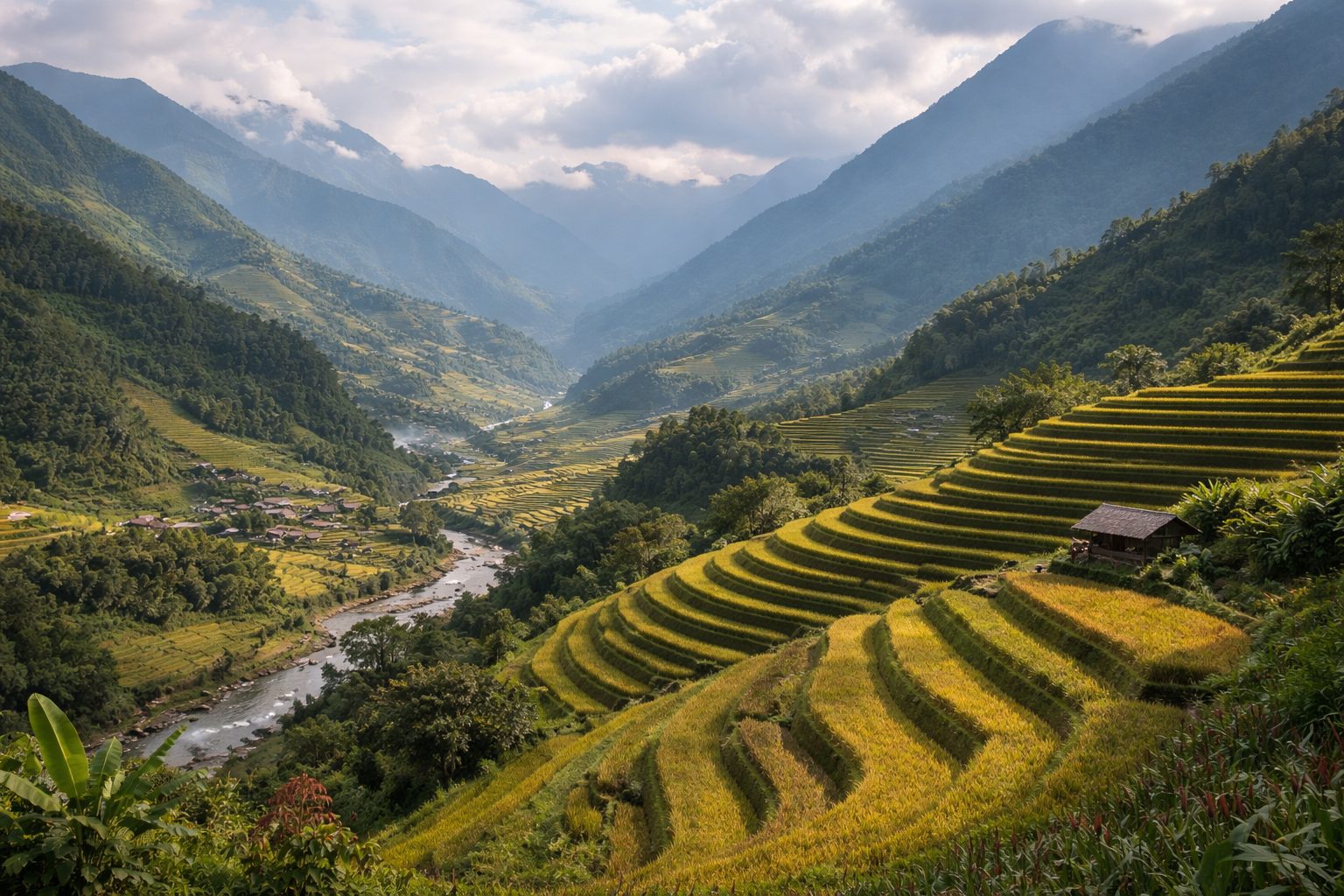
Sapa sits in the northwest of Vietnam, close to the Chinese border, at an elevation of around 1,500 meters. The landscape around it is dramatic in a way that’s different from the karst south. Here it’s all steep mountains, deep valleys, and hillsides that have been shaped over centuries by human agriculture.
The rice terraces are what most people come to see. They cascade down hillsides in steps, following the contours of the land with a precision that looks almost mathematical from a distance. The best time to see them flooded is May and June, when the paddies reflect the sky. Harvest in September and October turns everything gold.
The area is home to several ethnic minority communities, including the Hmong, Dao, and Tay peoples, who maintain distinct traditions, dress, and agricultural practices. Trekking between villages gives access to landscapes and ways of life that feel genuinely removed from modern Vietnam’s rapid development.
Fansipan, Vietnam’s highest peak at 3,143 meters, rises above Sapa and can be reached by cable car or on a two to three day hike. The hiking route is steep and can be wet and muddy, but the views from the summit on a clear day are remarkable.
The Sand Dunes of Mui Ne
Mui Ne is coastal and warm, a fishing town turned resort destination on Vietnam’s south-central coast. What makes it unusual are the red and white sand dunes that rise just outside town, a landscape that looks completely out of place in a country associated with jungle and rice paddies.
The red dunes are smaller and closer to town. The white dunes, about 25 kilometers further, are more impressive, larger and more varied, with a small lake called the Fairy Stream running beside them. Both are at their best in early morning light, before the heat and the off-road vehicle traffic makes them less appealing.
Mui Ne is also one of Vietnam’s top spots for kitesurfing and windsurfing. The wind conditions from November to April are reliable enough to attract professionals. So you get an interesting mix of landscape tourism and water sports in the same small area.
Unique Natural Features of Vietnam
The Cu Chi Tunnels and Their Natural Surroundings
The Cu Chi tunnels are primarily a historical site, a network of underground passages used during the Vietnam War by Viet Cong fighters. But the landscape around them is genuinely interesting from a natural perspective. The area sits in the transitional zone between the Mekong Delta and the upland forests of southern Vietnam.
The tunnel complex is surrounded by secondary forest that has regenerated since the war. The area was heavily bombed and defoliated, and the regrowth you see now is only a few decades old. It’s a reminder of how resilient tropical vegetation can be when pressure is removed.
The tunnels themselves demonstrate something interesting about the relationship between humans and their natural environment. They were designed to exploit the clay-rich soil of the region, which is dense enough to support tunnel systems without reinforcement in most places. Nature was not incidental to their construction. It was structural.
The Unique Ecosystems of Cat Tien National Park
Cat Tien is about 150 kilometers north of Ho Chi Minh City and protects one of the last significant lowland tropical rainforest areas in southern Vietnam. The park covers around 72,000 hectares and contains a serious range of biodiversity, including gibbons, sun bears, leopard cats, and several hundred bird species.
The Javan rhinoceros survived here until around 2010, when the last individual was confirmed dead, almost certainly due to poaching. That loss is a painful reminder of how thin the margin can be. But Cat Tien remains an important conservation area, and the wildlife you can actually encounter, birds, primates, reptiles, is still impressive.
Night walks in the park reveal a different ecosystem than the daytime version. The forest comes alive after dark with frogs, insects, and nocturnal mammals. Guided night treks are available from the park headquarters. It’s one of the more accessible wildlife experiences in southern Vietnam.
The Enigmatic Marble Mountains
The Marble Mountains are a cluster of five limestone and marble hills rising from the coastal plain near Da Nang. They’re not large by any measure, the tallest reaches about 106 meters. But they’re packed with caves, pagodas, and viewpoints that have accumulated religious and cultural significance over centuries.
The caves formed as the limestone dissolved over millennia, the same basic process that created the vast systems of Phong Nha, just on a much smaller and more accessible scale. Some caves contain Buddhist shrines that have been there for hundreds of years. Others open to the sky through natural openings that let shafts of light fall into the interior.
From the summit of Thuy Son, the largest of the five hills, you can see Da Nang’s coastline stretching in both directions and the Truong Son range rising inland. It’s a surprisingly clear and far-reaching view from a relatively modest elevation.
Comparison of Vietnam’s Natural Wonders
Ha Long Bay vs. Phong Nha-Ke Bang
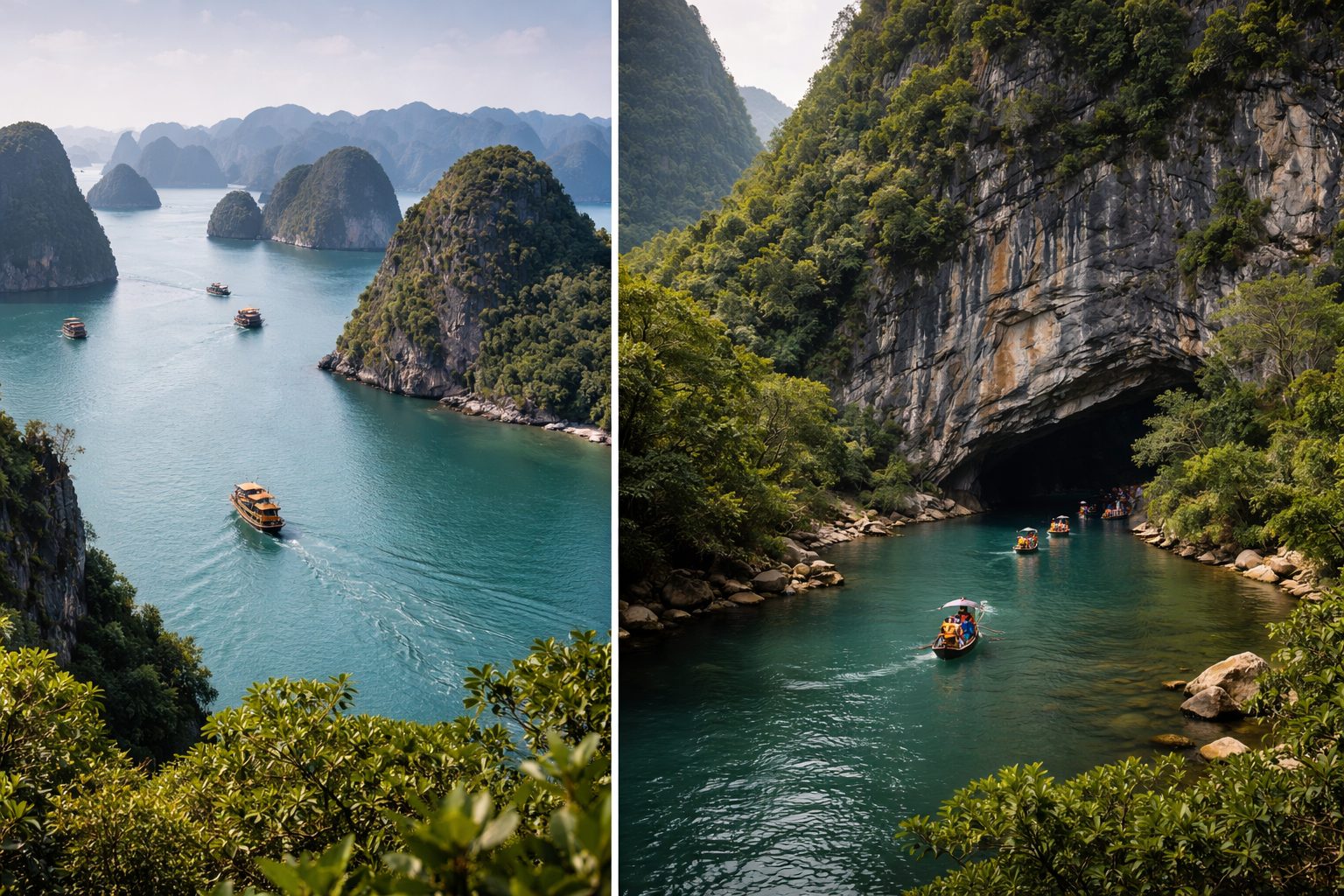
Both are UNESCO World Heritage Sites. Both involve karst limestone. But they offer completely different experiences.
| Feature | Ha Long Bay | Phong Nha-Ke Bang |
|---|---|---|
| Primary appeal | Seascape, sailing, kayaking | Caves, jungle, adventure trekking |
| Accessibility | Easy, well-developed tourism | Moderate, some sites require guides |
| Crowd level | High, especially in peak season | Growing, but still less crowded |
| Best for | First-time visitors, scenic cruises | Cave enthusiasts, eco-travelers |
| Unique factor | Karst islands rising from sea | World’s largest cave system |
| Season | Best March to May | Best February to August |
Ha Long Bay is more immediately spectacular in a visual sense. You understand it instantly. Phong Nha rewards curiosity. The more you explore, the more you find. If you have to choose one and you’re interested in something off the main tourist trail, Phong Nha is the better pick right now, before the crowds catch up.
Sapa vs. Mui Ne: Choosing the Right Destination
These two places represent opposite ends of Vietnam’s natural spectrum. Sapa is cool, misty, green, and mountain-oriented. Mui Ne is hot, dry, coastal, and sun-dependent. They suit different travelers.
- Sapa suits trekkers, those interested in ethnic minority cultures, and travelers who want cooler temperatures and cloud-wrapped landscapes.
- Mui Ne suits beach travelers, water sports enthusiasts, and those looking for reliable sunshine between November and April.
- Sapa is best visited in spring or autumn to avoid both the peak summer crowds and the winter fog that can obscure the views.
- Mui Ne is a wind-dependent destination. Come between November and April for kitesurfing; come at other times if you prefer calm water.
Neither is superior. They just serve different interests.
Urban vs. Rural Natural Attractions in Vietnam
Vietnam’s cities sit within interesting natural contexts. Da Nang is flanked by mountains on one side and the sea on the other. Hanoi sits beside Hoan Kiem Lake and within reach of several significant natural areas. Ho Chi Minh City borders the Can Gio mangrove reserve.
But the most impressive natural wonders of vietnam are outside the cities. The karst systems, the delta, the highland forests, the cave networks. These require travel, usually a flight, an overnight train, or a long drive. That’s worth knowing before you plan your itinerary.
Urban attractions like the Marble Mountains or the Ba Na Hills near Da Nang are convenient add-ons. They’re genuine natural features with real interest. But they shouldn’t substitute for the larger landscapes if you have time and mobility to reach them.
Practical Information for Visiting Natural Wonders
Best Time to Visit Vietnam’s Natural Wonders
Vietnam’s weather is complex because the country is long and the monsoon affects different regions at different times. There’s no single best time for the whole country.
- North (Hanoi, Ha Long Bay, Sapa): March to May and September to November are optimal. Summer brings crowds and occasional storms. Winter in the far north can be cold and foggy, which mutes the scenery in Sapa.
- Central (Hue, Da Nang, Hoi An, Phong Nha): February to August is the dry season. The central coast gets heavy rain from October to January.
- South (Ho Chi Minh City, Mekong Delta, Mui Ne): November to April is dry season. May to October brings rain, though it’s rarely continuous.
If you’re trying to do north and south in one trip, shoulder months like March to April or October to November tend to offer reasonable conditions across most of the country.
Travel Tips for Exploring Vietnam’s Natural Landscapes
Getting around Vietnam is manageable, but requires planning. The country has a reasonably priced domestic air network, and flying between Hanoi and Ho Chi Minh City is fast and cheap compared to the alternatives. For regional travel, overnight trains are comfortable on main routes and save you a night’s accommodation.
- Hire local guides for cave and jungle treks. They know conditions, routes, and safety considerations that no guidebook fully captures.
- Book boat trips for Ha Long Bay carefully. The quality difference between budget and mid-range operators is significant.
- In highland areas like Sapa, weather changes fast. Bring layers even in warmer months.
- Check national park opening hours and permit requirements before arriving. Some sites, including Son Doong, require advance booking months ahead.
- Carry cash in rural areas. Card payment infrastructure is limited outside cities and major tourist hubs.
Learning a few phrases of Vietnamese goes a long way in smaller towns and rural areas where English is limited.
Recommended Tours and Guides for Natural Wonders
For the major sites, reputable operators make a real difference. Some worth considering:
- Oxalis Adventure for Phong Nha cave expeditions, including Son Doong and Tu Lan.
- Ethnic Travel for community-based trekking in Sapa and the northern highlands.
- Bhaya Cruises or Heritage Line for higher-quality Ha Long Bay experiences.
- Buffalo Tours for multi-destination itineraries that combine natural and cultural sites.
- Local guesthouses and homestays in the Mekong Delta can arrange boat trips and cycling routes that outperform standard agency offerings.
Independent travel is feasible for experienced travelers, but for caves, jungle treks, and remote highland routes, guiding matters for both safety and quality of experience.
Frequently Asked Questions (FAQs)
What are the must-see natural wonders in Vietnam?
Ha Long Bay and Phong Nha-Ke Bang are the two most important natural sites and should be at the top of any list. Beyond those, Sapa’s rice terraces, the Mekong Delta, and Cat Tien National Park offer experiences that cover very different aspects of what the country’s natural environment offers.
How can I travel between different natural attractions in Vietnam?
Vietnam Airlines, VietJet, and Bamboo Airways all operate domestic routes between major cities near natural attractions. For shorter distances, overnight trains are often the most practical option. Local buses reach many rural areas, though journey times can be long.
Are there any eco-friendly practices to follow while visiting?
Stick to marked trails in national parks, avoid buying products made from wildlife, and refuse plastic bags and single-use items where alternatives exist. Choose operators with transparent environmental policies, particularly for Ha Long Bay boat trips, where waste management varies significantly between operators.
What is the best way to experience Vietnam’s natural beauty?
Slow down. The travelers who get the most from the natural wonders of vietnam are the ones who stay longer in fewer places rather than rushing between highlights. Spend three nights in Phong Nha instead of one. Trek for two days in Sapa rather than doing a day trip. The landscape reveals itself on its own schedule, not yours.